Showing posts with label science-fiction. Show all posts

Sunday, 1 October 2023

There's Nothing Out There

 Year:  1991

Director:  Rolfe Kanefsky

Screenplay:  Rolfe Kanefsky

Starring:  Craig Peck, Wendy Bednarz, Mark Collver, John Carhart, Bonnie Bowers

Genre:  Comedy, science-fiction, horror

Running Time:  91 minutes

Seven students head off to a remote house in the woods, and soon come under attack from a vicious alien creature.  However, one of the group, Mike (Peck), is able to use his extensive knowledge of horror movies to help them defeat the creature.

This low-budget blend of comedy and horror is most notable as an early example of post-modern horror, five years before Wes Craven's hugely successful Scream (1996) popularised the genre.  The film parodies the various tropes of teen slasher films, which are discussed at length by sarcastic movie fan Mike.  Bits of the film are clever and funny, such as a character escaping the monster by grabbing the hanging microphone boom and using it to swing to safety, while the soundtrack plays a riff on the "Indiana Jones" theme.  It's the kind of film that would probably work best if played at a horror festival or convention or towards the end of an all-night horror movie marathon, when an audience might be more kindly disposed to laugh at it.  The film suffers from low production values, atrocious performances, and terrible special effects.  The monster is a puppet that looks like a cross between a giant frog and a fish with large teeth and shoots green rays out of it's eyes, which enable it to take control of the minds of its victims.  The female characters really have nothing to do except run around wearing as little as possible, and the film's ostensible hero is extremely unlikeable, with his constant sarcastic comments.  The film is an interesting curio for fans of horror, but has little real value as a movie.  


Sally (Lisa Grant) in There's Nothing Out There

Monday, 8 May 2023

Star Trek: The Motion Picture

 Year:  1979

Director:  Robert Wise

Screenplay:  Harold Livingston, from a story by Alan Dean Foster, based on Star Trek created by Gene Roddenberry

Starring:  William Shatner, Leonard Nimoy, DeForest Kelley, Stephen Collins, Persis Khambatta, James Doohan, Nichelle Nichols, George Takei, Walter Koenig

Running Time:  132 minutes

Genre:  Science-fiction


When a mysterious alien cloud possessed of powerful destructive capabilities is detected on a course heading directly for Earth, Admiral James T. Kirk (Shatner) is put in charge of the newly overhauled USS Enterprise, and reunites his old crew to investigate and stop the cloud's path of destruction by any means necessary.

When the original television series of Star Trek ended in 1969 after three seasons and 79 episodes, it looked like it would be one more cancelled TV show that would exist for evermore in the fuzzy afterlife of repeats.  However, as the 1970s progressed, Star Trek became a major success in syndication, as well as attracting increasing numbers of devoted fans.  A 14 episode Saturday morning cartoon version was broadcast in the mid '70s, but Paramount Studios were becoming interested in a new live-action Star Trek.  In the late '70s Paramount announced plans for a new cable TV  network, to be imaginatively named The Paramount Network, and the flagship programme on launch night would be Star Trek: Phase II, which would feature some of the original cast alongside new characters.  Pre-production was already well advanced on Star Trek: Phase II, scripts had been written, sets had been built, parts had been cast, costumes designed and some special effects footage had already been shot, when Paramount pulled the plug on The Paramount Network, and Star Trek: Phase II was cancelled.  Rather than waste the considerable amount of money and time that had been spent on the new Star Trek, Paramount decided to remount what would have been the pilot episode of Star Trek: Phase II as a stand-alone feature film.  The script was rewritten and veteran director Robert Wise was hired to helm the project.  The resulting film boasts some very impressive special effects, but is hindered by a slow pace, and a drab feeling to the whole thing, from the colourlessness of the Enterprise interiors, to the new uniforms which all seem to be in varying shades of light blue, white and beige.  There is also the pretentiousness and po-faced philosophising which hampered Star Trek at its worse, with very little of the action and humour of the TV series at its best.  Many of the returning actors have little more than cameo roles, and the two new additions Stephen Collins as Kirk's rival for the Enterprise, Captain Decker, and Persis Khambatta at the alien Deltan Ilia, never really get the chance to make much of an impression.  Despite the plot being a race against time to save the earth, there is very little dynamism, and the story essentially calls for the actors to do little more than react to what they see on monitor screens.  It's clear that what the producers were going for was a serious cerebral science-fiction epic along the lines of 2001: A Space Odyssey (1968), but that is the wrong approach for Star Trek.  The film does have its good points though.  The opening sequence, where the alien cloud encounters three Klingon spaceships is exciting, the special effects are still impressive even after all this time, and there are moments when that create a genuine sense of wonder.  Also the climax, with its clear sexual metaphor is quite daring.  


William Shatner, DeForest Kelley and Leonard Nimoy in Star Trek: The Motion Picture
  

Sunday, 13 November 2022

Naked Lunch

 Year:  1991

Director:  David Cronenberg

Screenplay:  David Cronenberg, based on the novel Naked Lunch by William S, Burroughs

Starring:  Peter Weller, Judy Davis, Ian Holm, Julian Sands, Roy Scheider

Running Time:  115 minutes

Genre:  Science-fiction, fantasy


New York City, 1953:  Pest exterminator William Lee (Weller) discovers that his wife, Joan (Davis), has become addicted to the yellow powder he uses to kill bugs.  Lee is contacted by a giant talking insect that claims that he is a secret agent and that the bug is his boss.  It further informs him that his wife is a non-human agent of the sinister Interzone Incorporated.  Lee accidentally kills Joan while attempting to shoot a glass off her head.  Lee flees to Interzone, a "notorious free port on the North African coast", and finds himself in a surreal nightmare of giant, talking bugs, shapeshifting typewriters and monstrous "Mugwumps".


William S. Burroughs' controversial novel, Naked Lunch, was first published in 1959, and has baffled, appalled and fascinated readers ever since.  The "novel' (for want of a better term) is a bizarre and often incoherent mishmash of vignettes and stories without any conventional structure or plot, and had been widely considered unfilmable.  However directors such as Stanley Kubrick had attempted to crack it.  In the 1960s experimental filmmaker Anthony Balch attempted to make a musical adaptation with a script written by Burroughs himself starring Mick Jagger, and, at one stage, Dennis Hopper.  Cronenberg solved the problem by largely jettisoning the book.  The film instead is more structured around Burroughs' life and the writing of the novel, mixed with various elements of Burroughs writing, not all of which come from Naked Lunch.  Cronenberg stated that the difficulty of making a film about a writer, is that the act of writing itself is not particularly exciting to watch.  He solved it by merging Burroughs' life with his fantasies.  The name William Lee was often used by Burroughs as his alter ego, and sometimes a pseudonym on some of his books, and Burroughs did kill his wife while trying to shoot a glass from her head, and Burroughs considered this incident the start of his life as a writer.  Some of Burroughs friends, such as writers Jack Kerouac, Allen Ginsberg and Paul Bowles, appear in thinly disguised portrayals.  The cadaverous, pale-eyed Peter Weller, who is probably best known for RoboCop (1987), is well cast as in the  lead role, looking and sounding a lot like a 1940s film noir gumshoe.  Judy Davis plays the dual role of Joan Lee and Joan Frost, a double of Lee's wife who he meets in Interzone.  Ian Holm plays Joan Frost's husband, the sinister writer Tom (based on American writer Paul Bowles), and Roy Scheider plays the evil Doctor Benway, one of Burroughs' most memorable characters.  Interzone itself was a frequent setting for Burroughs' writing, and was the title of 1989 book of short stories.  It's based on the International Zone of Tangiers, where Burroughs lived for a time.  The fact that Interzone is very obviously created on soundstages, helps make it seem less a place than a state of mind.  The film features some startling special effects and creatures.  As bizarre and graphic as the film is in places, it is still much more restrained than Burroughs' imaginings, which displeased some fans.  Certainly the film is more David Cronenberg than William Burroughs, in it's tone and style, reducing the novel's themes of drugs and particularly toning down the novel's sexual elements, and making it more a film about writing, however Cronenberg's detached style of directing, chimes well with Burroughs' dry, dispassionate prose style.  It is also possibly the best introduction to Burroughs for a mainstream audience.


They were both disappointed with their Tinder date:  Peter Weller and friend in Naked Lunch


Saturday, 13 August 2022

Prey

 Year:  2022

Director:  Dan Trachtenberg

Screenplay:  Patrick Aison, from a story by Patrick Aison and Dan Trachtenberg, based on characters by Jim Thomas and John Thomas

Starring:  Amber Midthunder, Dakota Beavers, Michelle Thrush, Stormee Kipp, Julian Black Antelope, Dane DiLiegro

Running Time:  100 minutes

Genre:  Science-fiction, action

The Great Plains of North America, 1719:  Naru (Midthunder) is a young Comanche woman, who is a hugely skilled healer and tracker, and dreams of becoming a great hunter like her brother, Tabbe (Beavers).  However, after seeing strange signs, and coming across strangely mutilated corpses of animals, Naru becomes convinced that there is something else out there, that is even more dangerous than the vicious cougars and bears, and the brutal fur trappers.  Soon the hunter becomes the hunted as Naru has to face a completely new type of Predator.


This is the fifth film in the Predator franchise, not counting the two Alien vs. Predator films which mix Predator with the Alien franchise.  The Predators are a race of aliens who come to Earth to hunt humans for sport.  This is a well made film, mixing panoramic visual beauty (in fact it is a real pity that the film debuted on streaming rather than in the cinema because it would look spectacular on the big screen).  Amber Midthunder is great in the lead as the calm but ferocious Naru, who uses her intelligence and skills, rather than just a strength against her opponents, and also turns the fact that she is almost always underestimated to her advantage.  The Predator itself is different to the ones previously seen on screen.  As in the other films, it has a cloaking device to make itself more or less invisible, and uses heat vision to track down it's prey, unlike previous versions, however, it's mask is made of bone, rather than metal, and it doesn't use an energy gun, using instead it's strength and bladed weapons.  As with previous Predators; it has it's own code of honour, not attacking those who it doesn't deem to be a threat.  The film takes it's time building up the characters and the world of the story, a world if kill or be killed, emphasised by repeated scenes of animals hunting and killing other animals.  It also takes it's time in building up Naru's world, exploring the customs and practices of the tribe.  The film is well made by Dan Trachtenberg, who previously made 10 Cloverfield Lane (2016).  While there are references to other films in the series, they don't feel forced, and there is no need to see any of the others to watch this.  it is a completely stand alone film.   While it doesn't feel very original, aside from the setting and largely indigenous cast, the story structure feels very similar to the first film, particularly towards the end, it is probably the best film in the series.


 Amber Midthunder in Prey


Thursday, 19 May 2022

Everything Everywhere All at Once

 Year:  2022

Directors:  Dan Kwan and Daniel Scheinert

Screenplay: Dan Kwan and Daniel Scheinert

Starring:  Michelle Yeoh, Stephanie Hsu, Ke Huy Quan, Jenny Slate, Harry Shum Jr., James Hong, Jamie Lee Curtis

Running Time:  139 minutes

Genre:  Science-fiction, action, comedy

Evelyn Wang (Yeoh) is having a very bad day.  The laundromat she runs with her husband, Waymond (Quan), is struggling; her elderly father Gong Gong (Hong) who has effectively disowned her has arrived from China to be cared for by Evelyn and her family; she has a difficult relationship with her daughter, Joy (Hsu); and Waymond is trying to serve her with divorce papers.  To make matters worse, they are being audited by the IRS and have an appointment with severe auditor Deirdre Beaubeirdra (Curtis).  The last thing Evelyn needs is to learn that she has to connect with multiple alternate versions of herself from parallel universes in order to defeat a powerful force which threatens to destroy all of the infinite realities.


This film is a wild, unpredictable mix of genres and styles, taking in family drama, science-fiction, martial arts action and surreal comedy.  The result is one of the most imaginative, vibrant, and funniest films to come along in a very long time.  The basic concept is that for every decision that is made, the alternative outcome is played out in a parallel universe.  Through a technique called "verse jumping" which involves a special portable headset and performing a completely improbable action an individual can connect to their counterpart in a particular parallel universe that has the skills or abilities that they want to access.  In this way Evelyn is treated to glimpses of her life if she had made different choices, such as ending up as a skilled martial artist, a famous film star, a chef and more bizarre realities including one where humans have hot dogs instead of fingers, and one where she ends up as a rock.  Michelle Yeoh is great in the lead role and convincingly depict Evelyn's change from stressed and unhappy wife, mother and business owner, to action hero; Ke Huy Quan, who is possibly best known as a child actor in Indiana Jones and the Temple of Doom (1984) and The Goonies (1985), is affecting as Evelyn's gentle and goofy husband; Stephanie Hsu is good as Evelyn and Waymond's troubled daughter and Jamie Lee Curtis gives a great comic performance as the tough IRS investigator.  In all the film's wildness and goofiness it doesn't lose sight of the more serious issues such as Evelyn's inability to accept the fact that her daughter is gay and has a girlfriend, and the importance of accepting people as they are and not how we may want them to be. Evelyn is someone who has had endless dreams and hopes but has abandoned them thanks to cruel reality, and now seems to see life itself as something of a miserable chore, but when she opens herself to the limitless possibilities, the experience is both frightening but ultimately liberating for her. The film also examines themes of Chinese-American cultural identity and existential despair.  The film is surprisingly emotional, and by the end is genuinely moving.  While at times it can be overwhelming, even with the generous run time of two hours and twenty minutes it seems to shoot past at breakneck speed with little pause for breath, this is one of the best films that I have seen in a very long time.


Michelle Yeoh in Everything Everywhere All at Once


Saturday, 7 May 2022

Planet of the Apes

 Year:  1968

Director:  Franklin J. Schaffner

Screenplay:  Michael Wilson and Rod Serling, based on the novel Planet of the Apes by Pierre Boulle

Starring:  Charlton Heston, Roddy McDowall, Maurice Evans, Kim Hunter, James Whitmore, James Daly, Linda Harrison

Running Time:  112 minutes

Genre:  Science-fiction


Three astronauts crash-land on a seemingly desolate planet, in the far future.  As they explore, they discover, to their horror, that humans are mute, primitive creatures, and apes have become the dominant species, having developed language, technology and society.  

Based on the 1963 novel by French author Pierre Boulle, this has become one of the most influential science-fiction films ever made.   The film opens with the four astronauts in suspended animation, crashing into a lake.  Stewart, the only woman on the ship, has died due to a leak in her suspended animation capsule. The survivors: macho, cigar-chomping cynic Taylor (Charlton Heston), square-jawed, idealistic patriot Landon (Robert Gunnar) and ambitious scientist  Dodge (Jeff Burton), soon discover that 2978, two thousand years after they set out, and believe that they are on an alien planet.  As they explore they discover a tribe of humans, who are hunted by armed gorillas on horseback.  In the course of which, Dodge is killed, Landon knocked out and Taylor shot in the throat, rendering him temporarily unable to speak.  Taylor is locked in a kind of zoo, where he has to convince the chimpanzee scientists researching him that he is an intelligent being.  The film builds itself up quite slowly, the apes don't appear at all until quite well into the film, with a lot of time being spent on the bickering between the three astronauts.  Early in the film Taylor states that he joined the expedition because he wanted to find "something better than man".  The apes have an organised, fairly placid society (or so it seems), if very hierarchical:  Orang-utans are the leaders, judges, priests and teachers; Gorillas are the military and law enforcement and Chimpanzees are kind of the middle-class.  In the Pierre Boulle novel, the apes have a technologically advanced society, however the filmmakers deemed it easier, and cheaper to have the apes in a more primitive society.  The look of the ape village, and the costume designs are impressive.  However, it is fair that the ape make up (which won an honorary Academy Award for John Chambers for astounding make-up achievement) hasn't aged well and looks slightly comical today at times, and you might question why apes living in the 3978 would speak and write English.  The script was written by Michael Wilson, who worked on Bridge on the River Kwai, another Boulle adaptation, and Twilight Zone creator Rod Serling, and it was Serling who came up with the film's iconic conclusion, which is possibly one of the most famous movie endings of all time.  Heston is good at the heroics, snarling lines such as "Get your stinking paws off me, you damned dirty ape!"  Roddy McDowall and Kim Hunter as sympathetic chimpanzees Cornelius and Zira, and Maurice Evans as orange-utan Doctor Zaius do very well, acting under layers of heavy ape makeup.   The film has plenty of action, and there is some good humour (such as sulky teen chimp Lucius (Lou Wagner) moaning about the older generation, and three orang-utan judges doing the "Three Wise Monkeys", and Zira's reaction when Taylor moves to kiss her, telling him: "But your so ugly!"), however it is also an intelligent film depicting a world where the balance of power has reversed, and where humans are treated by apes, much the same as how humans have treated apes in our own world ("You lead me around on a leash!" Taylor snarls.  "We thought you were inferior" explains Zira).  Linda Harrison plays Nova, one of the mute humans, who the ape scientists want to mate with Taylor, and who eventually forms a mutual attachment with him.  However, she really doesn't have much at all to do.  The film ends with a shocking twist ending, and the final image packs a punch no matter how many times it has been parodied and references in the years since.


Chimpanzee that!:  Roddy McDowell, Kim Hunter and Charlton Heston in Planet of the Apes


Saturday, 23 April 2022

Tarantula

 Year:  1955

Director:  Jack Arnold

Screenplay:  Robert M. Fresco and Martin Berkeley, from a story by Jack Arnold and Robert M. Fresco, based on the television episode "No Food for Thought" written by Robert M. Fresco from Science Fiction Theatre 

Starring:  John Agar, Mara Corday, Leo G. Carroll

Running Time:  80 minutes

Genre:  Science-fiction, horror


When a strangely deformed man is found dead in the Arizona desert, Dr. Matt Hastings (Agar) investigates the laboratory of the respected Professor Gerald Deemer (Carroll), who has been working on a new nutrient to help feed the world's rapidly growing population, however, in it's unperfected state it causes rapid, uncontrolled growth, and exposure to it was somehow responsible for the deformity and death of the man found in the desert.  Things go from bad to worse when a tarantula Deemer had been experimenting on breaks out and goes on the rampage, as it keeps getting bigger and bigger, and hungrier and hungrier.


This is one of the better examples of the giant bug movies that were crawling all over American screens in the 1950s.  Science and particularly scientists were often depicted quite ambiguously in American film in the 1950s.  While science promised the brave new world of numerous gaudily printed science-fiction magazines, it also unleashed the horrors of the atomic bomb.  Even when the scientists were essentially benevolent and well-meaning, as in Tarantula, when the eggheads inevitably make a complete mess of things it is time for them to step aside and let the US Air Force blow everything to kingdom come. The film used quite advanced and complex special effects for the time, with blown up images of real animals used to depict the giant animals.  Most of the sequences of the tarantula itself use a real tarantula superimposed on to the footage, with model effects used for close-ups of it's fangs, and for the film's climax.  They may look unconvincing today, but the special effects were deemed convincing for the 1950s.  Also a lot of people are terrified of tarantulas anyway.  Jack Arnold was one of the great directors of B-movies, and has a solid cast of veterans, including Leo G. Carroll, who appeared in several Alfred Hitchcock films, as the avuncular professor who is unwittingly responsible for the whole mess.  John Agar, who appeared in a number of John Ford Westerns, plays the square jawed hero, and Mara Corday, who really doesn't have much to do as Carroll's assistant and Agar's love interest.  The film has an interesting script, adapted from a 1955 episode of the TV anthology series Science Fiction Theatre.  Tarantula's lasting legacy in popular culture is probably being name checked in the lyrics to "Science Fiction, Double Feature" the opening song for The Rocky Horror Picture Show (1975): "And Leo G. Carroll/ was over a barrel/ when tarantula took to the hills."  You may also recognise the Air Force pilot at the end of the film as it is a very early, uncredited appearance by Clint Eastwood.


Tarantula

Tuesday, 19 April 2022

It Came from Outer Space

Year:  1953

Director:  Jack Arnold

Screenplay:  Harry Essex, from a story by Ray Bradbury

Starring:  Richard Carlson, Barbara Rush

Running Time:  80 minutes

Genre:  Science-fiction

Writer and amateur astronomer Frank Putnam (Carlson) and his schoolteacher girlfriend Ellen Fields (Rush) witness what seems to be a meteor crashing in the Arizona desert.  When they discover, they discover that it is, in fact, a large spacecraft.  Of course, nobody believes them, but then local people begin acting very strangely.


This is one of the finest moments of the 1950s science-fiction craze.  To modern audiences the alien creature may be more likely to provoke giggles than screams, and the film's low budget is very obvious in places, however under celebrated science-fiction director Jack Arnold, it still conjures up some memorable images, and the desert landscapes are evocative.  Based on an original screen treatment by legendary science-fiction writer Ray Bradbury, and scripted by Harry Essex, the film is well written with intelligent dialogue.  Unusually the film's shape-shifting aliens are not malevolent, all they want is to repair their ship and leave.  Richard Carlson gives a strong performance as the increasingly stressed astronomer, even if Barbara Rush is a little underused as his loyal girlfriend.  Charles Drake plays the town's aggressive sheriff who is also Putnam's rival for Ellen's affections.  The film was originally shown in 3D which is why so many objects are thrust at the camera.  


It Came from Outer Space


Wednesday, 13 April 2022

Total Recall

 Year:  1990

Director:  Paul Verhoeven

Screenplay:  Ronald Shusett, Dan O'Bannon and Gary Goldman, from a story by Ronald Shusett, Dan O'Bannon and John Povill, based on the short story "We Can Remember It for You Wholesale" by Philip K. Dick

Starring:  Arnold Schwarzenegger, Rachel Ticotin, Sharon Stone, Michael Ironside, Ronny Cox

Running Time:  114 minutes

Genre:  Science-fiction, action


In a future where humans have colonised other planets of the Solar System, construction worker Douglas Quaid (Schwarzenegger) who lives on earth with his wife, Lori (Stone), is plagued by recurring dreams of a mysterious woman (Ticotin) on Mars, which is under the dominion of industrialist dictator Cohaagen (Cox).  Quaid visits an agency called Rekall, Inc. which implants realistic fake memories.  Quaid chooses an "Ego Trip" package where he can have a memory of visiting Mars under the guise of being a secret agent. However, during the implant procedure Quaid suddenly starts lashing out, revealing that he has already had his memory suppressed by a shadowy organisation.  Soon Quaid finds himself on the run, pursued by gunmen, lead by Richter (Ironside), Cohaagen's chief henchman, as he learns that his entire life as Douglas Quaid was an illusion, and Lori and his friends are all spies sent to watch him.  Searching for his true identity, Quaid travels to Mars, and makes contact with the underground resistance against Cohaagen's tyranny.  However, as Quaid's investigation progresses, dreams and reality become harder to distinguish.

Total Recall began as a short story called "We Can remember It for You Wholesale" by prolific science-fiction author Philip K. Dick.  The project spent a long time in development, at one time acclaimed horror director David Cronenberg was attached to direct, his vision of the film stuck close to the short story, in which Quaid, called Quail in the original, was a timid, weedy, little clerk.  Cronenberg wrote twelve drafts of the script, but the producers were unhappy with his cerebral take on the material, because they wanted, in producer/writer Ronald Shusett's terms "Raiders of the Lost Ark go to Mars".  Eventually Dutch director Paul Verhoeven, who had had a hit with RoboCop (1987), was given the director's job, and Arnold Schwarzenegger was chosen to star.  Obviously, Schwarzenegger is no-one's idea of a timid, weedy little clerk, as the film moved further away from the Philip K. Dick short story.  At the time, Total Recall was one of the most expensive films ever made, and it remains one of the iconic science-fiction and action films of that era.  Verhoeven was good at lacing fast paced, lurid action and carnage with  often quite subversive satire (here Cohaagen is the ultimate evil capitalist who has even privatised the air supply).  The special effects are showing their age, but mostly still stand up, particularly the vast alien complex where the film's climax takes place, and the Martians, who are mutated due to the use of cheap, inadequate protective domes, are memorable.  The film moves along at a good pace, it's funny, there is plenty of action, and very graphic violence, although the pulpy plotting often becomes very silly.  Although, one of the most interesting aspects of the film is the possibility that the whole thing is  Quaid's fantasy, which makes the daftness and weirdness make more sense.  The film leaves the question open, and there are hints in the film either way.  The performances are pretty good, including Sharon Stone in her first major role, but everything takes second place to Arnie and the action.  Arnold Schwarzenegger is basically Arnold Schwarzenegger, doing what he does best, he handles the action well and delivers the odd quip. Quaid himself comes across more as a gleefully violent anti-hero in his quite callous attitude, probably a lot of civilians get caught up in the crossfire in this film  (in the film's most controversial scene he points a gun at Lori who says: "You won't shoot me, will you?  After all, we're married."  Quaid shoots her point blank in the head and quips: "Consider that a divorce.").  One of the movies incidental pleasures is the future world, including self-driving taxis, with irritating robot taxi drivers, called "Johnny Cabs", although some of the future world looks charmingly dated now.  This is the kind of film that as it goes on, you get caught up in it, and it is a fun action packed ride.  Later you start picking holes in it.  It is flawed, but I enjoyed it.


Arnold Schwarzenegger in Total Recall

Saturday, 12 March 2022

Privilege

 Year:  1967

Director:  Peter Watkins

Screenplay:  Norman Bogner, from a story by John Speight

Starring:  Peter Jones, Jean Shrimpton, Mark London, Jeremy Child

Running Time:  103 minutes

Genre:  Comedy, drama, science-fiction, satire, 


Britain, the near future:  The country is ruled by an authoritarian coalition Government.  The biggest celebrity in the world is pop singer Steven Shorter (Jones), whose ruthless management have made a deal with the government to use Steven as a tool to keep the people in line.  When Steven meets sympathetic artist Vanessa (Shrimpton) he begins to see the need to rebel.


Director Peter Watkins made his name with the 1964 TV movie Culloden which depicted the 1746 Battle of Culloden in the style of modern TV news reportage, and the controversial 1966 TV film The War Game, about nuclear war, which was deemed so disturbing that the BBC refused to broadcast it.  Like Watkins' previous works Privilege is made as a pseudo-documentary following futuristic pop singer Steven Shorter.  Played by Manfred Mann lead singer Paul Jones, Steven is a shrunken, quiet, haunted figure, notably lacking in charisma, who is surrounded by people who pretend to care about him, but really just want to exploit him.  Jean Shrimpton's Vanessa, ironically the only one, initially, who couldn't care less about Steven Shorter, avoids the oily, slick media and political types to become the only one who really does care about him.  This is a horribly dated film, which screams late sixties in almost every frame, but it is funny (particularly a scene involving the filming of an advert to promote apples and the director calls: "I want you all to think like apples, act like apples, be apples!"), and frightening in it's depiction of government control of mass media to hypnotise and control the people.  It is certainly ripe for a remake.


Arthur Pentelow and Paul Jones in Privilege


Thursday, 10 February 2022

The Matrix Resurrections

Year:  2021

Director:  Lana Wachowski

Screenplay:  Lana Wachowski, David Mitchell, Aleksander Hemon, based on characters created by The Wachowskis

Starring:  Keanu Reeves, Carrie-Anne Moss, Yahya Abdul-Mateen II, Jessica Henwick, Jonathan Groff, Neil Patrick Harris, Priyanka Chopra Jones, Jada Pinkett Smith

Running Time:  148 minutes

Genre:  Science-fiction


San Francisco: Thomas Anderson (Reeves) is a successful video game developer who became famous for the hugely successful Matrix trilogy of games.  However he is experiencing strange hallucinations, memories from his previous life as Neo, which he puts down to stress from developing the games and the resulting fame.  In a coffee shop, Anderson happens upon Trinity (Moss), who is living a quiet life as mother of three Tiffany.  When he is approached by a new group of rebels, lead by hacker Bugs (Henwick)  and Morpheus (Abdul-Mateen II), Anderson discovers that the hallucinations are real memories of his past, and he needs to embrace his identity as Neo to save himself and Trinity from the Matrix and help the human rebels fight the machines that have enslaved humanity.  The problem is that he is not the man he was.


The concept behind The Matrix series of films is that what we see and experience as reality is in fact a vast, complex computer simulation known as The Matrix, and that the real world is a ravaged, bleak place controlled by malevolent machines, and humans are trapped in pods, brains plugged into The Matrix, bodies being harvested for energy to power the machines.  However, a small group of humans have escaped The Matrix and are fighting to defeat the machines.  The Matrix was released in the summer of 1999 and, despite being released mere weeks before Star Wars Episode I: The Phantom Menace, it was a huge hit, with an imaginative plot, lots of style, and groundbreaking visual effects.  Two sequels followed, The Matrix Reloaded and The Matrix Revolutions, which were both released in 2003.  The Matrix Resurrections is the fourth film in the series and its easy to be cynical about sequels that come out such a long time after their predecessor, but this is a very solid entry in the franchise, and possibly the best of the series since the first one.  Like the other films in the series, it suffers from a confused plot, with a lot of philosophical discussions and technobabble, and the characters often seem more like video game characters, ironically enough, so it's hard to really feel any sense of danger in the action scenes.  Also, it doesn't give any concessions to newcomers to The Matrix franchise, or those who may have forgotten the previous films, in the nearly twenty years since the previous one was released.  However, this is an enjoyable, intelligent science-fiction action film, and there is a lot more humour in this one.  The performances are good, and the new characters are engaging.  In this films, The Matrix film exist as games, and the story is kicked off when Anderson is asked to make a fourth game in the series, which gives the filmmakers an opportunity to poke fun at sequels and franchises.  In the scene where Anderson is in his bosses office being given the pitch for Matrix 4 it's easy to imagine director Lana Wachowski, who co-wrote and co-directed the first three films with her sister Lily Wachowski, sitting in an office being given the same pitch.  Interestingly enough, the boss turns out to be a hostile computer program.  Of course the special effects and action are as spectacular as ever and, while it is far from perfect, at least it feels like a big, special effects driven action film with brains and some heart as well.  

By the way, there is a brief additional scene after the end credits, which is funny, but it's certainly not unmissable and not worth missing the bus for.


  Keanu Reeves and Carrie-Anne Moss in The Matrix Resurrections


Tuesday, 1 February 2022

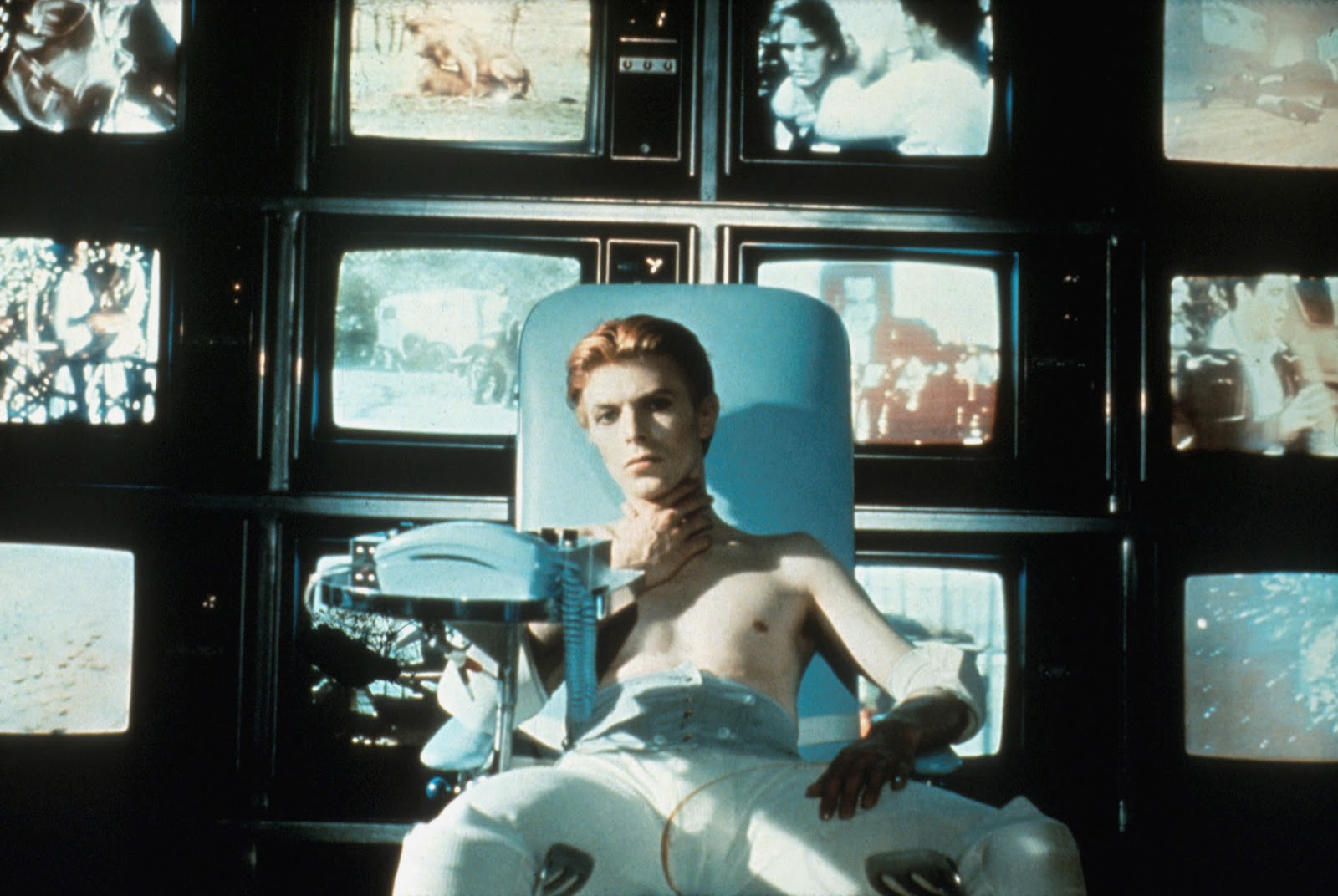
The Man Who Fell to Earth

Year:  1976

Director:  Nicolas Roeg

Screenplay:  Paul Mayersberg, based on the novel The Man Who Fell to Earth by Walter Tevis

Starring:  David Bowie, Rip Torn, Candy Clark, Buck Henry, Bernie Casey

Running Time:  139 minutes

Genre:  Science-fiction


A strange man, Thomas Jerome Newton (Bowie), stumbles into a small New Mexico town.  Within a few years he is the multi-millionaire head of World Enterprises Corporation, a company which sells innovative technological products.  However, Thomas Newton is not what he appears.  In reality he is a humanoid alien sent to Earth from a dying planet to bring back much-needed water supplies for his homeworld.  He has been using his advanced alien technology in his company's products, and plans to use the money that he is making to finance the construction of a spaceship to ship the water to his planet.  However, during his time on earth he begins to fall victim to human vices such as alcohol, sex, television and corporate greed.

This film was David Bowie's first leading role, and at the time he was at the height of his "Thin White Duke" phase.  He gives an astonishing performance, and is utterly convincing as an alien, according to Bowie he was in such a fragile state at the time that didn't need to act in the role at all, he just learned his lines for the day and acted naturally.  Rip Torn plays a creepy professor who finds the mystery of Newton and his corporation even more interesting than chasing after his female students; Buck Henry plays a patent lawyer who becomes Newton's confidante and right hand man; and Bernie Casey plays the ruthless owner of a rival company.  They all give good performances, but Candy Clark is very good as the naive hotel chambermaid who falls in love with Newton and both becoming the other's nemesis.  Based on the novel by American author Walter Tevis (who also wrote The Hustler and it's sequel The Color of Money which were both made into successful films, and The Queen's Gambit which became a miniseries on Netflix), the film was directed by British director Nicolas Roeg, who was coming off the success of the horror film Don't Look Now (1973).  Roeg was known for his innovative style, combining surreal, poetic imagery with a jagged stream-of-consciousness style of editing.  Despite a fairly conventional alien innocent on Earth storyline, The Man Who Fell to Earth is a very unconventional science-fiction film.  For one thing, there is very little traditional science-fiction imagery in the film, aside from several brief sequences where Newton remembers his homeworld.  Despite being set entirely in America, it is a British film made with an almost entirely British crew, which may help explain how the film makes America look like the alien planet, it's one of the great outsider's views of America.  The film is long, slow, and the style makes it at times difficult to follow, but it is mesmerising.  At times it is funny and it is powerful, while the technology and values on display (such as Rip Torn's professor sleeping around with students) date the film as a product of the seventies, it is still a pertinent comment on the modern world, which may be more pertinent now than in 1976.  The film is visually striking, powerful and memorable, and remains one of the highpoint of David Bowie's career and of 1970s science-fiction cinema.


David Bowie is The Man Who Fell to Earth
 

Saturday, 29 January 2022

Westworld

Year:  1973

Director:  Michael Crichton

Screenplay:  Michael Crichton

Starring:  Richard Benjamin, Yul Brynner, James Brolin

Running Time:  88 minutes

Genre:  Science-fiction, Western

Welcome to Delos, a state of the art amusement park where, for a mere $1,000 per day, guests can live out their fantasies in one of three different "worlds": Western World (themed on the Wild West), Medieval World or Roman World.   The zones are populated by highly sophisticated robots, which look virtually indistinguishable from humans, and are programmed to allow the guests to live out any adventure or desire that they have.  Of course, the sophisticated computer programming means that the robots will never turn on their human guests and begin slaughtering home.  Nothing can possibly go wrong.  Until everything does.

This was written and directed by author/filmmaker Michael Crichton, who would return to the theme of a futuristic amusement park run amok with his novel Jurassic Park (1990).  The film moves between two friends, Peter Martin (played by Richard Benjamin) a first time visitor to Delos and John Blane (played by James Brolin) who is something of a Delos veteran, and their experiences in Western World as they become targets of a homicidal Gunslinger (played by Yul Brynner); the scientists and technicians in the vast subterranean complex below the theme park, where damaged androids are repaired, and the whole park is monitored; and an obnoxious guest in Medieval World.  It's not really until nearly an hour into the film where the robots completely break down and become murderous, and the story moves fully into thriller territory.  Up until then its is almost a comedy parodying Western tropes.  In it's last half hour the film becomes a genuinely tense chase as the Gunslinger remorselessly hunts down it's prey.  Richard Benjamin is good as the nervous, slightly jittery first time visitor, and James Brolin is charismatic as the relaxed would-be cowboy, but it is Yul Brynner as the deathly pale, blank-faced robot who provides the most iconic performance.  The film is mostly well structured, opening with an advert for Delos, which really gives all the backstory you need, and following Peter and John as they arrive and get to experience Western World.  Meanwhile in Medieval World a would be king (Norman Bartold) spends his time flirting with the Queen (Victoria Shaw) and eyeing up buxom serving wenches.  As this is all going on in the park, in the laboratories and offices below, the technicians are concerned that the robots are displaying more malfunctions and errors than usual.  The problems and malfunctions mount up slowly but steadily, until everything suddenly goes haywire.   The film is certainly showing it's age now.  The special effects and futuristic technology on-screen now look very dated, which is inevitable.  It's not a great film, it moves from light-hearted almost comedy to full science-fiction  action thriller a little too late and too suddenly.  It is good though, it's funny and suspenseful and features some memorable sequences.  

The film was a hit in it's day, and was followed by a sequel, Futureworld (1976), a TV series Beyond Westworld which ran for five episodes in 1980, and the far more successful Westworld TV series which began on HBO in 2016 and has, as of January 2022, run for three seasons with a fourth on the way.


Yul Brynner in Westworld

Thursday, 27 January 2022

Invasion of the Body Snatchers

 Year:  1956

Director:  Don Siegel

Screenplay:  Donald Mainwaring, based on the novel The Body Snatchers by Jack Finney

Starring:  Kevin McCarthy, Dana Wynter, Larry Gates, King Donovan, Carolyn Jones

Running Time:  80 minutes

Genre:  Science-fiction


Dr. Miles Bennell (McCarthy) returns home from a medical convention to the small California town of Santa Mira, where a surprising number of residents seem to be suffering from the delusion that their loved ones have been replaced by near-identical duplicates.  It soon turns out that the delusion is all too real, slowly the townspeople are being replaced by soulless duplicates spawned from large alien seed pods that threaten to take over the world.

Based on a story by writer Jack Finney, Invasion of the Body Snatchers has gone down as one of the classics of science-fiction, and has been remade several times, most notably in 1978, directed by Philip Kaufman and starring Donald Sutherland in the Kevin McCarthy role.  At the heart of it is a genuinely frightening idea, that the people you love are not themselves any more, and that you yourself could lose your identity and humanity.  To make things even worse, the process of takeover is never really depicted.  The duplicates grow out of the alien pods, hence the term "pod-people" which has come to enter pop culture, despite never being spoken in the film.  What happens to the original is never explained, although it is hinted that the original is somehow destroyed.  The film was released at the height of the Cold War and it has divided people over whether it is a left wing or right wing film.  Some people saw it as an allegory for the "Red under every bed" scare, while others saw it as an allegory for the dangers of McCarthyism (Senator Joe McCarthy and his obsession with rooting out Communists - real or imagined).  Director Don Siegel claimed that the film was about insomnia - the pods duplicate the original while they sleep, and Siegel suffered terrible insomnia throughout his life.  Whatever political leanings you have, you can read something into the film to suit yourself, but at it's core it is a science-fiction thriller and the scenes where McCarthy and his girlfriend Dana Wynter are running from the alien townspeople is really suspenseful.  The performances are good, and the script is pretty adult for a science-fiction film of the time, when most sf films seemed to be pitched to children's Saturday matinees, or drive-in double features.    Future director Sam Peckinpah (The Wild Bunch (1968) and Straw Dogs (1971) appears briefly as a meter reader.  Apparently early test audiences found the film's conclusion too downbeat and so an additional prologue and epilogue were shot, which does dilute the tension somewhat at the end, but the scene of a hysterical McCarthy in the middle of a freeway shouting at unheeding traffic as it shoots by him is one of the classic sequences of science-fiction cinema: "They're already here!  They're not human!  They're coming for you!"


It came from the vegetable patch: Dana Wynter, King Donovan, Carolyn Jones and Kevin McCarthy face an Invasion of the Body Snatchers 

Saturday, 16 October 2021

From Beyond

Year of Release:  1986

Director:  Stuart Gordon

Screenplay:  Dennis Paoli, story by Brian Yuzna, Stuart Gordon and Dennis Paoli, based on the short story "From Beyond" by H. P. Lovecraft

Starring:  Jeffrey Combs, Barbara Crampton, Ted Sorel, Ken Foree, Carolyn Purdy-Gordon

Running Time:  82 minutes

Genre:  Horror, science-fiction

Dr. Edward Pretorius (Sorel) and Crawford Tillinghast (Combs) create a machine called the Resonator which stimulates the pineal gland in the human brain, allowing a person to see beyond normal, perceptible reality, revealing grotesque monsters.  One of them bites off Pretorius' head, and Crawford is accused of his murder.  Intrigued by his story, ambitious psychiatrist Dr. Katherine McMichaels (Crampton) and Detective Bubba Brownlee (Foree) persuade Crawford to recreate the experiment.  They soon discover that Crawford was telling the truth, and that Pretorius has been absorbed by the creatures and returns hungry for more prey.


This film reunites many of the cast and key behind the scenes personnel behind cult hit Re-Animator (1985) for another take on the works of influential American writer H. P. Lovecraft.  This film, written by Dennis Paoli from a story by Paoli, director Stuart Gordon and producer Brian Yuzna is very loosely based on a very brief minor H. P. Lovecraft story written in 1920 and published in 1934.   As with Re-Animator much of the material is played more for laughs than scares, and is full of slimy, rubbery monstrosities and gore galore.  There's a surprisingly strong sexual element here as well.  A scene where a monster attempts to assault Barbara Crampton is queasily unpleasant and strikes a sour note on what is otherwise an essentially fun, gory monster movie.  Later, in one of the film's most memorable scenes, the buttoned-up, serious Crampton appears in full leather bondage gear and also, if you are so inclined, there is the sight of Ken Foree in very small briefs.  It's one of those films where everyone seems to be having a ball.  Jeffrey Combs overacts tremendously as the twitchy, bug-eyed scientist; Barbara Crampton is good as ever as the sympathetic if slightly sinister psychiatrist and she conveys well her slow transformation under the influence of the Resonator; Ted Sorel provides a fun pantomime performance as the hissable villain under increasing layers of latex; Ken Foree, who is possibly best known for Dawn of the Dead (1978), is engaging as the likeable tough-guy detective; and Carolyn Purdy-Gordon is fun as the psychiatrist who despises Katherine and her methods.  While the special effects may look a dated today, the gruesome monsters are imaginatively designed and it's all satisfactorily gross.  At a brisk 82 minutes the whole thing keeps moving along.  It's the kind of film that is best watched late at night maybe with a few drinks and a few likeminded friends.  None of it is supposed to be taken seriously.       


Barbara Crampton and Ted Sorel in From Beyond

Friday, 10 September 2021

Dr. Who and the Daleks

 Year of Release:  1965

Director:  Gordon Flemyng

Screenplay:  Milton Subotsky, based on the Doctor Who serial "The Daleks" by Terry Nation

Starring:  Peter Cushing, Roy Castle, Jennie Linden, Roberta Tovey

Running Time:  82 minutes

Genre:  Science-fiction


In London, eccentric inventor Dr. Who (Cushing) shows his granddaughters Barbara (Linden) and Susan (Tovey), and Barbara's clumsy boyfriend Ian (Castle), his latest invention the Tardis, a machine disguised as a police telephone box which can travel anywhere in time and space.  When Ian accidentally activates it, they are catapulted to a mysterious, desolate planet, where they encounter deadly cyborgs called Daleks, who plan to destroy the planet's other inhabitants, the peace-loving Thals.


This is based on the second serial from the BBC television series Doctor Who (1963-1989, 1996, 2005- ) which introduced the series' most popular antagonist, the Daleks.  This is an adaptation of the seven part serial "The Daleks", not really the Doctor Who series itself, while it more or less follows the plot of the serial, it changes a lot about the characters and backstory.  Peter Cushing's Doctor Who (who is definitively named as such in the film, but is always just The Doctor on TV) is a doddery, eccentric, grandfatherly old gentleman, rather than William Hartnell's portrayal of The Doctor on TV as an abrasive, crotchety alien antihero.  On TV, Barbara and Ian (as played by Jacqueline Hill and William Russell) were staid, responsible schoolteachers, whereas here their occupations are never given and Ian in particular is more of a klutzy comic relief character.  Susan (played by Carole Anne Ford on TV) was a sixteen year old high school student, but in this film she appears to be about twelve years old.  The film is a colourful affair, although it's low budget is painfully obvious in several places.  The blonde, blue-eyes Thals are supposedly starving, but their supply of mascara, lip gloss and hair care products seem to be plentiful, because they all seem to style themselves after David Bowie.  The Daleks themselves seem to have a fondness for lava lamps and salmon-pink plastic sheeting.  Originally the guns were supposed to shoot fire, but this was vetoed on the grounds of health and safety, and also that it would be too frightening for the kiddies, so instead they shoot jets of CO2 gas.  The Daleks were hugely popular in the 1960s, appearing in comics, games, toys, books and even a terrible novelty song by The Go-Gos called "I Wanna Spend my Christmas with a Dalek" (which contains the lyrics "I wanna spend my Christmas with a Dalek / and hang him underneath the mistletoe /and if he's very nice / I'll feed him sugar spice / and hang a Christmas stocking from his big left toe").  

The film suffers from bad dialogue (particularly the Daleks' long speeches which serve as clunky exposition) and storytelling, the climax is especially ludicrous and seems to largely hinge on the Daleks immediately becoming extremely stupid, and misplaced humour.  Peter Cushing does what he can with what he is given, and Roy Castle (who would later go on to present the long running children's TV series Record Breakers from 1972 to 1993) hams it up although he did have a gift for clowning.  The big problem with the film is that it just hasn't aged well, not that it is really offensive or anything like that, but it looks so cheap and such a product of it's time, that it just appears comical today.  If you are a Doctor Who completist or interested in sixties science-fiction it's worth a look, and to be fair it can serve as a guilty pleasure on a dull afternoon.  It was followed by Daleks' Invasion Earth 2150AD (1966).


Dr. Who (Peter Cushing) and Susan (Roberta Tovey) encounter the mechanical meanies in Dr. Who and the Daleks 

Saturday, 28 August 2021

Metropolis

 Year of Release:  1927

Director:  Fritz Lang

Screenplay:  Thea von Harbou and Fritz Lang, based on the novel Metropolis by Thea von Harbou

Starring:  Alfred Abel, Brigitte Helm, Gustav Fröhlich, Rudolf Klein-Rogge

Running Time:  153 minutes (original cut)

Genre:  Science-fiction


In the futuristic city of Metropolis the elite live and play in towering skyscrapers, while the workers toil in underground cities operating the vast machines that keep Metropolis running.  One day, Freder (Fröhlich), the son of the city's ruler Joh Fredersen (Abel), glimpses the saintly Maria (Helm), a teacher from the underground city who is also a spiritual leader to the workers.  Tracking her down to the subterranean caverns, Freder is shocked by the horrible conditions in which the workers live and work.  He becomes inspired by Maria's teaching of a Mediator who will unite the people above ground with those below ground.  Meanwhile Joh Fredersen is concerned about Maria's influence among the workers, and enlists the aid of scientist Rotwang (Klein-Rogge) to construct an evil robot duplicate of Maria.


  This is one of the most iconic films ever made.  It's really the first epic science-fiction film, and it's images echo not only throughout the science-fiction genre, but throughout the whole of pop culture.  Even today, it's influence can be seen in movies, comics, music videos and TV shows.  It's full of memorable images and sequences, from the futuristic city, and the design of the robot.  There is also the hallucinatory imagery of the Moloch sequence, the Tower of Babel, and Death and the Seven Deadly Sins.  The performances are strong, with Brigitte Helm in the dual role of Maria and her evil mechanical duplicate, and Rudolf Klein-Rogge as mad scientist Rotwang.  There is also a strong performance by Fritz Rasp, as the sinister Thin Man, whose scenes are cut from many versions of the film, but are reinstated in the 2010 restoration). While elements have dated, sometimes humorously (biplanes floating among the city towers), it remains, even today, an overpowering visual experience.  The story may be simplistic, but the message of the disparity between rich and poor is as pertinent now as it was in 1927.  The film is available in many different versions of various lengths, including a 83 minute long colourised version released in 1984 with a rock score by Giorgio Moroder and songs by Freddy Mercury, Bonnie Tyler and Adam Ant among others.  The most complete version is probably the 2010 restored version which runs to 148 minutes.


Rudolf Klein-Rogge and Brigitte Helm in Metropolis

Wednesday, 7 July 2021

Black Widow

Year of Release:  2021

Director:  Cate Shortland

Screenplay:  Eric Pearson, story by Jackie Schaeffer and Ned Benson, based on the Marvel comics character Black Widow created by Stan Lee, Don Rico and Don Heck

Starring:  Scarlett Johansson, Florence Pugh, David Harbour, O-T Fagbenle, Ray Winstone, Rachel Weisz, Olga Kurylenko, William Hurt

Running Time:  134 minutes

Genre:  Thriller, science-fiction, superhero


Superhero team The Avengers has collapsed and former assassin turned Avenger Natasha Romanoff, aka Black Widow, (Johansson) is on the run from the US Government.  Contacted by her estranged younger sister, Yelena (Pugh), Natasha learns that the all-female team of elite brainwashed assassins known as "Widows" is still active, and she and Yelena have to confront a monstrous figure from their past and a powerful new "super-soldier" who can exactly mimic any opponent's fighting style so it's like "fighting a mirror".


This is the 24th film in the ongoing Marvel Cinematic Universe (MCU) franchise, based on characters and stories from Marvel Comics.  This film, however, while there are frequent references to the previous films, is by and large a stand-alone film and can be enjoyed even if you haven't seen all of the others, which is something of a relief.  The film starts off as a gripping spy thriller, although it does become increasingly science-fictional as to goes along.  As played by Scarlett Johansson, Natasha Romanoff is one of the stalwarts of the MCU franchise, but this is the first time that she headlines her own film.  By now, Johansson fits the role like a glove, and here is added Florence Pugh as her sister.  The two work really well together, and there is real chemistry.  In particular Pugh has a nice line in the throwaway delivery of comic one-liners.  David Harbour more or less reprises his gruff-but-loveable dad from Stranger Things (2016-present) but with an added Russian accent.  O-T Fagbenle appears as Natasha's own version of James Bond's Q supplying her with vehicles and equipment.   Rachel Weisz is sinisterly maternal and Ray Winstone is oilily villainous.  Olga Kurylenko does a lot with a little as a tragic, silent assassin and William Hurt has a extended cameo as the US agent on Natasha's trail.  The film has obvious nods to the James Bond franchise, acknowledged in one scene where Natasha watches Moonraker (1979), and there are nods to the TV series The Americans (2013-2018).  By and large this is a very good action film.  the action scenes and special effects are spectacular, the fighting scenes are well choreographed, the jokes are funny and there is some real emotion.  The performances, particularly from Scarlett Johansson and Florence Pugh, are good.  The film's main problem is that the story runs out of steam before the end, and it all wraps up a little too neatly, but it's engaging and spectacular enough that it doesn't really matter.  

By the way, as with all of the MCU films there is an additional brief scene after the closing credits, so stick around.


  Scarlett Johansson and Florence Pugh in Black Widow


Saturday, 26 June 2021

Invasion of the Body Snatchers

Year of Release:  1978

Director:  Philip Kaufman

Screenplay:  W. D. Richter, based on the novel The Body Snatchers by Jack Finney

Starring:  Donald Sutherland, Brooke Adams, Jeff Goldblum, Veronica Cartwright, Leonard Nimoy

Running Time:  115 minutes

Genre:  Science-fiction, horror


Elizabeth Driscoll (Adams) is a laboratory scientist for the San Francisco Department of Public Health, with an interest in botany.  She becomes aware of unusual pink flowers growing out of small pods.  Shortly afterwards she notices that her boyfriend (Art Hindle) is acting strangely, and she becomes convinced that somehow he has become someone she doesn't know.  She approaches her friend and fellow employee at the Department of Health, Matthew Bennell (Sutherland).  At first Matthew doesn't believe her, but when he notices increasingly strange things happening, he realises that what has happened to Elizabeth's boyfriend is just the beginning.  Alien seed pods have landed on Earth and are somehow replacing people while they sleep: replacements that are physically identical to the original, and have the same memories and personalities, but lack emotion or basic humanity.  Matthew and Elizabeth have to save themselves and stop the invasion, but it may already be too late.


Jack Finney's 1953 science-fiction novel The Body Snatchers had previously been adapted in 1956 as Invasion of the Body Snatchers, directed by Don Siegel, one of the classics of science-fiction cinema.  It was later adapted in 1993 as Body Snatchers, directed by Abel Ferrara and starring Gabrielle Anwar, and most recently as The Invasion (2007), starring Nicole Kidman and Daniel Craig.  Of course, it's a very risky proposition to remake a classic.  This film updates the setting from 1950s small town California, to 1970s San Francisco.  While Jack Finney denied that the novel was intended to be anything other than an exciting adventure story, the 1956 film is usually seen as a parable about the Communist scare of the 1950s, either a warning that there is a "Red under every bed" or a warning about the McCarthyite witch hunts of the time.  This film could be seen as a film about urban alienation and paranoia.  The mobile camera frequently following the actors like a surveillance camera.  The fact is that this has a very scary premise, your loved ones becoming someone that you don't recognise; the idea of losing your own humanity, and worse yet, they get you while you sleep, while you are at your most defenceless.  Also there is the general uneasiness of city life, living cheek by jowl with countless strangers, some of whom may not have your best interests at heart.  Seen in 2021, the film has the added resonance of the age of social distancing, with the fear of catching a fatal disease just from being around people.  The film has an interesting cast, with Donald Sutherland handling the heroics; Brooke Adams affecting as the first person to become suspicious; an early role for a nervously funny Jeff Goldblum as a struggling poet; Veronica Cartwright, who would later have to deal with even more unpleasant pods in Alien (1979), as Goldblum's frantic wife; and Leonard Nimoy as a pop-psychiatrist (this was the '70s, remember).  Nimoy's casting is interesting, as his best known role was half-alien half-human Spock in Star Trek (1966-1969) who was constantly trying to suppress his human emotions, and almost marks him as an emotionless "pod-person" right from the start, and he gives an effective and quite sinister performance.  Kevin McCarthy, who starred in the 1956 film, cameos as a man yelling warnings at passing cars, as in the previous film's famous ending.  The film is stylishly directed, opening with strangely poetic images of the gossamer pods drifting through space, and the film is shot with the afore-mentioned roving camera, and odd camera angles, right from the start everyone appears suspicious and strange, including Robert Duvall appearing in an uncredited cameo as a priest on a park swing set, gazing at the camera.  It sets itself up slowly, and has some genuinely nightmarish imagery.  The film is very much a 1970s movie, but it has aged very well, the tone is very bleak and there is a real sense of inescapable doom throughout (which makes it feel very current).  It all ends with one of the most famous screams in science-fiction history.


Broke Adams and Donald Sutherland in Invasion of the Body Snatchers (1978)


Monday, 21 June 2021

Aliens

Year of Release:  1986

Director:  James Cameron

Screenplay:  James Cameron, from a story by James Cameron, David Giler and Walter Hill

Starring:  Sigourney Weaver, Michael Biehn, Carrie Henn, Paul Reiser, Lance Henriksen, Bill Paxton, Jenette Goldstein

Running Time:  137 minutes (theatrical cut); 157 minutes (director's cut)

Genre:  Science-fiction, action, horror


Following the events of Alien (1979), Ripley (Weaver) is found in suspended animation in an escape pod.  Recuperating on a space station orbiting Earth, she learns that she has been drifting through space in stasis for 57 years.   Traumatised by her experiences, her situation is only made worse by the fact that no-one believes her story.  It turns out that the planet where the Alien was found, Planet LV-426, has been home to a human colony for the past twenty years.  That is until Earth loses contact with the LV-426 colony, and Ripley is persuaded to join a platoon of Colonial Marines on a mission to investigate.  


Aliens is one of the great sequels in film history.  While Alien is a horror film in space, Aliens takes a completely different approach and is a war film in space, in fact writer/director James Cameron described it as being a Vietnam film in space, with it's depiction of a technologically superior invading force being repelled by an enemy which they have completely underestimated.  The film takes it's time building up the characters and suspense, but when the Aliens do appear in all their slimy, toothy, insectoid glory the film immediately kicks into high gear and doesn't let up until the end credits roll.  The Aliens are a largely unseen enemy, usually attacking en masse or hidden in shadow, or moving so fast that you can barely get a good look at them, this was partly practical because the production couldn't get many Alien costumes.  The action scenes are well staged and exciting, and the special effects still hold up today, with the Alien Nest, where their luckless victims are gruesomely cocooned to be impregnated by the facehuggers, memorable and disturbing.  The lengthy set up means that we get to spend time with the characters, they are not just there to be eaten by the monsters.  There is a theme of motherhood in the movie, Ripley is a mother, and there is a scene which is in the extended director's cut, but not in the theatrical cut,  where she is informed that he daughter had died during her absence.  The sole survivor of the colony is a young girl called Newt (played by Carrie Henn) and she becomes a surrogate daughter to Ripley.  In the film's climax however, Ripley has to battle the vast Alien Queen, which lays the Alien eggs.  It's the battle between two mothers: one seeking to protect her daughter, the other seeking vengeance for her slaughtered children.  The heart of the film really belongs to Newt and Ripley, the scenes between them have real emotional heft, and the male characters with a couple of notable exceptions, by and large take a back seat.  Sigourney Weaver gives one of her best performances as Ripley, who is one of the great characters in action movies, tough, compassionate and ruthlessly practical where necessary

The film continues and expands the anti-corporate theme of the original, with the treacherous weasel Carter Burke (played by Paul Reiser), an oily space yuppie and Eighties Guy par excellance who unfortunately feels all too contemporary, whose actions lead Ripley to contemplate whether the humans are any better than the Aliens.  Also in the supporting cast is Michael Biehn as likeable Marine Hicks, and provides the closest thing that the film has to a love interest for Ripley; Lance Henriksen as the soft spoken but slightly sinister android (although "artificial person" is the preferred term) Bishop; and Bill Paxton as Hudson, the most arrogant of the Marines, but the one who quickly falls apart.  

The 1980s were the era of flamboyant, excessive action spectacles, where living action figures routinely blasted enough firepower to wipe out a small country, as well as throwing up endless sequels to anything even slightly popular (which, to be fair, is something that for better or worse shows no sign of ever going away).  Aliens is a high point, expanding and developing the story of it's predecessor, as well as taking it in a completely new direction, igniting the screen with spectacular carnage, and nightmarish visions, but with added intelligence and heart, putting it ahead of it's contemporaries.  The best of the Alien franchise, and one of the highpoint of action cinema.


Sigourney Weaver hunts Aliens