Showing posts with label Western. Show all posts

Saturday, 30 April 2022

High Noon

 Year: 1952

Director:  Fred Zinnemann

Screenplay:  Carl Foreman, based on the short story "The Tin Star" by John W. Cunningham

Starring:  Gary Cooper, Thomas Mitchell, Lloyd Bridges, Katy Jurado, Grace Kelly, Otto Kruger, Lon Chaney, Henry Morgan

Running Time: 85 minutes

Genre:  Western

Hadleyville, New Mexico, 1800s:  Marshal Will Kane (Cooper) is getting married to Amy Fowler (Kelly).  The next day he is due to retire.  However, no sooner has the marriage ceremony concluded, than Kane hears that Frank Miller (Ian MacDonald), a vicious outlaw who Kane put away for murder, has been pardoned and is heading into town on the noon train, and there are three other gunslingers who are waiting for him at the station.  A devout Quaker and pacifist, Amy pleads with Kane to leave town, but Kane refuses.  However, when Kane tries to get help from the townspeople, no-one is willing to step forward.


High Noon is one of the classic Westerns and one of the classic American films.  It takes place largely in real time, and there is a sense of impending dread as Kane goes from place to place, trying to round up volunteers to fight with him, but finding no-one willing to help.  Intercut with Miller's three desperadoes waiting at the station, and low angle shots of the ominous, looming railway tracks, and clocks ticking off the minutes to noon.  Gary Cooper is good as Kane, as he becomes increasingly haggard and bitter at the lack of help he receives.  He also gives Kane an element of vulnerability.  When he gets hurt, it feels real, and he doesn't just brush it off in the next scene.  Grace Kelly appears in an early role, as Amy, Kane's new Quaker wife, and she is good, but the nearly 30 year age difference between Cooper (born in 1901) and Kelly (born in 1929) seems a little questionable today.  Also in the cast are veterans such as Otto Kruger and Lon Chaney, who is possible best known for his horror films such as The Wolf Man (1941), and it also marks the screen debut for Lee Van Cleef, as one of Miller's gang.  The film maintains a tense atmosphere throughout and the climatic gunfight is exciting.  It was very successful upon release, but also very controversial, particularly the final scene where the townspeople gather around Kane and Amy as they prepare to leave, and Kane silently throws his tin star into the dust with contempt.  John Wayne called Hugh Noon "the most un-American thing I've ever seen in my whole life," and made Rio Bravo (1959) with Howard Hawks, in which Wayne's marshal rejects several offers of help, as a riposte to it.  However, the film did become popular with several American presidents.  Bill Clinton screened the film 17 times at the White House, and Ronald Reagan, himself hardly known for his liberal leanings, cited High Noon as his favourite film.  High Noon remains a gripping and intelligent film to this day, which is more of a thriller and a drama about morality and courage, rather than just a straight shoot-em-up oat opera.  


Gary Cooper in High Noon

Tuesday, 5 April 2022

She Wore a Yellow Ribbon

 Year:  1949

Director:  John Ford

Screenplay:  Frank Nugent and Laurence Stalling, based on the stories The Big Hunt and War Party by James Warner Bellah

Starring:  John Wayne, Joanne Dru, John Agar, Ben Johnson, Harry Carey Jr.

Running Time:  103 minutes

Genre:  Western

1876: At Fort Starke, a remote US Cavalry post, Captain Nathan Brittles (Wayne), six days away from retirement, is heading out for his last patrol: to prevent a new war between the Cheyenne and Arapaho  and the white colonists following the Battle of the Little Big Horn.  However, Brittles' task is complicated by a second order: to deliver his commanding officer's wife, Abbey Allshard (Mildred Natwick), and niece, Olivia Dandridge (Dru), to an eastbound stagecoach.  To make matters worse, two of the soldiers in the patrol are vying for Olivia's affections, causing tensions among the patrol.


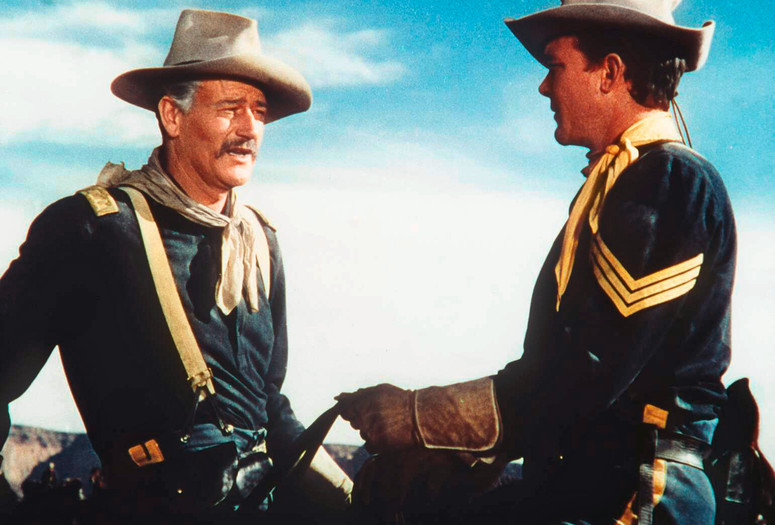
Named for a popular US Army marching song,  She Wore a Yellow Ribbon was the second film in director John Ford's "Cavalry Trilogy" following Fort Apache (1948) and concluding with Rio Grande (1950).  Ford originally didn't want John Wayne for the lead, partly due to the fact that Wayne would be playing a character about twenty years older than he was at the time, and partly because he didn't think that Wayne had the acting skill to play the role.  However, Ford changed his mind after seeing Wayne in the film Red River (1948), which caused Ford to exclaim "I didn't know the big son of a bitch could act!"  Wayne himself considered She Wore a Yellow Ribbon as one of his best performances.  While the film has plenty of broad humour (Victor McLaglen as the stereotypical drunk Irish soldier), it has surprisingly little of the action you might expect from a film like this, although there are a few battles between the cavalrymen and the Native American braves, they are brief and far between. The film has aged pretty badly with it's attitude towards the Native Americans (although there is a sympathetic and layered Native American character, Pony-That-Walks played by Chief John Big Tree), it's sympathetic attitude towards the Confederacy, Victor McLaglen's comic relief Irish character, and also the blood-and-thunder militarism.  The film also gets bogged down in the love triangle subplot between the two soldiers (John Agar and Harry Carey Jr.) , who are pretty much indistinguishable except one has dark hair and one is blonde, and Olivia.  However, the film has a strongly elegiac tone, as Brittles, a lifelong soldier and widower, contemplates a life away from his beloved Army.  John Wayne is at his best here, delivering an unusually thoughtful performance, and Joanne Dru is good, although she really isn't given much to do.  As always in John Ford Westerns, the locations in Monument Valley look spectacular.  


John Wayne and John Agar in She Wore a Yellow Ribbon
 

Monday, 14 March 2022

The Power of the Dog

Year:  2021
Director:  Jane Campion
Screenplay:  Jane Campion, based on the book The Power of the Dog by Thomas Savage
Starring:  Benedict Cumberbatch, Kirsten Dunst, Jesse Plemons, Kodi Smit-McPhee, Thomasin McKenzie, Genevieve Lemon, Keith Carradine, Frances Conroy
Running Time:  126 minutes
Genre: Western

1920s Montana:  George Burbank (Plemons) and his brother Phil (Cumberbatch) co-own a successful cattle ranch.  During a cattle drive the brothers meet widow and inn owner Rose (Dunst).  George immediately falls for her, but the volatile, bullying Phil immediately dislikes her, believing that she is just after their money.  Phil particularly dislikes Rose's teenage son, Peter (Smit-McPhee), who he sees as soft and weak.  George and Rose quickly get married and she moves into the ranch while Peter is away studying medicine.  When Peter returns for the holidays he finds that Rose is descending into alcoholism, and soon his and Phil's mutual dislike changes not a much more complex relationship.

Based on a 1967 novel by Thomas Savage, The Power of the Dog is a complex, bleak, psychological drama in a Western setting.  Filmed in director Jane Campion's native New Zealand, the film features beautiful landscapes and almost impressionistic imagery of seas of dusty cattle.  In fact it is kind of a pity that, since it is a Netflix film, it will mostly only be available to watch on television, because it really cries out for a big cinema screen.  Benedict Cumberbatch is impressive as the verbally abusive Phil, who constantly gives the impression that he is just about to burst into violence.  Kirsten Dunst gives a great performance as the troubled, struggling Rose, with Jesse Plemons as the husband who deeply cares about her but doesn't know how to help her, and really can't unless they move off the ranch and away from Phil.  Kodi Smit-McPhee is very good as Peter, Rose's intelligent, artistic, sensitive son, who can't fit in with the macho world of the ranch, and is constantly taunted by all the cowboys and ranch hands.  Thomasin McKenzie (from JoJo Rabbit (2019) and Last Night in Soho (2021)) has a small role as the ranch's cheery maid, Lola.  The film depicts a dark, alienating world, where danger is a constant fact of life, and there is always threat in the air.  Phil belongs fully to that world, but Rose and Peter belong to towns and cities, they are part of a more urbane world, and George has a foot in both worlds.  He is a rancher and something of a cowboy, but he is also kindly, gentle and reasonable, and he wants to become a "gentleman rancher" and the state governor, along with his and Phil's wealthy parents.  There is a strong, intelligent script by Jane Campion who directs beautifully, with memorable imagery and very strong performances.  This is a great film.


Benedict Cumberbatch and Jesse Plemons in The Power of the Dog

Friday, 11 February 2022

Fort Apache

Year:  1948

Director:  John Ford

Screenplay:  Frank S. Nugent, based on the short story "Massacre" by James Warner Bellah

Starring:  John Wayne, Henry Fonda, Shirley Temple

Running Time:  125 minutes

Genre:  Western

Arrogant, embittered Lieutenant Colonel Owen Thursday (Fonda) and his teenage daughter, Philadelphia (Temple), arrive at Fort Apache, an isolated U. S. Cavalry outpost, where Thursday is to assume command.  While Philadelphia adapts well to life at the Fort, Thursday's high-handed manner and strict adherence to military rule and discipline, alienate him from his troops, particularly his second in command Captain Kirby Yorke (Wayne).  To make matters worse, Thursday's ignorance and bigotry towards the indigenous Apache tribes threatens to lead to war.


This was the first of director John Ford's "Cavalry Trilogy", which also included She Wore a Yellow Ribbon (1949) and Rio Grande (1950), both of which also starred John Wayne.  For the first hour or so, the film feels almost like a comedy, as the strict, strait-laced Lieutenant Colonel finds himself at odds with the ragtag bunch of soldiers he finds himself commanding, while his daughter falls for a dashing young officer (played by John Agar), much to her father's displeasure.  However, it becomes more somber and surprisingly dark as it goes along.   Despite having star billing, John Wayne really has more of a supporting role here, with Henry Fonda's Owen Thursday being the main character.  Thursday was a General in the Civil War and is bitter at being busted down to the ranks and posted to some isolated fort in the middle of nowhere.  From his appearance here, it seems that Thursday was at best an armchair general, who might be able to recite chapter and verse of Genghis Khan's campaigns, but is terrible at the business of real leadership.  His attitude towards the local Native American tribes, in whom he is completely uninterested, veers from hostility to contempt.  In fact it's his daughter Philadelphia who is far better able to adapt to life at the Fort and, while he immediately dismisses the Fort and it's surroundings, Philadelphia is interested and curious about the country and the people who live there.  Fort Apache is notable for Westerns of it's time in taking a sympathetic view of the Native Americans.  While it is still very much from the view of the white settlers, the Native Americans are willing to come to a peaceful solution and their demands are perfectly reasonable, it's Thursday's racism that escalates the conflict.  The film was shot in Ford's favourite location, Monument Valley.  The film takes it's time to get into it's stride and the story doesn't really get into it's stride until it's second hour.  The climax is well staged and exciting and there is a moving epilogue which shows how the myth of the West was being written even while it was happening.  Henry Fonda is good as Thursday, managing to humanise a pretty unlikeable character.  John Wayne does well as Yorke, trying his best to counter Thursday's bigotry and avoid disaster for all concerned.  Shirley Temple is good as Philadelphia, and it is a pity that she isn't even more to do.   

Saturday, 29 January 2022

Westworld

Year:  1973

Director:  Michael Crichton

Screenplay:  Michael Crichton

Starring:  Richard Benjamin, Yul Brynner, James Brolin

Running Time:  88 minutes

Genre:  Science-fiction, Western

Welcome to Delos, a state of the art amusement park where, for a mere $1,000 per day, guests can live out their fantasies in one of three different "worlds": Western World (themed on the Wild West), Medieval World or Roman World.   The zones are populated by highly sophisticated robots, which look virtually indistinguishable from humans, and are programmed to allow the guests to live out any adventure or desire that they have.  Of course, the sophisticated computer programming means that the robots will never turn on their human guests and begin slaughtering home.  Nothing can possibly go wrong.  Until everything does.

This was written and directed by author/filmmaker Michael Crichton, who would return to the theme of a futuristic amusement park run amok with his novel Jurassic Park (1990).  The film moves between two friends, Peter Martin (played by Richard Benjamin) a first time visitor to Delos and John Blane (played by James Brolin) who is something of a Delos veteran, and their experiences in Western World as they become targets of a homicidal Gunslinger (played by Yul Brynner); the scientists and technicians in the vast subterranean complex below the theme park, where damaged androids are repaired, and the whole park is monitored; and an obnoxious guest in Medieval World.  It's not really until nearly an hour into the film where the robots completely break down and become murderous, and the story moves fully into thriller territory.  Up until then its is almost a comedy parodying Western tropes.  In it's last half hour the film becomes a genuinely tense chase as the Gunslinger remorselessly hunts down it's prey.  Richard Benjamin is good as the nervous, slightly jittery first time visitor, and James Brolin is charismatic as the relaxed would-be cowboy, but it is Yul Brynner as the deathly pale, blank-faced robot who provides the most iconic performance.  The film is mostly well structured, opening with an advert for Delos, which really gives all the backstory you need, and following Peter and John as they arrive and get to experience Western World.  Meanwhile in Medieval World a would be king (Norman Bartold) spends his time flirting with the Queen (Victoria Shaw) and eyeing up buxom serving wenches.  As this is all going on in the park, in the laboratories and offices below, the technicians are concerned that the robots are displaying more malfunctions and errors than usual.  The problems and malfunctions mount up slowly but steadily, until everything suddenly goes haywire.   The film is certainly showing it's age now.  The special effects and futuristic technology on-screen now look very dated, which is inevitable.  It's not a great film, it moves from light-hearted almost comedy to full science-fiction  action thriller a little too late and too suddenly.  It is good though, it's funny and suspenseful and features some memorable sequences.  

The film was a hit in it's day, and was followed by a sequel, Futureworld (1976), a TV series Beyond Westworld which ran for five episodes in 1980, and the far more successful Westworld TV series which began on HBO in 2016 and has, as of January 2022, run for three seasons with a fourth on the way.


Yul Brynner in Westworld

Sunday, 17 October 2021

Pale Rider

Year of Release:  1985

Director:  Clint Eastwood

Screenplay:  Michael Butler and Dennis Shryack

Starring:  Clint Eastwood, Michael Moriarty, Carrie Snodgress, Chris Penn, Richard Dysart, Sydney Penny

Running Time:  116 minutes

Genre:  Western


19th century, California: A group of independent prospectors, panning for gold, are regularly harassed by a gang of thugs in the pay of wealthy mining baron Coy LaHood (Dysart), who is determined to drive off the prospectors so he can seize their land.  Following a raid in which her pet dog is shot dead, 14 year old Megan Wheeler (Penny) prays for a miracle to save them.  Shortly afterwards a mysterious Preacher (Eastwood) arrives to help the prospectors.


Plot wise, this is similar to endless Westerns in which a lone hero arrives to defend the good and the helpless against brutal villains.  This film however has a strange supernatural angle to it, similar to Eastwood's directorial debut High Plains Drifter (1973).  It is very strongly hinted that the unnamed Preacher is a ghost, although it is left ambiguous.  The Preacher's backstory is hinted at, but never really revealed.  It's even hinted that the Preacher is Death himself.  He seems to appear in answer to Megan's prayer, riding in accompanied by thunder, lighting and howling winds, and he enters the prospector's camp accompanied by a reading if the Biblical verse from which the film takes it's title: "And lo, I beheld a pale horse, with a pale rider on it, and the name of the rider was Death.  And Hell followed him."  As an actor, Eastwood does what he does best, with his squinting glares, and snarling drawl, as a director, Eastwood handles the material with style, often using interesting framing and camera angles, that take advantage of every part of the screen, and the wintery landscapes are beautiful.  The influence of Sergio Leone, who directed the Dollars trilogy that made Eastwood a movie star, is very strong here.  There is also a slight environmental element to the film with LaHood's controversial hydraulic mining technique destroying the landscape, as opposed to the prospectors peacefully panning for gold in the river.  Michael Moriarty plays Hull Barret, the put upon but determined leader of the prospectors, Carrie Snodgress plays Sarah Wheeler, Megan's mother who has become increasingly cynical after she was abandoned by Megan's father, but with whom Barret is in love, and Chris Penn plays LaHood's son and head of the thugs.  Richard Kiel (best known as the metal-toothed Jaws in the James Bond movies The Spy who Loved Me (1977) and Moonraker (1979)) has a small role as one of LaHood's heavies.  The performances are all fine, if unmemorable,  they do what they need to do.  Snodgress probably gives the best performance, and the film does build up a fairly complex relationship between Sarah and Barret.  There is a brief but very unpleasant scene of an attempted sexual assault on the 14 year old Megan, although is is stopped and she is rescued by the Preacher.  It sours an otherwise innocuous film, and really serves little purpose.  Despite being an action film, this is mostly quite a slow film, and all wrapped up in a fairly neat, if disappointing climax.  This is not an essential film but, if you like Westerns, you may enjoy it, but if you're not a fan of the genre this will not convert you.     


Monday, 13 September 2021

The Tin Star

Year of Release:  1957

Director:  Anthony Mann

Screenplay:  Dudley Nichols, from a story by Joel Kane and Barney Slater

Starring:  Henry Fonda, Anthony Perkins, Betsy Palmer

Running Time:  93 minutes

Genre:  Western


The Old West:  Bounty hunter Morg Hickman (Fonda) arrives in a small town to collect his latest bounty.  While waiting for his claim to be processed, he befriends Nona Mayfield (Palmer) a young woman who is treated with contempt by the townspeople due to her son Kip (British actor Michel Ray), whose father was Native American.  Hickman also forms a grudging almost-friendship with the town's decent, but inexperienced young sheriff Den Owens (Perkins), who Hickman helps build his confidence and improve his shooting skills.  When one of the town's most beloved citizens is shot dead, Hickman and Owens find themselves caught between a pair of ruthless bandits and a violent posse.  


This is a solid old-school Western.  It moves along at a good pace, empty of inessentials and, while the outcome is never really in doubt, it's final half hour or so is extremely suspenseful.  Henry Fonda, with his weathered face and sad eyes, plays the grizzled bounty hunter with a past whose hard shell of weary cynicism hides his innate decency.  Anthony Perkins, who will forever be known as Norman Bates in Psycho (1960), plays the idealistic and courageous, but naive and inexperienced sheriff with the blend of nervy energy and boyish charm that he would bring to his most famous role.  Anthony Perkins was a good actor, with a strong screen presence, but never really became a major star because he became so associated with Norman Bates, although, to be fair, it is an iconic performance.  Betsy Palmer, who, like Perkins, became something of a horror icon for her role as Pamela Voorhees (Jason's mum) in Friday the 13th (1980), and does well as the winsome single mother who wins Henry Fonda's heart, and keeps the home fires burning while the guys are away playing cowboys.  Anthony Mann had a reputation for more psychologically complex Westerns, many of which starred James Stewart, who was the original choice to play the Henry Fonda role.  Here, the characters have flaws, they do have complexity and are more than the cliches that you often find in these films.  There is also a message about the evils of racism and mob justice, although it is still a product of its time.  The script by Dudley Nichols (who wrote the Western classic Stagecoach (1939)) from a story by Joel Kane and Barney Slater was nominated for the Academy Award for Best Screenplay (if your interested it lost out to George Wells for Designing Woman, a film which I had never heard of).  The film is well made, and the action is exciting, and the film's California locations are impressive.  Western veteran Lee Van Cleef has a supporting role as a bandit.           


Anthony Perkins and Henry Fonda in The Tin Star

Friday, 30 October 2020

Meek's Cutoff


Year of Release:
2010

Director:  Kelly Reichardt

Screenplay:  Jonathan Raymond

Starring:  Michelle Williams, Bruce Greenwood, Will Patton, Zoe Kazan, Paul Dano, Shirley Henderson

Running Time:  104 minutes

Genre:    Western, drama


This film is set in 1845 during the Oregon Trail, a small group of settlers throw in with disreputable guide Stephen Meek (Greenwood), who claims that he knows a short cut through the Oregon High Desert.  As a journey of two weeks becomes five, tensions among the group increase, as food, water and other supplies start to run low.  Things come to a head when the group kidnap a lone Native American (Rod Rondeaux), and try to force him to show them where they can find water.


This meditative, slow burning Western may not be to everyone's tastes, but if you stick with it, it casts a surprising spell.  The film is beautifully photographed, with long still shots, often depicting the characters in the middle distance, dwarfing them among the grandeur of the landscape.  The cast is note perfect, and it rings the changes with the traditional Western by staying mainly with the women, left out of the main decisions and debates which are held at a remove with the sound muted.  Very little really happens in the film, with it being mostly characters trudging through a beautiful but bleak landscape with occasional muttered discussing and arguments.  It tried my patience at first, but after I had got used to the film's rhythms and pace I really got into it, and, if you go along with it, it is really absorbing.  


Michelle Williams in Meek's Cutoff 


Saturday, 23 May 2020

A Fistful of Dollars

Year of Release:  1964
Director:  Sergio Leone
Screenplay:  Victor Andrés Catena, Jaime Comas Gil, Sergio Leone, Adriano Bolzani and Mark Lowell, based on Yojimbo by Akira Kurosawa and Ryūzō Kikushima
Starring:  Clint Eastwood, Marianne Koch, Josef Egger, Wolfgang Lukschy, John Wells, Daniel Martin, Carol Brown, Benny Reeves
Running Time:  99 minutes
Genre:  Western, Spaghetti Western, action

The small town of San Miguel, on the Mexican-United States border, is divided between two smuggler families, who are engaged in a violent and long-running feud.  One day a mysterious stranger (Eastwood) arrives in town and, learning of the situation, decides that he can make some money by playing each side off against the other.

This relatively low budget film with no big stars, and from fairly unknown director, which was panned by the critics on it's initial release, went on to not only launch one of the biggest movie stars, and one of the most iconic characters but almost defined an entire genre.  If you don't know, the term "Spaghetti Western" were Westerns produced and directed by Italian filmmakers and usually shot in Spain.  A Fistful of Dollars was not the first Italian Western but it created the style and the hallmarks of the genre.  Leone wanted to make a Western that felt like an Italian film.  In this film, everything feels exaggerated, the streets of the small town are as wide as most modern city streets, the closeups are extreme so you can read every crevice on the craggy faces, the violence is stylish and fast moving.  This was the first film to star Clint Eastwood, who at the time was best known for the TV series Rawhide (1959 - 1965), and his "Man With No Name" became possibly his defining role (although in this film, an undertaker refers to him as "Joe").  The character is iconic, the man of mystery who you know about as much at the end of the film as you did at the beginning.  The fast shooting, quick drawing gunman with a permanent squint in the eye and sneer who always seems to be two moves ahead of everyone else.
The film is widely regarded as an unauthorised remake of the classic Japanese film Yojimbo (1961), directed by Akira Kurosawa who brought a lawsuit against the filmmakers.  Kurosawa stated "Leone made a fine film, but it was my film."  Leone pointed out that Kurosawa was not the first person to use the plot of an individual playing two sides off against each other, noting the Dashiell Hammett novel Red Harvest (1929) and the 18th Century play Servant of Two Masters by Carlo Goldoni.  However, the lawsuit was settled out of court.
A Fistful of Dollars is a must see for all fans of Westerns or action films in general.  Leone and Eastwood would ride again in two sequels: For a Few Dollars More (1965) and The Good, the Bad and the Ugly (1966).


Clint Eastwood as The Man with No Name            

Thursday, 5 September 2019

The Man Who Shot Liberty Valance

Year of Release:  1962
Director:  John Ford
Screenplay:  James Warner Bellah and Willis Goldbeck, from a short story by Dorothy M. Johnson
Starring:  James Stewart, John Wayne, Vera Miles, Lee Marvin, Edmond O'Brien
Running Time:  123 minutes
Genre:  Western

In the Old West, idealistic lawyer Ransom Stoddart (Stewart) arrives in the remote frontier town of Shinbone.  On the way his stagecoach is held up and Stoddart is brutally beaten by vicious local bandit Liberty Valance (Marvin).  Ransom is determined to bring Valance to justice.  However, the local marshal (Andy Devine) lacks the courage and the skill to tackle Valance and his gang.  The only one willing to stand up to the bandit is tough local cowboy Tom Doniphon (Wayne).  In Doniphon's view, the only way to stop Valance is with a bullet, but Stoddart, who doesn't even carry a gun, is determined to bring Valance in alive and by the book. 

Filmed in crisp black-and-white, this late John Ford directed Western is one of his best, and a classic of the genre.  James Stewart is in good form as the idealistic lawyer who tries to civilise the tough frontier town by opening a school, and trying to teach the townspeople about politics and Government.  John Wayne is well used as the gruff cowboy.  Wayne was not a particularly good actor, but he had a lot of presence, and Ford always managed to get the best out of him.  Vera Miles is very good as Hallie, the cook and waitress who attracts the attention of both Stoddart and Donophin.  She gives the role some real depth and emotion.  Also worthy of note is Lee Marvin as the snarling, savage Liberty Valance.  The film is bookended by sequences set twenty five years later which are effective but unnecessary.  This is a surprisingly dark film, and quite ambiguous towards the end.  It does have slow patches, but it has some real tension, and a lot of humour.  Considering it is a John Wayne Western it is surprisingly progressive, and has a real elegiac feel about the beginning of the end of an era and the beginnings of the modern United States.

Lee Marvin, James Stewart and John Wayne in The Man Who Shot Liberty Valance     

Saturday, 17 November 2018

The Ballad of Buster Scruggs

Year of Release:  2018
Directors:  Joel Coen and Ethan Coen
Screenplay:  Joel Coen and Ethan Coen
Starring:  Tim Blake Nelson, James Franco, Liam Neeson, Zoe Kazan, Tom Waits, Tyne Daly, Brendan Gleeson
Running Time:  133 minutes
Genre:  Western

This is an anthology film consisting of six unconnected short stories set in the Old West:  A singing gunslinger (Nelson) meets his match; A condemned bankrobber (Franco) tries to escape his fate; An elderly impresario (Neeson) and his artist, who has no arms and legs, scratch out an existence travelling from town to town; A prospector (Waits) dreams of riches as he searches for gold; Following the death of her brother, a young woman (Kazan) undertakes an arduous journey in a wagon train; and a group of travelers in a stagecoach encounter a pair of bounty hunters en route to a strange destination.

This film is funny, dark, profound, violent, occasionally lyrical and often beautiful.  As with all anthology films, some segments work better than others, although they are all impressive, well-written and well-performed.  The Coen Brothers are no strangers to the Western genre, and here they make full use of their gift for dialect and witty, absurdist dialogue.  The first story is the most traditionally "Coen-esque" being a violent and funny take on the "singing cowboy" genre.  The second story starts as a simple hold-up tale before becoming something much more poignant.  The third story is a dark tale of cruelty, with a disturbing conclusion.  The fourth story which is almost entirely a single-hander, featuring a great performance by Tom Waits, is dramatic and beautiful.  The fifth story, which features a powerful performance from Zoe Kazan, is possibly the most traditional, until it's heartbreaking conclusion.  The sixth story marks a turn almost into "weird west" territory with a strange and ambiguous tale set in a stagecoach to a surreal town.  This film had a limited theatrical run before being released onto the Netflix streaming service.  Personally I loved it, and hopefully it will to another revival of the Western genre.     

Tim Blake Nelson saddles up for The Ballad of Buster Scruggs

Sunday, 26 August 2018

Bone Tomahawk

Year of Release:  2015
Director:  S. Craig Zahler
Screenplay:  S. Craig Zahler
Starring:  Kurt Russell, Patrick Wilson, Matthew Fox, Richard Jenkins, Lili Simmons, David Arquette
Running Time:  132 minutes
Genre:  Western, horror, action, adventure,

In the 1890s, grizzled Sheriff Franklin Hunt (Russell), his loyal, elderly deputy Chicory (Jenkins), ruthless, bigoted gunslinger Brooder (Fox) and cowboy Arthur O'Dwyer (Wilson), who has a broken leg, set off on a dangerous quest to rescue three people, including O'Dwyer's wife, Samantha (Simmons), who have been kidnapped by a hidden clan of cave-dwelling cannibals.

For a variety of reasons, the Western genre has declined greatly in popularity in recent years, but good ones are still made occasionally, and this is a good one.  It is a gripping, if bleak, blend of horror and Western, that plays like a mix of The Searchers (1956) and The Hills Have Eyes (1977).  The film is beautifully shot with stunning landscapes, contrasted with (literally) gut-wrenching violence.  Mostly it moves at a sedate pace, but keeps the tension high and there is a strong vein of dark humour throughout, which helps alleviate the film's often grim tone.  It's very well-performed by a great cast and always visually interesting.  The film really kicks into another gear with the action-packed climax, which feels as if it's been dropped in from another movie entirely.  The film's violence is pretty graphic, and the amount of gore may put off some viewers, while the film's largely slow pace may put off some of the horror fans, but it's worth giving it a go. 


Richard Jenkins, Kurt Russell and Matthew Fox saddle up for Bone Tomahawk
  

Saturday, 24 September 2016

The Magnificent Seven

Year of Release:  2016
Director:  Antoine Fuqua
Screenplay:  Nic Pizzolatto and Richard Wenk, based on Seven Samurai by Akira Kurosawa, Shinobu Hashimoto and Hideo Oguni
Starring:  Denzel Washington, Chris Pratt, Ethan Hawke, Vincent D'Onofrio, Byung-hun Lee, Manuel Garcia-Rulfo, Martin Sensmeier, Haley Bennett, Peter Sarsgaard
Running Time:  133 minutes
Genre:  Western, action

The year is 1879, and the small mining town of Rose Creek is plagued by ruthless industrialist Bart Bogue (Sarsgaard), who wants control of the entire town.  After Bogue turns a town meeting in the local church into a massacre, young widow Emma Cullen (Bennett), whose husband was killed by Bogue, and her friend Teddy (Luke Grimes) ride out to find gunfighters to help protect the town.  They find bounty hunter Sam Chisholm (Washington), who has a personal grievance against Bogue, gunfighter and gambler Josh Faraday (Pratt), sharpshooter Goodnight Robicheux (Hawke), and his associate and expert knife fighter Billy Rocks (Lee), wanted outlaw Vasquez (Garcia-Rulfo), grizzled frontiersman Jack Horne (D'Onofrio) and Comanche warrior Red Harvest (Sensmeier).  These seven have to protect a town of farmers against a ruthless army.

This is a remake of the classic 1960 Western The Magnificent Seven, which in turn was a remake of the 1954 film Seven Samurai.  This is a hugely entertaining, classical Western, full of the traditional tropes of the genre, there is even a scene where the piano stops playing when a  character shoulders into the saloon.  I have to confess, I am a huge fan of Westerns, and this film left me with a big smile on my face.  It's a good old-fashioned romp, in the best sense, full of action, and daring-do, with a dash of humour and emotion (the final moments have real emotional weight).  Washington and Pratt provide real movie-star charisma.  Aside form a more diverse cast, this is very much a traditional Western, and doesn't really do much that hasn't been done before, but for old-school Saturday matinee fun, it certainly delivers.

Vincent D'Onofrio, Martin Sensmeier, Manuel Garcia-Rulfo, Ethan Hawke, Denzel Washington, Chris Pratt and Byung-hun Lee are The Magnificent Seven

Tuesday, 24 January 2012

The Ox-Bow Incident

Year:  1943
Director:  William A. Wellman
Screenplay:  Lamar Trotti, based on the novel The Ox-Bow Incident by Walter Van Tilburg Clark
Starring:  Henry Fonda, Dana Andrews, Mary Beth Hughes, Anthony Quinn
Running Time:  75 minutes
Genre:  Western, drama

This film takes the traditional Western movie and turns it into a bleak morality tale, which savagely condemns mob rule and vigilante violence.  Set in Nevada, 1885, the film opens with cowboy Gil Carter (Fonda) and his friend Art Croft (Harry Morgan) returning to the small town of Bridger's Wells.  The town has been suffering due to large numbers of cattle-rustling incidents, and the inhabitants are resentful and angry.  News reaches the town that a popular rancher has been murdered and his herd stolen.  Despite the protestations of Carter, preacher Sparks (Leigh Whipper) and elderly store-keeper Davies (Harry Davenport) a posse is soon formed to go after the killers.  Carter, Sparks and Davies are worried that the posse will turn into a lynch-mob, and execute any suspects themselves without any trial or due process of law.  The three protestors join the posse in the hope of talking them out of any violent action, but it may already be too late.

The studio insisted that this film was shot cheaply on studio sets rather than on location, and this actually benefits the film, because the small studio space makes the film more intimate and claustrophobic than it might have been on an expansive location.  There is also very little of the traditional Western action, the film mostly being driven by character and dialogue.  Even the setting is different from the traditional oat opera, being mostly set at night, with repeated references to the bitter cold.  The characters are well drawn and even minor characters are developed with believable reasons for their actions (or inactions).  A haunted looking Fonda gives a great performance as a character who at first appears to be a mindless saloon-brawler but turns out to be one of the voices of conscience.     

Packing a lot into it's brief run time, this depicts a shockingly bleak and cynical view of human nature, and marks a turning point for the American Western genre, when it began to grow and develop and turn from romanticised adventure stories into a mature and valid genre which was capable of dealing straight on with mature, adult themes.


It's judgement day in The Ox-Bow Incident

Friday, 25 February 2011

True Grit

Year: 2010
Director: Joel Coen and Ethan Coen
Screenplay: Joel Coen and Ethan Coen, based on the novel True Grit by Charles Portis
Starring: Jeff Bridges, Matt Damon, Josh Brolin, Hailee Steinfeld, Barry Pepper, Domhnall Gleeson
Running Time: 110 minutes
Genre: Western, adventure

Summary: Arkansas, 1878: While collecting the body of her murdered father and settling his business affairs, fourteen year old Mattie Ross (Steinfeld) decides to hire a US Marshall to track down her father's killer, a hired hand named Tom Chaney (Brolin). Searching for a man with "true grit" Mattie decides to hire Rueben "Rooster" Cogburn (Bridges), an alcoholic who nevertheless has a reputation of being the toughest and most ruthless Marshall around. Eventually Cogburn reluctantly agrees to be hired by Mattie, however he is much less agreeable to her condition that she accompany him on the trail. However, she follows Cogburn anyway, and discovers that he has formed an uneasy partnership with a Texas Ranger, LaBoeuf (Damon), who is also on the hunt for Chaney, who is wanted in Texas for killing a Senator. The three embark on the dangerous trail through wild hostile terrain on the hunt for Chaney, who has joined up with a gang of violent armed robbers.

Summary: True Grit was previously made into a film in 1969 with John Wayne playing "Rooster" Cogburn (a performance for which Wayne won the only Academy Award of his career) and has since become a staple of Sunday afternoon television.
The new version is certainly more intense and violent than the earlier film, but it also has more heart. It has a witty and intelligent script and makes good use of wintery New Mexico and Texan locations. It also boasts a strong cast with Jeff Bridges perfectly cast as the mean, tough, but fundamentally decent Cogburn, and newcomer Hailee Steinfeld (who was 13 years old at the time of filming) delivering a superb performance as the intelligent and determined Mattie. The movie also boasts a strong soundtrack, primarily consisting of 19th Century Church music which works perfectly with the film's time and location.
Joel and Ethan Coen, who wrote and directed the film, are among the best film-makers working today, and the film has a genuine stately grandeur in both it's powerful visuals and soundtrack, and also delivers in the all-important action sequences with some brilliant shootouts.
This film is a great return to the classic Western, which is a must-see for fans of the genre as well as delivering enough action and humour to appeal to those who ordinarily would never watch a Western.


Hailee Steinfeld and Jeff Bridges hit the trail in True Grit

Wednesday, 23 February 2011

Rio Bravo

Year: 1959
Director: Howard Hawks
Screenplay: James Furthman and Leigh Brackett, based on a short story by B.H. McCampbell
Starring: John Wayne, Dean Martin, Ricky Nelson, Angie Dickinson, Walter Brennan, Ward Bond, John Russell
Running Time: 141 minutes
Genre: Western, action, drama

Summary: A small Texan border town in the late 19th Century: A brutal bandit, Joe Burdette (Claude Akins), shoots an unarmed man and is arrested by the town's no-nonsense sheriff, John T. Chance (Wayne), and is locked up in the town jail. Burdette's wealthy rancher brother, Nathan (Russell), has employed a gang of hired killers who, along with Joe Burdette's friends, will stop at nothing to get him out of jail.
With only the town drunk, Dude (Martin), a garrolous, trigger-happy old guard, Stumpy (Brennan), and a young gunslinger, Colorado (Nelson), whose boss was killed by Nathan Burdette's hired killers, Chance has to keep Joe Burdette in jail for about a week until a US Marshall can arrive in the town to collect him.

Opinions: The movie was made as a riposte to the 1952 film High Noon, in which a town sheriff cannot find anyone willing to help him fight the bandits soon to arrive in town. In this film John Wayne has a number of people willing to help him, but repeatedly turns down their offers of help.
However this is very much it's own film. The film features a witty and intelligent script which has a good understanding of male camaraderie. It features some memorable action sequences and set pieces, in particular a lengthy wordless opening sequence where John Wayne saves a desperate Dean Martin from humiliation, with the look of mingled pity and disgust with Wayne regards Martin is one of the high-points of his acting career. In fact this is one of John Wayne's best movies, with the script and direction playing up to his strengths, basically he doesn't have to do much actual acting, he just has to stand around with a rifle and look tough.
Dean Martin also shines as the once great sharpshooter turned alcoholic laughing-stock, who has to battle with his addictions and personal demons throughout the film. It's Martin who provides the film with it's human drama elements, and he does it brilliantly. The only problem is that Ricky Nelson, engaging as he is in the film, never really manages to convince as a gunslinger.
The film also features a great score by Dimitri Tiomkin and, obviously enough with singers Martin and Nelson in the cast, there is a musical interlude where they both sing a couple of songs, but they're good songs.
This is a great slice of entertainment which has been a huge influence on action movies since. Hawks himself returned to elements of this film twice, in the films El Dorado (1967) and Rio Lobo (1970), both of which also starred John Wayne. The 1976 film Assault on Precinct 13, written and directed by John Carpenter, is almost an updated remake.


Dean Martin and John Wayne in Rio Bravo