Showing posts with label reviews. Show all posts

Sunday, 12 May 2024

Battleship Potemkin

 Year:  1925

Director:  Sergei Eisenstein

Screenplay:  Nina Agadzhanova, Sergei Eisenstein, Nikolai Aseyev, Sergei Tretyakov

Starring:  Aleksandr Antonov, Vladimir Barksy, Grigori Aleksandrov

Running Time:  70 minutes

Genre:  Drama

In 1905, the crew of the Russian battleship Potemkin endure a miserable existence in cramped conditions, with harsh punishments and bad food.  A consignment of rotten meat eventually proves the breaking point and the crew mutiny, successfully taking over the battleship.  The mutiny proves the inspiration for the people of the port of Odessa to turn against the tsar, but the tsarist soldiers retaliate with extreme ferocity.


Intended as Soviet propaganda, Battleship Potemkin has been hailed as one of the greatest films ever made, and is certainly one of the most influential.  The justifiably famous "Odessa Steps" sequence in which soldiers march mechanically down the steps gunning down fleeing civilians, has been initiated and referenced in countless films, including The Untouchables (1987), Star Wars: Episode III - revenge of the Sith (2005) and Dune (2021).  Aside from its purpose as propaganda, director Sergei Eisenstein used the film to test his theories of "montage".  Montage theory is that the juxtaposition of certain sequences of film  can either create an emotional response in viewers or convey information in a quick and effective way: for example training sequences in sports or action films where montage is used to compress time to show how the training is progressing in a quick and effective way.  Eisenstein intended the way that Battleship Potemkin was edited to fire up his audience's revolutionary zeal.  In fact, Eisenstein was disappointed that the film was not a huge success in its native Soviet Union, but the film was highly praised internationally.  It has been controversial for its politics and, for the time, graphic violence.  The film is simplistic in it's plot, with the characters quite crudely drawn, as may be expected for a propaganda film, the audience is left in no doubt who they are supposed to root for, but in terms of style it is still effective, even almost 100 years later.  There are unforgettable images such as the looming guns of the battleship, the baby carriage rolling down the steps, the face of a woman shot in the eye, the red flag being hoisted (a vivid splash of colour in an otherwise black and white film), and three separate stone lions shown in quick succession as if a slumbering lion statue is awakening.  Even if you disagree with the film's politics, it is an important work and a required viewing for film fans.  


   Battleship Potemkin


Saturday, 4 May 2024

The Caine Mutiny

 Year:  1954

Director:  Edward Dmytryk

Screenplay:  Stanley Roberts and Michael Blankfort, based on the novel The Caine Mutiny by Herman Wouk

Starring:  Humphrey Bogart, José Ferrer, Van Johnson, Fred MacMurray, Robert Francis, May Wynn

Running Time:   125 minutes

Genre:  War, drama, 

During World War II, the USS Caine, a dilapidated minesweeper, manned by a tired, disillusioned crew, comes under the command of veteran Captain Queeg (Bogart).  Queeg, a strict martinet, immediately starts whipping the crew into shape and instilling strict discipline.  Some of the officers on the Caine suspect that Queeg is paranoid, and, as he becomes increasingly unbalanced, decide to seize control of the vessel.  Soon they find themselves facing a court-martial.


This is based on the 1951 Pulitzer Prize winning novel by Herman Wouk.  Humphrey Bogart gives a strong performance as the jittery, paranoid Queeg, who is forever rubbing together a pair of metal spheres.  He conveys Queeg's incipient madness subtly, with a slight tensing of his face, and shifting of his posture, as well as adopting a slightly staccato speech pattern.  Another strong performance comes from José Ferrer, who only appears in the second half of the film, as the Navy lawyer who defends the mutineers at the court martial, despite his own moral conflict over the case.  Considering the fact that the film was made in 1954 it is interesting that it focuses as much as it does on mental health and psychology.  Queeg, for all his paranoia and instability, is never an entirely unsympathetic character.  There is a lot of discussion in the film about Freudian psychology in regards to Queeg's paranoia, although the good Doctor might have something to say about the romantic subplot where the newly graduated Ensign Keith (Francis) has to choose between his nightclub singer girlfriend (May Wynn) and his domineering mother (Katherine Warren).  It is in the romantic subplot that the film is at its weakest, because it feels completely extraneous to the rest of the movie.  Lee Marvin and E. G. Marshall appear in small roles in the film.  Lee Marvin had himself served in the US Marines during World War II and was wounded in action during the Battle of Saipan, and was thus an unofficial technical adviser for the film.

The film moves from a Naval adventure film, including a sequence where the Caine has to escort some small landing craft during the invasion of a Pacific island, where Queeg cracks up, causing the ship to abandon it's mission before it's completed, and a sequence where the ship is almost destroyed during a fierce typhoon.  However the undoubted highlight is the climatic trial scene.


The Caine Mutiny

Saturday, 13 April 2024

Duel

Year:  1971

Director:  Steven Spielberg

Screenplay:  Richard Matheson, based on the short story Duel by Richard Matheson 

Starring:  Dennis Weaver

Running Time:  90 minutes

Genre:  Action, thriller


Middle aged travelling salesman David Mann (Weaver) sets off on a long drive through rural California to meet a client, but the uneventful journey soon turns into a desperate battle for survival when Mann finds himself involved in a deadly cat-and-mouse game with a deranged truck driver (Carey Loftin).

Originally made as a television "Movie of the Week", this film is possibly most notable as the feature film debut from director Steven Spielberg, who at the time only had a few episodes of television shows under his belt, including episodes of Night Gallery and an episode of Columbo.  The original 74 minute TV movie was so successful with critics and audiences that the studio allowed Spielberg to shoot extra footage to increase the running time for a theatrical release.  Aside from several brief encounters with people he meets on his journey, the film almost entirely focusses solely on Mann.  The truck driver is almost entirely unseen, and never seen in full.  A couple of times we see a beefy forearm cocked out of the window, his hands on the steering wheel, and his booted feet, but that's all we see of the driver.  The antagonist becomes the huge, menacing truck itself, with its dirty windows, bellowing air horn and belching black fumes, like a vast mechanical dragon.  Aside from the anonymity of Mann's attacker, the randomness of the pursuit itself is scary, with Mann seemingly targeted for no reason.  Throughout the film, Mann seems almost painfully out of place, during the opening credits we travel from the comfortable suburbs, into the Californian deserts, and even when he is not in danger, Mann, in his suit and tie, seems to be uncomfortable in the blue-collar diners and truck stops where he finds himself.  In an early scene, he telephones his wife (Jacqueline Scott), providing the only glimpse we have of his home life, and she criticises him for not standing up for her against an offensive colleague of his at a party the previous night.  Ultimately, Mann has to shed his veneer of suburban civilisation to find a more primal survival instinct, if he is to defeat his enemy.  While the film doesn't entirely keep up its momentum throughout its entire running time, it is still a gripping suspense film, with plenty of excitement and a thrilling climax.


Keep on truckin':  Dennis Weaver in Duel

Sunday, 15 October 2023

Saw X

 Year:  2023

Director:  Kevin Greutert

Screenplay:  Peter Goldfinger and Josh Stolberg

Starring:  Tobin Bell, Shawnee Smith, Synnøve Mackey Lund, Steven Brand, Renata Vaca, Michael Beach

Running Time:  118 minutes

Genre:  Horror

John Kramer (Bell) has been given just months to live due to his terminal brain cancer.  In desperation, he approaches a clinic in Mexico that promises a radical new treatment to cure cancer.  Kramer soon realises, however, that he has been tricked, and the operation is merely a scam to con cancer sufferers out of thousands of dollars.  However, John Kramer has a few tricks of his own.  What the scammers don't know is that he is none other than the notorious Jigsaw Killer, and soon the predators become the prey, when Kramer forces them to play his sadistic games.

This is the tenth instalment in the hugely popular Saw franchise.  The Saw films focus on serial killer John Kramer, known as "Jigsaw", whose victims are those he deems to have done wrong or wasted their lives.  he doesn't kill his victims directly but imprisons them in elaborate, specially designed traps, which usually make some ironic comment on the "sins" Kramer believes them to have committed.  The traps, which Kramer refers to as "tests" or "games", are lethal but there is a way to escape, at the cost of extreme physical or psychological torture, which very few can withstand, and so most of Kramer's victims are killed by their traps.  The cadaverous, softly-spoken Tobin Bell once more reprises his role as John Kramer, this time taking centre stage as anti-hero rather than out and out villain.  Series regular Shawnee Smith also returns as Amanda, one of Kramer's victims who survived her ordeal and became his devoted apprentice.  The surrogate father-daughter relationship between Kramer and Amanda forms the emotional core of the film.  Norwegian actress Synnøve Mackey Lund is impressive as the heartless head of the scam operation.  Despite being the tenth film in the series, the story takes place between the events of Saw (2004) and Saw II (2005).  The film is slow to get going.   There is a brief scene at the beginning of the film where we see Kramer witnessing a hospital orderly stealing from a patient, and imagining the orderly in one of his death traps, he decides to spare the orderly when he puts the patient's possessions back after noticing Kramer staring at him, despite this it is a long time before we get to the traditional Saw action, although when it does get going it is impressive enough with all the gore and carnage that fans have come to expect from the series.  Incidentally, there is an additional scene partway through the end credits.


        The Gamesmaster:  Tobin Bell in Saw X

Saturday, 14 October 2023

Friday the 13th

 Year:  1980

Director:  Sean S. Cunningham

Screenplay:  Victor Miller

Starring:  Betsy Palmer, Adrienne King, Harry Crosby, Laurie Bartram, Mark Nelson, Jeannine Taylor, Robbi Morgan, Kevin Bacon

Running Time:  95 minutes

Genre:  Horror

Camp Crystal Lake is preparing for it's grand reopening after being closed for twenty years.  The camp, however, has a bad reputation town, where it is nicknamed "Camp Blood" due to it's history of mysterious deaths and disappearances.  The local eccentric, Crazy Ralph (Walt Gorney), claims that the camp has a "death curse".  However, six teenage camp counsellors have arrived at the camp, along with the new owner (Pete Brouwer), to prepare for the opening in two weeks time.  When the owner leaves the camp to get some supplies, the counsellors enjoy themselves. However, the fun soon turns to terror as they are brutally murdered one by one by an unknown prowler.


Producer and director Sean S. Cunningham was known to horror fans for producing Wes Craven's notorious debut film The Last House on the Left (1972).  Prompted by the success of John Carpenter's Halloween (1978), Cunningham decided to do his own take on what would become known as the "slasher" genre.  Sticking to the calendar theme of Halloween, the title "Friday the 13th" seemed like a no-brainer for a horror film title, and Cunningham was in fact concerned that the title might already have been used, and so while the script was still being drafted, he took out a full page ad in the film industry trade magazine Variety announcing Friday the 13th as being in production, partly to raise additional financing for the project, and partly to ensure that no-one objected to them using the title.  The film sticks closely to the Halloween story structure, which would become the standard for slasher films.  Beginning with a short prologue set in 1958, most of the film takes place over a 24 hour period in the "present day", on Friday 13th June.  During the scenes set during the day, the first half hour or so of the film, we are introduced to the characters, thinly sketched as they are, and there is one murder, which the main characters are unaware of.  It's at night, during a torrential rain shower, that the fun really starts.  There is nothing particularly memorable in the script, and the performances are variable at best, if effective enough for this type of film.  Future Hollywood star Kevin Bacon has an early appearance as one of the camp counsellors, and a memorable death scene.  The score by Harry Manfredini is obviously inspired by Bernard Herrmann's score for Psycho (1960), but it does have the memorable "ki ki ki, ma ma ma" motif, that represents the unseen killer.  The gore effects are by legendary special effects artist Tom Savinvi, who had previously worked on Dawn of the Dead (1978), and they are impressive.  After the controversy surrounding The Last House on the Left, Sean S. Cunningham wanted to make. film that was, as he put it, "a rollercoaster ride", the film its directed effectively, aside from some quite jarring transitions, and both script and direction suffer from some real lapses in logic (the killer always seems to know where the counsellors will wander off to on their own, and be ready with a variety of different weapons, and also seems to be able to travel from one place to another very quickly without being seen or heard).  The scenes where the camera takes the killer's point-of-view, lurking behind trees and observing the characters from a distance, are effective.  For a fun horror movie, however, it works almost as the cinematic equivalent of a campfire ghost story.  Simple, gruesome, silly and fun.  The film was a huge success, kickstarting the slasher movie boom of the early 1980s and launching a franchise which has, to date, clocked up eleven film, including a cross-over with the Nightmare on Elm Street franchise, a remake, a TV series, comics, novels and video games.    


Jeannine Taylor, Harry Crosby and Adrienne King in Friday the 13th


Sunday, 1 October 2023

There's Nothing Out There

 Year:  1991

Director:  Rolfe Kanefsky

Screenplay:  Rolfe Kanefsky

Starring:  Craig Peck, Wendy Bednarz, Mark Collver, John Carhart, Bonnie Bowers

Genre:  Comedy, science-fiction, horror

Running Time:  91 minutes

Seven students head off to a remote house in the woods, and soon come under attack from a vicious alien creature.  However, one of the group, Mike (Peck), is able to use his extensive knowledge of horror movies to help them defeat the creature.

This low-budget blend of comedy and horror is most notable as an early example of post-modern horror, five years before Wes Craven's hugely successful Scream (1996) popularised the genre.  The film parodies the various tropes of teen slasher films, which are discussed at length by sarcastic movie fan Mike.  Bits of the film are clever and funny, such as a character escaping the monster by grabbing the hanging microphone boom and using it to swing to safety, while the soundtrack plays a riff on the "Indiana Jones" theme.  It's the kind of film that would probably work best if played at a horror festival or convention or towards the end of an all-night horror movie marathon, when an audience might be more kindly disposed to laugh at it.  The film suffers from low production values, atrocious performances, and terrible special effects.  The monster is a puppet that looks like a cross between a giant frog and a fish with large teeth and shoots green rays out of it's eyes, which enable it to take control of the minds of its victims.  The female characters really have nothing to do except run around wearing as little as possible, and the film's ostensible hero is extremely unlikeable, with his constant sarcastic comments.  The film is an interesting curio for fans of horror, but has little real value as a movie.  


Sally (Lisa Grant) in There's Nothing Out There

Saturday, 30 September 2023

Lost Highway

 Year:  1997

Director:  David Lynch

Screenplay:  David Lynch and Barry Gifford

Starring:  Bill Pullman, Patricia Arquette, Balthazar Getty, Robert Blake, Natasha Gregson Wagner, Gary Busey, Robert Loggia

Running Time:  135 minutes

Genre:  Thriller, drama, horror

Jazz saxophonist Fred Madison (Pullman) and his wife Renee (Arquette) are disturbed to receive a series of mysterious VHS tapes of their large Los Angeles house.  Fred is convicted of Renee's murder, and sentenced to death.  In his jail cell, Fred transforms into Pete Dayton (Getty), a mechanic who has seemingly no connection to Fred.  The authorities release Pete, who comes under the influence of violent gangster Mister Eddy (Loggia), and finds himself drawn to Eddy's moll, Alice (Arquette again).

David Lynch saw in the 1990s on a critical and commercial high, with his cult TV series Twin Peaks (1989-1991, 2017) at the peak (no pun intended) of it's success, and his film Wild at Heart (1990) winning the Palme d'Or at the Cannes Film Festival.  However, Twin Peaks came to an end and Wild at Heart received mixed reviews and underperformed at the US Box Office.  Lynch's next film, Twin Peaks: Fire Walk With Me (1992), seemed like a guaranteed hit, however, the film, which leaned heavily into all the darkness, violence and weirdness that he was unable to put on mainstream TV in the early '90s baffled and dismayed both fans and critics, and was a commercial disappointment (except in Japan where it was a smash hit).   

The five years between Fire Walk With Me and Lost Highway were the longest gap between film projects of Lynch's career to that date.  Lynch's inspiration came from coming across the term "lost highway" in Barry Gifford's book Night People (1992), and also the O. J. Simpson murder case.  Lynch, who knew Gifford after adapting his novel Wild at Heart, teamed up with the author to work on the film's screenplay.  The film is a "2 A. M." movie.  Whatever time of the day or night you put it on, it feels like it is two o'clock in the morning.  That kind of night time delirium, where the world feels like it made of shadows and ghosts.  Lost Highway does not offer up its secrets easily or willingly, working as it does with a kind of dream logic.  Among the cast, Robert Blake, who would be accused of murder in 2001, although he was acquitted, is genuinely terrifying as the "Mystery Man", dressed in black, with slicked back, black hair, white makeup and black lips and eyes.  Patricia Arquette appears as the mysterious woman in both Fred and Pete's lives (although as Renee she has dark hair, and as Alice she is blonde), who may in fact be the same person, or may not be.  Gary Busey appears as Pete's dad, and Richard Pryor has a cameo as Pete's boss.  Robert Loggia plays the seemingly affable but threatening gangster, in one of the film's standout scenes, he violently attacks a tailgating driver, yelling lessons on road safety while savagely pistol-whipping the man, in a scene that could have come from a Quentin Tarantino film.  Lynch regular Jack Nance appears in a small role as Pete's coworker, however Nance died before the film was released, following injuries sustained in a brawl outside a donut shop.

The film's baffling narrative, surrealism and graphic sex and violence, put off many viewers and critics.  However, it has its own beauty.  Lynch is a master at using sound and visuals, and this is a film that benefits hugely from being seen with the best possible screen and sound system.  Lynch started out as a painter, and the film has some beautifully composed shots, and a complex sound design, ranging from sinister low rumbling, and quiet whispering, to loud industrial rock from the likes of Marilyn Manson and the Nine Inch Nails.  If some of Lynch's films are dreams wrapped in nightmares, this is like a nightmare in hell with dreams of heaven.


  Patricia Arquette and Bill Pullman in Lost Highway


Sunday, 3 September 2023

The Mark of Zorro

 Year:  1940

Director:  Rouben Mamoulian

Screenplay:  John Taintor Foote, story by Garrett Fort and Bess Meredyth, based on the novel The Curse of Capistrano by Johnston McCulley

Starring:  Tyrone Power, Linda Darnell, Basil Rathbone

Running Time:  94 minutes

Genre:  Action, adventure

19th Century California:  Don Diego Vega (Power) is summoned home from Madrid by his father.  In California, Diego is horrified by how the local people are oppressed by the cruel and corrupt governor.  Outwardly coming across as a wealthy, cowardly fop, Diego adopts the secret identity of masked outlaw El Zorro ("The Fox") to fight for justice.

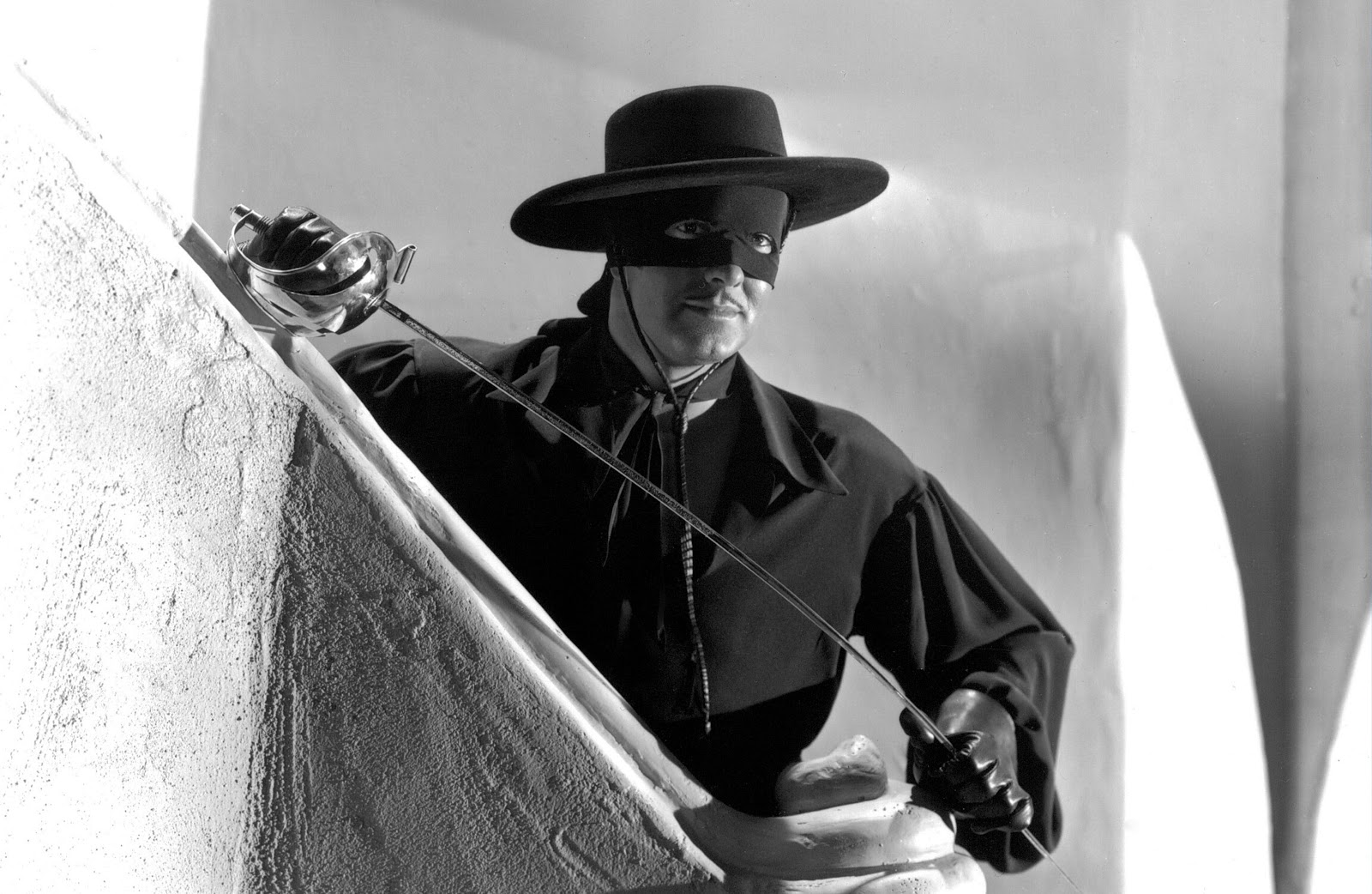
The swashbuckling hero Zorro had previously rode onto cinema screens in the 1920 silent film The Mark of Zorro, which starred Douglas Fairbanks in the lead role.  This is a spirited old fashioned adventure film, with some enjoyable action, and some exciting sword fights.  The film's title comes from Zorro's habit of marking things and sometimes people with three quick sword slashes to form the letter "Z".  Also it doesn't take itself too seriously and there is a welcome vein of humour throughout.  Tyrone Power is good in the lead role, obnoxiously foppish as Diego, but athletically physical and romantic as Zorro.  Basil Rathbone is good as the evil master swordsman who Zorro must defeat.  Linda Darnell doesn't really have anything much to do other than be courted by Diego, as she falls in love with his Zorro persona.  This is the kind of Saturday matinee film that really doesn't get made much anymore, and while it hasn't aged well in places, it is still a very entertaining film.   The Mark of Zorro has gone on to become part of the Batman mythos.  In both comic books and movies, it's depicted as the film that the young Bruce Wayne watched with his parent's the night that they were killed.  Although it differs among various versions whether it was the 1920 or 1940 film that they watched.  


Tyrone Power in The Mark of Zorro


Saturday, 5 August 2023

Wolfen

 Year:  1981

Director:  Michael Wadleigh

Screenplay:  David M. Eyre Jr., Michael Wadleigh and Eric Roth, based on the novel The Wolfen by Whitley Streiber

Starring:  Albert Finney, Diane Venora, Edward James Olmos, Gregory Hines, Tom Noonan

Running Time:  114 minutes

Genre:  Horror, crime, drama

New York City:  Troubled former detective Dewey Wilson (Finney) is brought back on the job when a wealthy property developer, his wife and their bodyguard are found brutally murdered.  As he investigates, Dewey connects the murders to a string of similar slayings throughout the city.  Dewey eventually discovers the existence of savage, intelligent wolf-like creatures prowling the city.

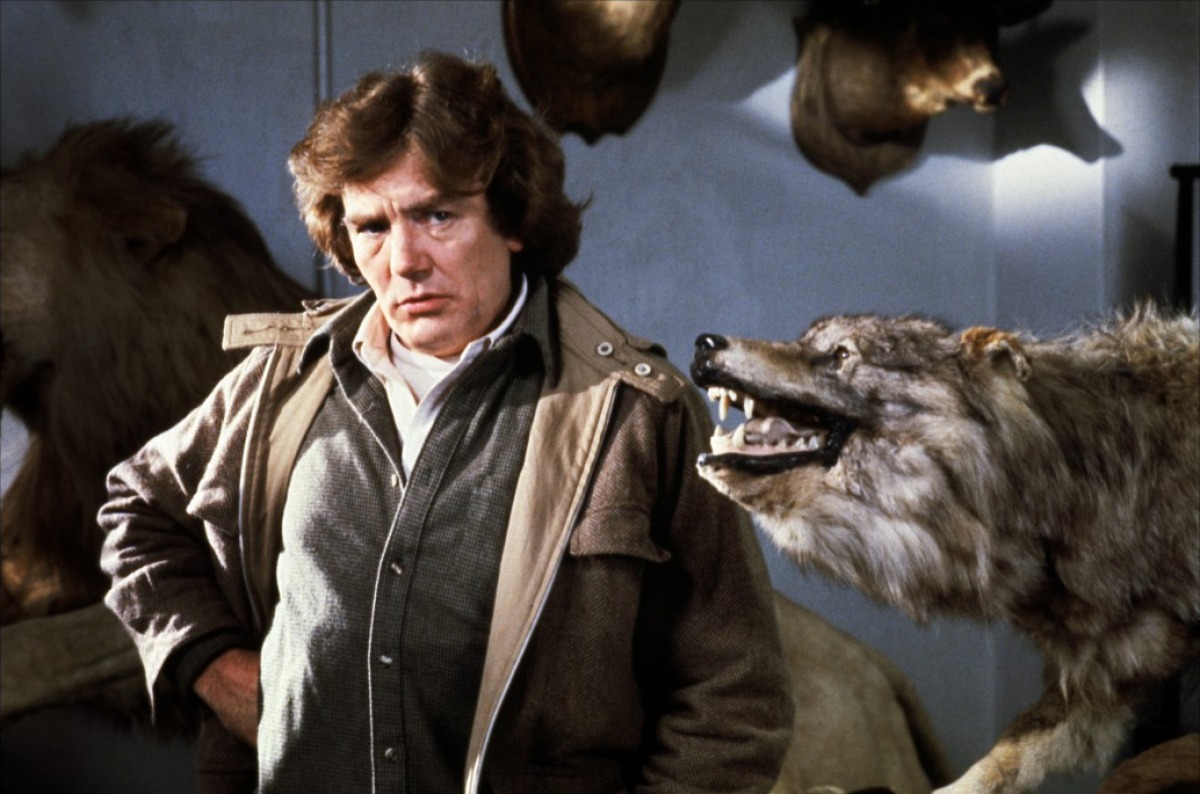
This is a mixture of gory horror, police procedural and social commentary.  While the different aspects of the film don't always hang together particularly well, it is a slick and often suspenseful monster movie.  Albert Finney is very good as the cynical rumpled detective for whom carnivorous wolf spirits are just one more story in the Naked City.  Diane Venora is good as the criminal psychologist who Wilson is partnered with, and there is good support from Gregory Hines, as Wilson's pathologist friend, Edward James Olmos, as a Native American activist, and Tom Noonan as a sinister wolf expert.  The film gets good milage out of the run-down inner city setting, and it has some really effective horror moments.  It uses a kind of electronic effect to depict the point of view of the Wolfen, which is slightly overused but effective, and also features a few too many fake scares where a character is startled only for them (and the audience) to realise that it's nothing.  The Wolfen themselves are kept mostly off screen only appearing fully towards the end of the film.  The explanation as to what the Wolfen actually are (a kind of Native American animal spirit) is muddled, particularly at the end.  While the Wolfen aren't strictly speaking werewolves, they are lycanthropic enough for the film to be lumped in with the other, better known, werewolf movies released at the time, namely The Howling (1981) and An American Werewolf in London (1981), both of which were more successful at the Box Office.  Despite its flaws, Wolfen is consistently suspenseful, and intriguing, the police procedural elements and the New York setting are effective, and the script has a welcome vein of cynical, hard-boiled humour.  The plot is intelligent, and while the different themes don't always hang together, the film deserves credit for trying to do something different with some well-worn tropes. 


Albert Finney and furry friend in Wolfen


Saturday, 22 July 2023

She Said

 Year:  2022

Director:  Maria Schrader

Screenplay:  Rebecca Lenkiewicz, based on the book She Said by Jodi Kantor and Megan Twohey

Starring:  Carey Mulligan, Zoe Kazan, Patricia Clarkson, Andre Braugher, Jennifer Ehle, Samantha Morton, Ashley Judd

Running Time:  129 minutes

Genre:  Drama


In 2017, New York Times journalists Jodi Kantor (Kazan) and Megan Twohey (Mulligan) investigate allegations by actresses Rose McGowan, Gwyneth Paltrow and Ashley Judd against powerful film producer Harvey Weinstein.  As they investigate the claims, Kantor and Twohey uncover a history of abuse by Weinstein stretching back decades, against numerous women.

When allegations against film producer Harvey Weinstein, co-founder and one time head of Miramax Films, with his brother Bob Weinstein, and later co-head of The Weinstein Company, first hit the headlines in late 2017 it had a seismic impact not just in Hollywood but around the world, helping to ignite the #MeToo movement against sexual abuse and harassment.  Megan Twohey and Jodi Kantor, who investigated and reported on the claims for The New York Times, detailed their investigation in the 2019 book She Said.  The world of journalism has always provided a rich source for filmmakers, and the film certainly echoes the classics of the genre, such as All the President's Men (1973) and Spotlight (2015).   However, the film moves away from the some of the cliches of boozy, chain-smoking, fast-talking men, barreling down corridors, shouting, instead the journalists are depicted as hard-working, dedicated, professionals who have full lives outside the newsroom, and we see both Kantor and Twohey at home with their respective young families, and Twohey's struggle with postpartum depression, having recently given birth.  Carey Mulligan and Zoe Kazan both give strong, empathic performances in the lead roles, and Samantha Morton and Jennifer Ehle give powerful performances as two of Weinstein's victims.  With such a recent, high profile and important case, filmmakers have to perform a very delicate balancing act, between creating a compelling piece of drama, while more importantly not exploiting, or sensationalising the horrific crimes.  The film mostly plays as a docudrama and, wisely, the decision is made not to centre Weinstein, who is only glimpsed once in the film, towards the end and only seen from behind amidst a huddle of people striding through the New York Times building.  Mike Houston provides Weinstein's voice on the phone rasping insults and threats to the journalists.  Weinstein's crimes are not dramatised.  Instead we have victims giving their accounts over images of empty hallways and dishevelled hotel rooms.    At one point a recording of voice recording of Weinstein harassing and threatening Ambra Gutierrez is played.  The film's main issue is that the story is so recent, and has been so well-covered, that most viewers will already be familiar with it all.  However, even while the story may be familiar, and the pacing is sometimes uneven, this is a compassionate and gripping film.  


Zoe Kazan and Carey Mulligan in She Said

Friday, 14 July 2023

The Dunwich Horror

 Year:  1970

Director:  Daniel Haller

Screenplay:  Curtis Hanson, Henry Rosenbaum and Ronald Silkosky, based on the short story The Dunwich Horror by H. P. Lovecraft

Starring:  Sandra Dee, Dean Stockwell, Ed Begley, Lloyd Bochner, Donna Baccala, Joanne Moore Jordan, Sam Jaffe

Running Time:  90 minutes

Genre:  Horror


At the Miskatonic University in Arkham, Massachusetts, student Nancy Wagner (Dee) becomes fascinated with the strange Wilbur Whateley (Stockwell) who is desperate to get his hands on the University's copy of a very rare and valuable book knows as the Necronomicon.  Nancy accepts Wilbur's invitation to spend some time at his mansion in the nearby small town of Dunwich.  At the mansion, Nancy is disturbed by Wilbur's grandfather (Jaffe).  It turns out that the Whateley's have a very bad reputation in the town.  Wilbur is obsessed with using the Necronomicon to bring back the "Old Ones" who used to rule the earth, and plans to sacrifice Nancy in an occult ritual.

American writer H. P. Lovecraft has been hugely influential in the fields of horror and science fiction.  In particular his brand of cosmic horror known as the "Cthulhu Mythos" which postulates that long ago, Earth was ruled by monstrous creatures known  as the "Old Ones" who, due to their evil ways, were banished to another dimension by the yet more powerful "Elder Gods".  The immortal Old Ones still exist and are eternally desperate to get back and reclaim their dominion over Earth.  They can be summoned by various rituals and incantations, which have thoughtfully been written down in various ancient grimoires, most famously the Necronomicon.  While Lovecraft has certainly been influential his work has proved challenging to filmmakers.  His conception of creatures that can drive to madness any human unfortunate enough to so much as look at them is difficult to render on film, even with CGI.  Lovecraft is also controversial due to his blatant racism and misogyny.  There have been successful Lovecraft adaptations, however, such as Re-Animator (1985), From Beyond (1986) and Color Out of Space (2019).  This film, from the stable of B-movie maestro Roger Corman, is enjoyable enough, but not one of the best.  Incidentally, Roger Corman previously directed one of the first Lovecraft adaptations, The Haunted Palace, which was officially part of Corman's series of eight films based on Edgar Allan Poe, but the plot is actually from the Lovecraft story The Case of Charles Dexter Ward.  Loosely based on the 1928 short story by Lovecraft, The Dunwich Horror does a decent enough job of putting Lovecraft onto the screen.  Although Sandra Dee never really seems particularly frightened by the goings-on around her; Dean Stockwell gives an intense, quiet performances as the wicked warlock, and is really the film's highlight.  Veteran actor Ed Begley, in one of his final roles, seems slightly embarrassed in his role as the heroic professor who races to save the day.  Talia Shire (here credited as Talia Coppola), who would go on to appear in The Godfather and Rocky series, appears in a small role as a nurse.  The film is full of bizarre psychedelic effects, which are lively if unintentionally funny, and frequent dream sequences, which just really seem shoehorned in to get some nudity into the film.  The film is watchable enough, and there is enough going on that it never really gets boring, however it is likely to disappoint Lovecraft fans and is probably not enough to convert non-fans.  


Dean Stockwell in The Dunwich Horror

Saturday, 8 July 2023

Nosferatu: A Symphony of Horror

 Year:  1922

Director:  F. W. Murnau

Screenplay:  Henrik Galeen, based on the novel Dracula by Bram Stoker

Starring:  Max Schreck, Gustav von Wangenheim, Greta Schröder, Alexander Granach, Ruth Landschoff, Wolfgang Heinz

Running Time:  84 minutes

Genre:  Horror

Wisborg, 1838:  Young clerk Hutter (von Wangenheim) is sent by his sinister boss, Knock (Granach), to a remote castle high in the Carpathian Mountains in Transylvania to negotiate the purchase of a house by the mysterious nobleman Count Orlok (Schreck).  Hutter soon discovers the horrific truth that Count Orlok is a blood-thirsty vampire or nosferatu.

This classic silent horror film is technically the first adaptation of Bram Stoker's famous novel Dracula.  However the adaptation was unauthorised and unofficial.  The filmmakers approached Stoker's widow, Florence Stoker, for the rights to adapt the film, but they decided that they couldn't afford the price she was asking, and so they just decided to go ahead anyway.  When Florence Stoker found out, she was furious, and sued the filmmakers, bankrupting the studio, with the court ordering all copies of the film to be destroyed.  However it had already been exported internationally and some prints resurfaced in France and the United States.  The film is one of the most influential horror films ever made.  While not as heavily stylised as the surreal dreamscape of The Cabinet of Dr. Caligari (1919), it is part of the German Expressionist movement, in which the character's inner worlds are reflected in the outer world.  Viewed today, it does suffer from overly melodramatic acting, as well as director F. W. Murnau's decision to use sped-up motion in scenes such as the carriage driving through the forest, and Orlok loading his coffins into a cart.  Murnau, apparently thought that sped-up motion was scary, but today it looks more comical than anything else, although at this point cinema was still very new and was still trying to find it's own language and style.   In fact some of Murnau's innovations work very well, for example the novel Dracula is told through diaries, journals, newspaper cuttings, and so on, and Murnau carefully designed the intertitles of the film himself to replicate the pages of old books and documents.  Despite being 100 years old, the film is still hugely effective, and is still one of the greatest vampire films ever made.  The vampire in Nosferatu is based on the traditional European folkloric vampire, as a hideous reanimated corpse rather than a suave lounge lizard in evening dress.  Max Schreck makes an indelible impression as Count Orlok, a cadaverous figure incased in black, his hands as grotesque talons, bat-like ears, bald, with a pinched face and sharp, rodent-like fangs.  The vampire is explicitly connected with disease, arriving in the town of Wisborg, accompanied by hordes of rats, and bringing the plague.  Schreck's portrayal was so convincing that there were rumours at the time that he really was a vampire.  The rumour inspired its own film Shadow of the Vampire (2000), a fictionalised version of the filming of Nosferatu starring John Malkovich and Willem Dafoe.  The film contains some unforgettable images, such as Orlok on the death ship; the shadow of the vampire creeping up the stairs towards his victim; and also the climax where the vampire is dissolved by the rays of the sun.  Possibly the film's biggest contribution to vampire lore is the idea of the vampire being destroyed by sunlight.  In Dracula, the vampire is weakened by sunlight, but it is not lethal.    Nosferatu was remade in 1979 as Nosferatu the Vampyr, written and directed by Werner Herzog, with Klaus Kinski as the vampire, and another remake is set for release in 2024.  Although originating as an unauthorised adaptation of a popular novel, Nosferatu has grown beyond its origins, casting an indelible shadow that lingers to this day.


Max Schreck as Count Orlok in Nosferatu: A Symphony of Horror
     

Wednesday, 28 June 2023

The Killing of a Chinese Bookie

 Year:  1976

Director:  John Cassavetes

Screenplay:  John Cassavetes

Starring:  Ben Gazzara, Timothy Agoglia Carey, Seymour Cassel, Azizi Johari

Running Time:  135 minutes (cut to 109 minutes)

Genre:  Drama, thriller

Cosmo Vittelli (Gazzara) owns and operates the sleazy, failing nightclub Crazy Horse West in Los Angeles.  To make matters worse Cosmo owes a large gambling debt to the Mob.  The gangsters order Cosmo to kill a bookmaker, Harold Ling (Soto Joe Hugh).  After some less than gentle persuasion, Cosmo reluctantly accepts his task, but soon finds the hit is much more complex than he had expected.

Writer, director and actor John Cassavetes appeared as an actor in a number of big Hollywood movies such as The Dirty Dozen (1967), for which he received an Academy Award nomination for Best Supporting Actor, and most notably a starring role as Mia Farrow's traitorous husband in Rosemary's Baby (1968).  However, he is most influential as a writer and director, and his echo is still felt today in the world of Independent Cinema.  Despite its seemingly conventional thriller plot, in terms of style and approach, The Killing of a Chinese Bookie is anything but conventional.  More a character study than a thriller, the film focuses on the dilemmas and pressures of Cosmo Vittelli, a man whose entire world is this sleazy club, and who puts all of the money he earns back into the club, as well as spending a lot of time and effort writing and directing the cheesy cabaret acts, hosted by the club compere "Mr. Sophistication" (Meade Roberts), even though he knows that the audience only care about seeing naked women.  He also has a severe gambling problem.  To celebrate making his last payment on a previous debt to a loan shark, he immediately goes out on a night on the town and ends up losing everything on poker.  Ben Gazzara, who saw Vittelli as a kind coded version of Cassavetes himself, gives a great performance, giving Vittelli a kind of down-at-heels charm, and a cocktail of hope and despair.  As is common with Cassavetes' work, the film has a loose, documentary style look, filmed guerrilla-style on the streets and in nightclubs, restaurants and homes.  The performances, which include Cassavetes regular Seymour Cassel and veteran gangster movie actor Timothy Carey, have a naturalistic, improvised feel about them.  The film was originally released in 1976 with a running time of 135 minutes, and immediately tanked at the box office, being withdrawn from general release after a week, with even Gazzara stating that it "was too long".  Cassavetes re-released the film in 1978 in a much shortened version of 109 minutes, with scenes drastically rearranged and some new footage.  For a long time this was the only version available, but in 2004 the 109 minute and 135 minute versions were released on DVD, so now you can watch both, should you care to.

The eagle-eyed viewer may notice a familiar face in some of the crowd scenes.  David Bowie sat in on much of the filming, just to watch Cassavetes at work, although he was not involved in the film.  However he can be glimpsed in the audience during some of the nightclub scenes.


Ben Gazzara in The Killing of a Chinese Bookie


Monday, 8 May 2023

Star Trek: The Motion Picture

 Year:  1979

Director:  Robert Wise

Screenplay:  Harold Livingston, from a story by Alan Dean Foster, based on Star Trek created by Gene Roddenberry

Starring:  William Shatner, Leonard Nimoy, DeForest Kelley, Stephen Collins, Persis Khambatta, James Doohan, Nichelle Nichols, George Takei, Walter Koenig

Running Time:  132 minutes

Genre:  Science-fiction


When a mysterious alien cloud possessed of powerful destructive capabilities is detected on a course heading directly for Earth, Admiral James T. Kirk (Shatner) is put in charge of the newly overhauled USS Enterprise, and reunites his old crew to investigate and stop the cloud's path of destruction by any means necessary.

When the original television series of Star Trek ended in 1969 after three seasons and 79 episodes, it looked like it would be one more cancelled TV show that would exist for evermore in the fuzzy afterlife of repeats.  However, as the 1970s progressed, Star Trek became a major success in syndication, as well as attracting increasing numbers of devoted fans.  A 14 episode Saturday morning cartoon version was broadcast in the mid '70s, but Paramount Studios were becoming interested in a new live-action Star Trek.  In the late '70s Paramount announced plans for a new cable TV  network, to be imaginatively named The Paramount Network, and the flagship programme on launch night would be Star Trek: Phase II, which would feature some of the original cast alongside new characters.  Pre-production was already well advanced on Star Trek: Phase II, scripts had been written, sets had been built, parts had been cast, costumes designed and some special effects footage had already been shot, when Paramount pulled the plug on The Paramount Network, and Star Trek: Phase II was cancelled.  Rather than waste the considerable amount of money and time that had been spent on the new Star Trek, Paramount decided to remount what would have been the pilot episode of Star Trek: Phase II as a stand-alone feature film.  The script was rewritten and veteran director Robert Wise was hired to helm the project.  The resulting film boasts some very impressive special effects, but is hindered by a slow pace, and a drab feeling to the whole thing, from the colourlessness of the Enterprise interiors, to the new uniforms which all seem to be in varying shades of light blue, white and beige.  There is also the pretentiousness and po-faced philosophising which hampered Star Trek at its worse, with very little of the action and humour of the TV series at its best.  Many of the returning actors have little more than cameo roles, and the two new additions Stephen Collins as Kirk's rival for the Enterprise, Captain Decker, and Persis Khambatta at the alien Deltan Ilia, never really get the chance to make much of an impression.  Despite the plot being a race against time to save the earth, there is very little dynamism, and the story essentially calls for the actors to do little more than react to what they see on monitor screens.  It's clear that what the producers were going for was a serious cerebral science-fiction epic along the lines of 2001: A Space Odyssey (1968), but that is the wrong approach for Star Trek.  The film does have its good points though.  The opening sequence, where the alien cloud encounters three Klingon spaceships is exciting, the special effects are still impressive even after all this time, and there are moments when that create a genuine sense of wonder.  Also the climax, with its clear sexual metaphor is quite daring.  


William Shatner, DeForest Kelley and Leonard Nimoy in Star Trek: The Motion Picture
  

Wednesday, 26 April 2023

Evil Dead Rise

 Year:  2023

Director:  Lee Cronin

Screenplay:  Lee Cronin, based on characters created by Sam Raimi

Starring:  Lily Sullivan, Alyssa Sutherland, Morgan Davies, Gabrielle Echols, Nell Fisher

Running Time:  97 minutes

Genre:  Horror

Guitar technician Beth (Sullivan) goes to visit her sister Ellie (Sutherland), who is a single mother to teenagers Bridget (Echols) and Danny (Davies), and pre-teen Kassie (Fisher).  Following a minor earthquake, a hole opens up in the ground of the underground parking garage of Ellie's condemned apartment building.  Curious, Danny investigates and discovers an abandoned subterranean bank vault in which he finds three phonograph records from 1923 and a strange old book.  When Danny plays the phonograph records he discovers that they have been made by a strange priest, who has discovered one of  three surviving volumes of the Naturom Demonto, a book bound in human flesh and inked in blood, which has the power to resurrect evil demonic forces.  The priest thoughtfully recites these spells on the records, and the family soon find themselves assaulted by terrifying supernatural forces.

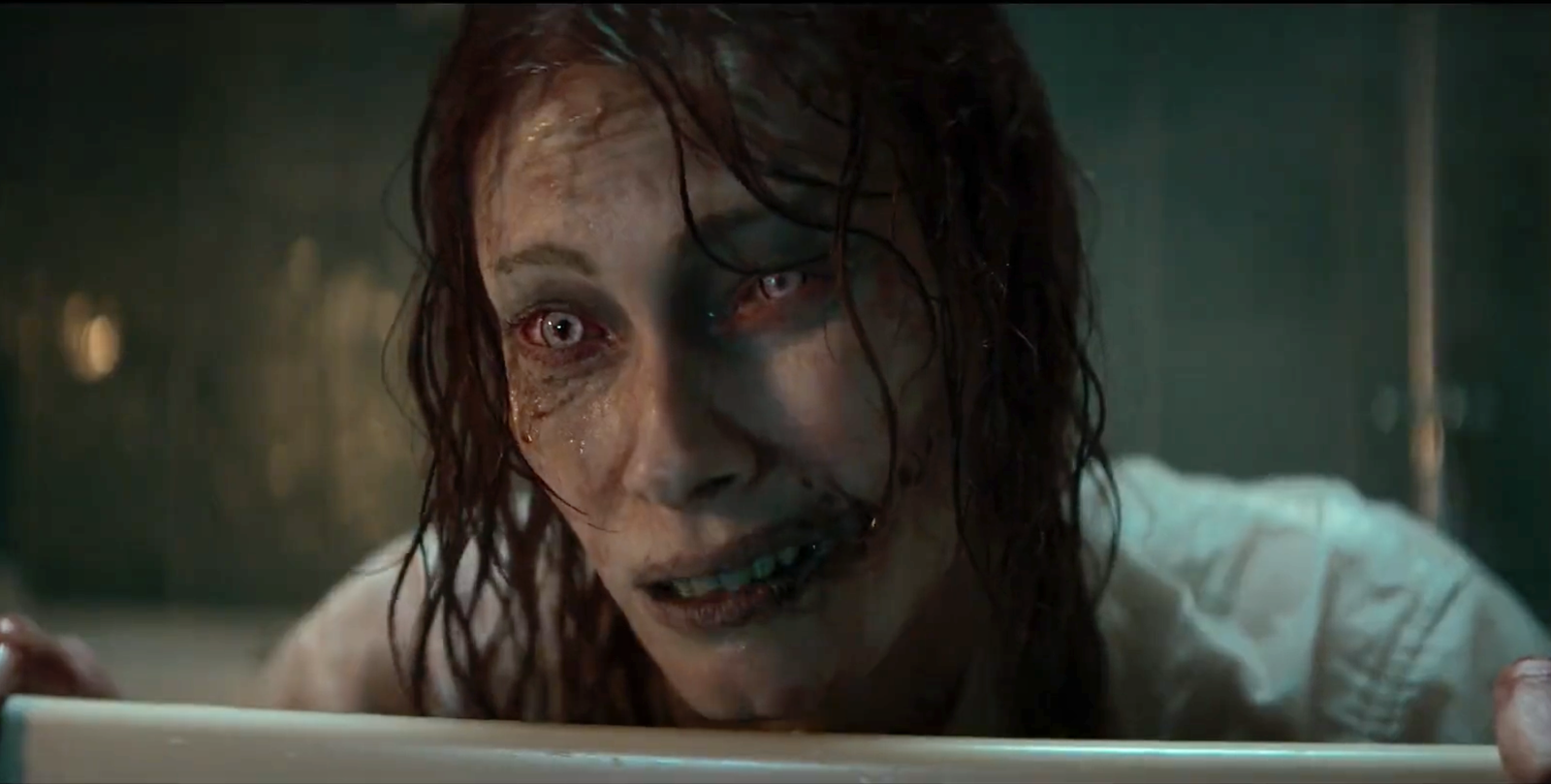
This is the fifth film in the Evil Dead franchise.  While Sam Raimi's original The Evil Dead (1981) was a fully fledged horror film, the sequel Evil Dead II (1987) was more of a comedy film influenced by Raimi's enthusiasm for the Three Stooges, and the third film in the series, Army of Darkness (1992), was pretty much a full on fantasy comedy with lead character Ash (Bruce Campbell) transported to the Middle Ages. In 2013 director Fede Álvarez released Evil Dead, a reboot of the series which returned it to its gruesome, horror original.  Evil Dead Rise continues this approach by being a full on horror film.  The blood doesn't so much flow here, as gush, pour, rain and flood.  It opens with a prologue, set in the familiar Evil Dead territory of a bucolic woodland, however the bulk of the film is set a day earlier in an unnamed rain soaked city.  The grim setting of a condemned, decaying, sparsely occupied apartment building works for the material.  It also takes it's time to set up the characters, particularly the tension between Ellie, a financially struggling tattoo artist, due to be evicted in a month, raising three children on her own, and her sister Beth, a freewheeling guitar technician, who is seen as the "cool aunt" by her nieces and nephews, but is frequently dismissed as a "groupie", a description which she angrily rejects.  It is Ellie who becomes possessed by the demonic forces, forcing Beth, who has just discovered that she is pregnant, to step into the maternal role and protect the children.  While there are some nods to the earlier Evil Dead films, this is a stand alone film, and can be watched even if you've ever seen any of the other films.  The performances are good, and the horror, when it comes in, is unrelenting.  It is graphically violent, in the best Grand Guignol tradition of splatter films, and will surely be a late night favourite for horror fans.


     Mother isn't quite herself today:  Alyssa Sutherland in Evil Dead Rise


Saturday, 22 April 2023

Searching

Year:  2018

Director:  Aneesh Chaganty

Screenplay:  Aneesh Chaganty and Sev Ohanian

Starring:  John Cho, Debra Messing, Michelle La, Sara Sohn, Joseph Lee, Steven Michael Eich

Genre:  Thriller

Running Time:  102 minutes


San Jose, California:  David Kim (Cho) desperately searches for his missing 16 year old daughter, Margot (La).


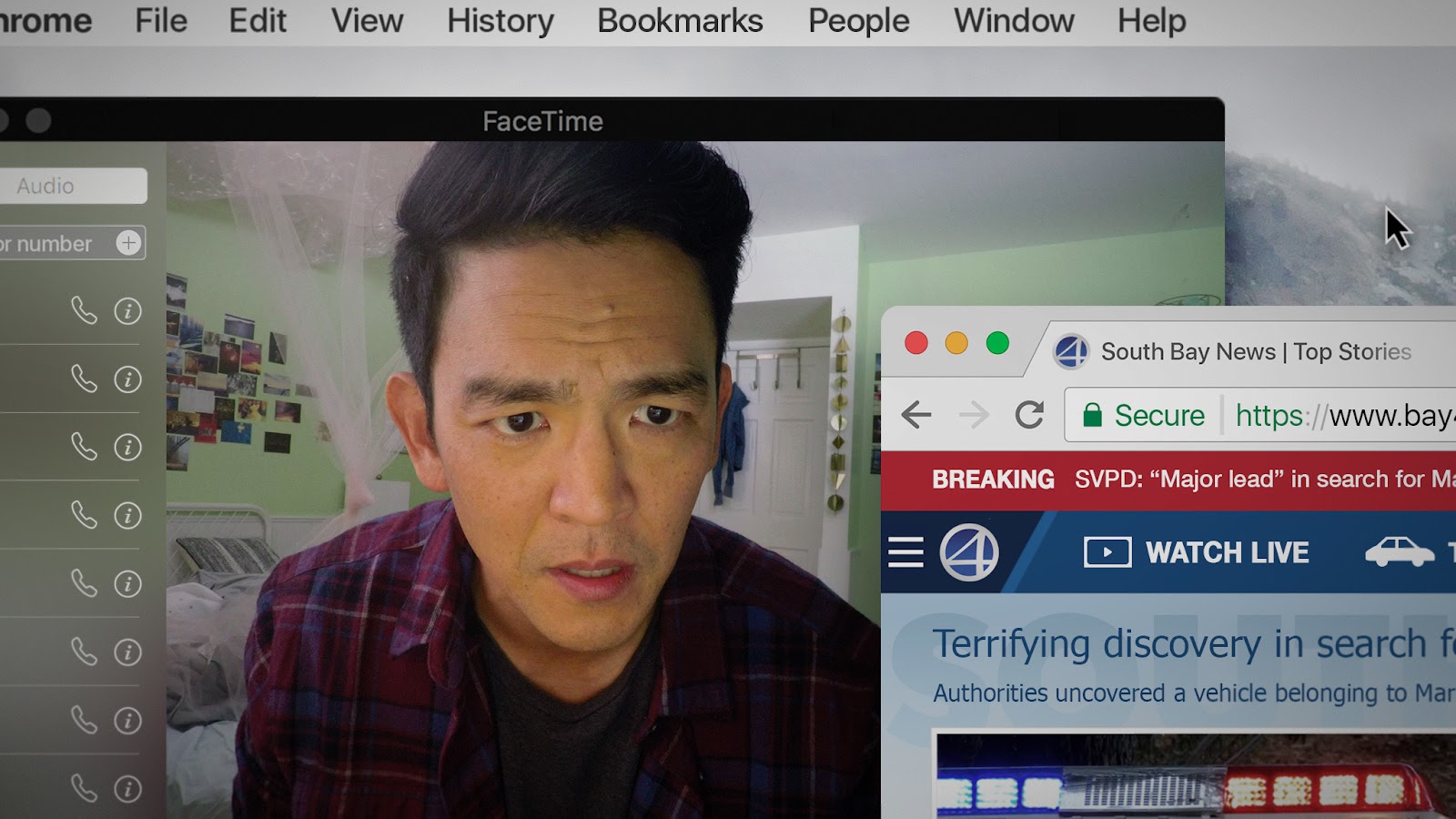
There is very little that you can say about the plot of this film without giving away one of its many twists.  The storyline is, in many ways, a traditional mystery thriller in which a widowed father desperately searches for his missing daughter, following clues, chasing down red herrings, and investigating suspects. However, what is innovative here is that the whole film takes place on computer screens.  David conducts his investigation mostly from his own home, searching through his daughter's social media feeds, Skypeing and WhatsApping potential witnesses and suspects, and finding clues through CCTV footage that he has been sent by the detective investigating the case (Debra Messing).  The film opens with a moving sequence of the family in happier times before David's wife and Margot's mother's death by cancer, depicted through the family's various screens, setting up family accounts on their new computer, videos of birthdays and holidays, online posts and calendar appointments.  Although the film was released two years before Covid, in a way it feels more pertinent in a covid and post-Covid world, now that we are living our lives more online than ever.  John Cho gives a strong performance as the tormented father, who for most of the film is sitting looking directly at the camera (his various screens).  The film mixes traditional detective story elements with modern technology, and at times the many twists and turns of the narrative strain credulity, but it is involving throughout, and the style manages to be more than just a gimmick.  The computer screen subgenre of found footage film is a difficult one to make work, partly because they look dated very quickly, due to how quickly computer technology moves forward.  Searching, however, is well worth the time.  


John Cho in Searching
  

Tuesday, 11 April 2023

Cold Light of Day

 Year:  1989

Director:  Fhiona Louise

Screenplay:  Fhiona Louise

Starring:  Bob Flag, Martin Byrne-Quinn, Geoffrey Greenhill, Mark Hawkins, Andrew Edmands, Claire King

Running Time:  81 minutes

Genre:  drama, true crime, horror


In a police interview room, unassuming middle-aged civil servant Jordan Marsh (Flag) is interrogated about a series of murders, which are depicted through a series of flashbacks.


True crime is a perennially popular genre in all kinds of media.  This film is based on the true story of serial killer Dennis Nilsen.  Sometimes dubbed "The British Jeffrey Dahmer", Nilsen murdered at least twelve young men and boys between December 1978 and January 1983.  His crimes were discovered in February 1983 when some human remains were found to be blocking drains in the building where Nilsen lived in an attic flat.  While this is not as good as the three part miniseries Des (2020) which starred David Tennant as Nilsen, this low-budget, low key drama is fairly effective in its own right.  Here Dennis Nilsen is called Jordan March and played by Bob Flag, who is probably best known as the face of Big Brother in 1984 (1984).  Saddled with a terrible wig, Flag gives a striking performance as the repellant Marsh, alternately arrogant, petulantly angry or cringing under his increasingly aggressive police interrogation.  Marsh however does have some moments of kindness, when he helps an elderly downstairs neighbour.  Written and directed by Fhiona Louise, who at the time was a 21 year old drama student, the film suffers from a very low budget, it's technically very crude, the performances are variable, sometimes the sound is hard to hear particularly under the loud soundtrack of pulsating breathing and tolling bells.  There are several flashbacks to Marsh's rural childhood and the death of his beloved grandfather (where his mother tells him that his grandfather is "just sleeping").  Even though it is short, the film seems to move at a snail's pace, and everything is bleak, depressing and grimy - which may be the best approach for a film about a serial killer.  There is stuff to admire here, but very little to really like.  


Bob Flag in Cold Light of Day


Saturday, 8 April 2023

Dracula

 Year:  1974

Director:  Dan Curtis

Screenplay:  Richard Matheson, from the novel Dracula by Bram Stoker

Starring:  Jack Palance, Simon Ward, Nigel Davenport, Pamela Brown, Fiona Lewis, Penelope Horner

Running Time:  100 minutes

Genre:  Horror

1897:  Solicitor Jonathan Harker (Murray Brown) is in Transylvania to visit mysterious nobleman Count Dracula (Palance), who plans to buy property in England.  However, Harker finds out too late, what his host's true motivations are.  In England, Arthur Holmwood (Ward) discovers that his fiancé Lucy (Lewis) is Dracula's latest victim, and it is up to him and Professor Van Helsing (Davenport) to stop the vampire for good.


The good count himself may not have proved to be immortal, but Bram Stoker's classic vampire novel has proved to be well nigh un-killable, with numerous adaptations in almost all forms of media.  Every Dracula fan has their favourite, and while this made-for-TV movie may not be one of the best, it is still a solid adaptation.  Producer and director Dan Curtis was familiar with horror having created the frankly bizarre supernatural daily soap opera Dark Shadows (1966-1971), as well as the TV movie The Night Stalker (1972) which was also scripted by Richard Matheson, and other adaptations of horror classics such as The Strange Case of Doctor Jekyll and Mister Hyde (1968) which also starred Jack Palance.  As scripted by horror writer Richard Matheson, this adaptation of Dracula remains faithful to Stoker's novel, albeit streamlining it a lot and cutting many supporting characters, including Dracula's bug-eating servant  Renfield.  Jack Palance, who was best known for playing heavies in gangster films and Westerns, may seem a strange choice for Dracula, but he does well, giving Dracula a Byronic menace, as well as a physicality often absent in other versions of the character.  The other performances are solid, and the film benefits from being filmed largely in England and Yugoslavia, despite being made for American TV.  While the film has its slow points, and there are times when the fairly low budget is obvious, it is a pretty impressive piece of work, and well worth checking out for horror fans.  The film's on-screen title is Bram Stoker's Dracula but, when Francis Ford Coppola was preparing his own film, also titled Bram Stoker's Dracula (1992), he bought the rights to the title in order to avoid comparisons, and the 1974 film is listed as either Dracula or Dan Curtis' Dracula.  There are a couple of other points of similarity between this and the 1992 film, in both Dracula is explicitly referred to as the historical Vlad Dracula (aka Vlad the Impaler) and in both versions Dracula hunts down the reincarnation of his lost love (Lucy in this film and Mina in the 1992 film).     


Jack Palance is Dracula

The Long Good Friday

 Year:  1980

Director:  John Mackenzie

Screenplay:  Barrie Keeffe

Starring:  Bob Hoskins, Helen Mirren

Running Time:  114 minutes

Genre:  Thriller


Harry Shand (Hoskins) is a powerful, ruthless gangster, who has plans to go legitimate with a scheme to redevelop the London Docklands with the aid of mafia investors from New York.  However, on the day of the mafiosi fly into London, Harry's empire is threatened by a series of bombings, and the stabbing of one of his closest associates.  Tasking his mistress, Victoria (Mirren) with handling the negotiations, Harry sets out on a violent quest to put a stop to the attacks.


This is one of the great, underrated classics of British gangster films.  The film mixes themes of political and police corruption, and the IRA, as well as an optimism about Britain becoming a European powerhouse, which in these days rings bitterly hollow.  Bob Hoskins had made a name as the star of the 1979 TV series Pennies from Heaven, but this was his first major film role.  He gives a fantastic performance as the brutal Harry Shand, mixing affability with menace, presenting himself as a legitimate, reasonable businessman but turning on friend or foe alike with brutal ferocity when crossed.  Helen Mirren is also memorable as the icy, intelligent Victoria, who serves almost as Shand's PA, and the acceptable face of his organisation.  The rest of the cast is full of now familiar faces from British TV and film, including Pierce Brosnan in his film debut as an IRA hitman.  The script is intelligent, with moments of dark humour, and the direction is slick, and the film maintains tension throughout, along with frequent, and often shocking moments of explosive violence.


Bob Hoskins in The Long Good Friday

Saturday, 18 March 2023

Marathon Man

Year:  1975

Director:  John Schlesinger

Screenplay:  William Goldman, based on the novel Marathon Man by William Goldman

Starring:  Dustin Hoffman, Laurence Olivier, Roy Scheider, William Devane, Marthe Keller

Running Time:  125 minutes

Genre:  Thriller

In New York City, history student Thomas "Babe" Levy (Hoffman), who is also training to run a marathon, becomes embroiled in a conspiracy involving sadistic Nazi Christian Szell (Olivier) and his attempt to obtain a cache of stolen diamonds.

Based on the 1974 novel by William Goldman, who also wrote the film's screenplay, this is not the film to watch just before your next visit to the dentist, as the film's most memorable scene involves Szell torturing Thomas by drilling into his teeth while intoning over and over again "Is it safe?... is it safe?... is it safe?..."  However it may be seen by the good people of the dental profession, this is an effective thriller, as with many films of the seventies there is a chilling air of paranoia that hangs over proceedings.  It does take a long time to get going, and several of the narrative threads don't really hang together, but for the most part it works really well, and has some genuinely exciting scenes.  Dustin Hoffman gives a great performance as the fresh-faced, wide-eyed marathon runner, who becomes increasingly haunted and hollow-eyed, as he is used to the limits by his torments.  Laurence Olivier is memorably chilling as the Nazi, with his collection of dental instruments and retractable knife hidden in his shirtsleeve.  One of the most famous behind the scenes anecdotes about the film is method actor Hoffman informing Olivier that he stayed up for three days to look tired on screen, to which Olivier replied "Why don't you just try acting?  It's much easier."  Roy Scheider is also good as Hoffman's older brother who is leading a double life.    


Laurence Olivier and Dustin Hoffman in Marathon Man