Showing posts with label horror. Show all posts

Sunday, 15 October 2023

Saw X

 Year:  2023

Director:  Kevin Greutert

Screenplay:  Peter Goldfinger and Josh Stolberg

Starring:  Tobin Bell, Shawnee Smith, Synnøve Mackey Lund, Steven Brand, Renata Vaca, Michael Beach

Running Time:  118 minutes

Genre:  Horror

John Kramer (Bell) has been given just months to live due to his terminal brain cancer.  In desperation, he approaches a clinic in Mexico that promises a radical new treatment to cure cancer.  Kramer soon realises, however, that he has been tricked, and the operation is merely a scam to con cancer sufferers out of thousands of dollars.  However, John Kramer has a few tricks of his own.  What the scammers don't know is that he is none other than the notorious Jigsaw Killer, and soon the predators become the prey, when Kramer forces them to play his sadistic games.

This is the tenth instalment in the hugely popular Saw franchise.  The Saw films focus on serial killer John Kramer, known as "Jigsaw", whose victims are those he deems to have done wrong or wasted their lives.  he doesn't kill his victims directly but imprisons them in elaborate, specially designed traps, which usually make some ironic comment on the "sins" Kramer believes them to have committed.  The traps, which Kramer refers to as "tests" or "games", are lethal but there is a way to escape, at the cost of extreme physical or psychological torture, which very few can withstand, and so most of Kramer's victims are killed by their traps.  The cadaverous, softly-spoken Tobin Bell once more reprises his role as John Kramer, this time taking centre stage as anti-hero rather than out and out villain.  Series regular Shawnee Smith also returns as Amanda, one of Kramer's victims who survived her ordeal and became his devoted apprentice.  The surrogate father-daughter relationship between Kramer and Amanda forms the emotional core of the film.  Norwegian actress Synnøve Mackey Lund is impressive as the heartless head of the scam operation.  Despite being the tenth film in the series, the story takes place between the events of Saw (2004) and Saw II (2005).  The film is slow to get going.   There is a brief scene at the beginning of the film where we see Kramer witnessing a hospital orderly stealing from a patient, and imagining the orderly in one of his death traps, he decides to spare the orderly when he puts the patient's possessions back after noticing Kramer staring at him, despite this it is a long time before we get to the traditional Saw action, although when it does get going it is impressive enough with all the gore and carnage that fans have come to expect from the series.  Incidentally, there is an additional scene partway through the end credits.


        The Gamesmaster:  Tobin Bell in Saw X

Saturday, 14 October 2023

Friday the 13th

 Year:  1980

Director:  Sean S. Cunningham

Screenplay:  Victor Miller

Starring:  Betsy Palmer, Adrienne King, Harry Crosby, Laurie Bartram, Mark Nelson, Jeannine Taylor, Robbi Morgan, Kevin Bacon

Running Time:  95 minutes

Genre:  Horror

Camp Crystal Lake is preparing for it's grand reopening after being closed for twenty years.  The camp, however, has a bad reputation town, where it is nicknamed "Camp Blood" due to it's history of mysterious deaths and disappearances.  The local eccentric, Crazy Ralph (Walt Gorney), claims that the camp has a "death curse".  However, six teenage camp counsellors have arrived at the camp, along with the new owner (Pete Brouwer), to prepare for the opening in two weeks time.  When the owner leaves the camp to get some supplies, the counsellors enjoy themselves. However, the fun soon turns to terror as they are brutally murdered one by one by an unknown prowler.


Producer and director Sean S. Cunningham was known to horror fans for producing Wes Craven's notorious debut film The Last House on the Left (1972).  Prompted by the success of John Carpenter's Halloween (1978), Cunningham decided to do his own take on what would become known as the "slasher" genre.  Sticking to the calendar theme of Halloween, the title "Friday the 13th" seemed like a no-brainer for a horror film title, and Cunningham was in fact concerned that the title might already have been used, and so while the script was still being drafted, he took out a full page ad in the film industry trade magazine Variety announcing Friday the 13th as being in production, partly to raise additional financing for the project, and partly to ensure that no-one objected to them using the title.  The film sticks closely to the Halloween story structure, which would become the standard for slasher films.  Beginning with a short prologue set in 1958, most of the film takes place over a 24 hour period in the "present day", on Friday 13th June.  During the scenes set during the day, the first half hour or so of the film, we are introduced to the characters, thinly sketched as they are, and there is one murder, which the main characters are unaware of.  It's at night, during a torrential rain shower, that the fun really starts.  There is nothing particularly memorable in the script, and the performances are variable at best, if effective enough for this type of film.  Future Hollywood star Kevin Bacon has an early appearance as one of the camp counsellors, and a memorable death scene.  The score by Harry Manfredini is obviously inspired by Bernard Herrmann's score for Psycho (1960), but it does have the memorable "ki ki ki, ma ma ma" motif, that represents the unseen killer.  The gore effects are by legendary special effects artist Tom Savinvi, who had previously worked on Dawn of the Dead (1978), and they are impressive.  After the controversy surrounding The Last House on the Left, Sean S. Cunningham wanted to make. film that was, as he put it, "a rollercoaster ride", the film its directed effectively, aside from some quite jarring transitions, and both script and direction suffer from some real lapses in logic (the killer always seems to know where the counsellors will wander off to on their own, and be ready with a variety of different weapons, and also seems to be able to travel from one place to another very quickly without being seen or heard).  The scenes where the camera takes the killer's point-of-view, lurking behind trees and observing the characters from a distance, are effective.  For a fun horror movie, however, it works almost as the cinematic equivalent of a campfire ghost story.  Simple, gruesome, silly and fun.  The film was a huge success, kickstarting the slasher movie boom of the early 1980s and launching a franchise which has, to date, clocked up eleven film, including a cross-over with the Nightmare on Elm Street franchise, a remake, a TV series, comics, novels and video games.    


Jeannine Taylor, Harry Crosby and Adrienne King in Friday the 13th


Sunday, 1 October 2023

There's Nothing Out There

 Year:  1991

Director:  Rolfe Kanefsky

Screenplay:  Rolfe Kanefsky

Starring:  Craig Peck, Wendy Bednarz, Mark Collver, John Carhart, Bonnie Bowers

Genre:  Comedy, science-fiction, horror

Running Time:  91 minutes

Seven students head off to a remote house in the woods, and soon come under attack from a vicious alien creature.  However, one of the group, Mike (Peck), is able to use his extensive knowledge of horror movies to help them defeat the creature.

This low-budget blend of comedy and horror is most notable as an early example of post-modern horror, five years before Wes Craven's hugely successful Scream (1996) popularised the genre.  The film parodies the various tropes of teen slasher films, which are discussed at length by sarcastic movie fan Mike.  Bits of the film are clever and funny, such as a character escaping the monster by grabbing the hanging microphone boom and using it to swing to safety, while the soundtrack plays a riff on the "Indiana Jones" theme.  It's the kind of film that would probably work best if played at a horror festival or convention or towards the end of an all-night horror movie marathon, when an audience might be more kindly disposed to laugh at it.  The film suffers from low production values, atrocious performances, and terrible special effects.  The monster is a puppet that looks like a cross between a giant frog and a fish with large teeth and shoots green rays out of it's eyes, which enable it to take control of the minds of its victims.  The female characters really have nothing to do except run around wearing as little as possible, and the film's ostensible hero is extremely unlikeable, with his constant sarcastic comments.  The film is an interesting curio for fans of horror, but has little real value as a movie.  


Sally (Lisa Grant) in There's Nothing Out There

Saturday, 30 September 2023

Lost Highway

 Year:  1997

Director:  David Lynch

Screenplay:  David Lynch and Barry Gifford

Starring:  Bill Pullman, Patricia Arquette, Balthazar Getty, Robert Blake, Natasha Gregson Wagner, Gary Busey, Robert Loggia

Running Time:  135 minutes

Genre:  Thriller, drama, horror

Jazz saxophonist Fred Madison (Pullman) and his wife Renee (Arquette) are disturbed to receive a series of mysterious VHS tapes of their large Los Angeles house.  Fred is convicted of Renee's murder, and sentenced to death.  In his jail cell, Fred transforms into Pete Dayton (Getty), a mechanic who has seemingly no connection to Fred.  The authorities release Pete, who comes under the influence of violent gangster Mister Eddy (Loggia), and finds himself drawn to Eddy's moll, Alice (Arquette again).

David Lynch saw in the 1990s on a critical and commercial high, with his cult TV series Twin Peaks (1989-1991, 2017) at the peak (no pun intended) of it's success, and his film Wild at Heart (1990) winning the Palme d'Or at the Cannes Film Festival.  However, Twin Peaks came to an end and Wild at Heart received mixed reviews and underperformed at the US Box Office.  Lynch's next film, Twin Peaks: Fire Walk With Me (1992), seemed like a guaranteed hit, however, the film, which leaned heavily into all the darkness, violence and weirdness that he was unable to put on mainstream TV in the early '90s baffled and dismayed both fans and critics, and was a commercial disappointment (except in Japan where it was a smash hit).   

The five years between Fire Walk With Me and Lost Highway were the longest gap between film projects of Lynch's career to that date.  Lynch's inspiration came from coming across the term "lost highway" in Barry Gifford's book Night People (1992), and also the O. J. Simpson murder case.  Lynch, who knew Gifford after adapting his novel Wild at Heart, teamed up with the author to work on the film's screenplay.  The film is a "2 A. M." movie.  Whatever time of the day or night you put it on, it feels like it is two o'clock in the morning.  That kind of night time delirium, where the world feels like it made of shadows and ghosts.  Lost Highway does not offer up its secrets easily or willingly, working as it does with a kind of dream logic.  Among the cast, Robert Blake, who would be accused of murder in 2001, although he was acquitted, is genuinely terrifying as the "Mystery Man", dressed in black, with slicked back, black hair, white makeup and black lips and eyes.  Patricia Arquette appears as the mysterious woman in both Fred and Pete's lives (although as Renee she has dark hair, and as Alice she is blonde), who may in fact be the same person, or may not be.  Gary Busey appears as Pete's dad, and Richard Pryor has a cameo as Pete's boss.  Robert Loggia plays the seemingly affable but threatening gangster, in one of the film's standout scenes, he violently attacks a tailgating driver, yelling lessons on road safety while savagely pistol-whipping the man, in a scene that could have come from a Quentin Tarantino film.  Lynch regular Jack Nance appears in a small role as Pete's coworker, however Nance died before the film was released, following injuries sustained in a brawl outside a donut shop.

The film's baffling narrative, surrealism and graphic sex and violence, put off many viewers and critics.  However, it has its own beauty.  Lynch is a master at using sound and visuals, and this is a film that benefits hugely from being seen with the best possible screen and sound system.  Lynch started out as a painter, and the film has some beautifully composed shots, and a complex sound design, ranging from sinister low rumbling, and quiet whispering, to loud industrial rock from the likes of Marilyn Manson and the Nine Inch Nails.  If some of Lynch's films are dreams wrapped in nightmares, this is like a nightmare in hell with dreams of heaven.


  Patricia Arquette and Bill Pullman in Lost Highway


Saturday, 5 August 2023

Wolfen

 Year:  1981

Director:  Michael Wadleigh

Screenplay:  David M. Eyre Jr., Michael Wadleigh and Eric Roth, based on the novel The Wolfen by Whitley Streiber

Starring:  Albert Finney, Diane Venora, Edward James Olmos, Gregory Hines, Tom Noonan

Running Time:  114 minutes

Genre:  Horror, crime, drama

New York City:  Troubled former detective Dewey Wilson (Finney) is brought back on the job when a wealthy property developer, his wife and their bodyguard are found brutally murdered.  As he investigates, Dewey connects the murders to a string of similar slayings throughout the city.  Dewey eventually discovers the existence of savage, intelligent wolf-like creatures prowling the city.

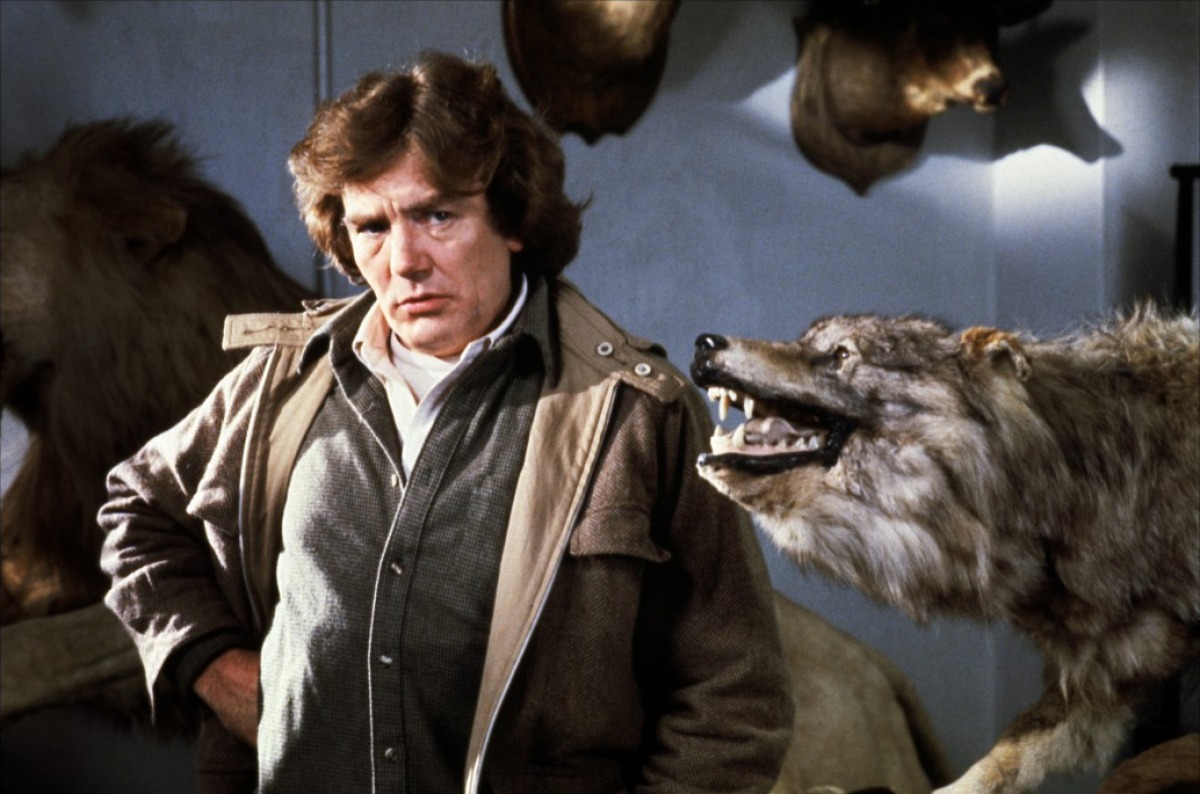
This is a mixture of gory horror, police procedural and social commentary.  While the different aspects of the film don't always hang together particularly well, it is a slick and often suspenseful monster movie.  Albert Finney is very good as the cynical rumpled detective for whom carnivorous wolf spirits are just one more story in the Naked City.  Diane Venora is good as the criminal psychologist who Wilson is partnered with, and there is good support from Gregory Hines, as Wilson's pathologist friend, Edward James Olmos, as a Native American activist, and Tom Noonan as a sinister wolf expert.  The film gets good milage out of the run-down inner city setting, and it has some really effective horror moments.  It uses a kind of electronic effect to depict the point of view of the Wolfen, which is slightly overused but effective, and also features a few too many fake scares where a character is startled only for them (and the audience) to realise that it's nothing.  The Wolfen themselves are kept mostly off screen only appearing fully towards the end of the film.  The explanation as to what the Wolfen actually are (a kind of Native American animal spirit) is muddled, particularly at the end.  While the Wolfen aren't strictly speaking werewolves, they are lycanthropic enough for the film to be lumped in with the other, better known, werewolf movies released at the time, namely The Howling (1981) and An American Werewolf in London (1981), both of which were more successful at the Box Office.  Despite its flaws, Wolfen is consistently suspenseful, and intriguing, the police procedural elements and the New York setting are effective, and the script has a welcome vein of cynical, hard-boiled humour.  The plot is intelligent, and while the different themes don't always hang together, the film deserves credit for trying to do something different with some well-worn tropes. 


Albert Finney and furry friend in Wolfen


Friday, 14 July 2023

The Dunwich Horror

 Year:  1970

Director:  Daniel Haller

Screenplay:  Curtis Hanson, Henry Rosenbaum and Ronald Silkosky, based on the short story The Dunwich Horror by H. P. Lovecraft

Starring:  Sandra Dee, Dean Stockwell, Ed Begley, Lloyd Bochner, Donna Baccala, Joanne Moore Jordan, Sam Jaffe

Running Time:  90 minutes

Genre:  Horror


At the Miskatonic University in Arkham, Massachusetts, student Nancy Wagner (Dee) becomes fascinated with the strange Wilbur Whateley (Stockwell) who is desperate to get his hands on the University's copy of a very rare and valuable book knows as the Necronomicon.  Nancy accepts Wilbur's invitation to spend some time at his mansion in the nearby small town of Dunwich.  At the mansion, Nancy is disturbed by Wilbur's grandfather (Jaffe).  It turns out that the Whateley's have a very bad reputation in the town.  Wilbur is obsessed with using the Necronomicon to bring back the "Old Ones" who used to rule the earth, and plans to sacrifice Nancy in an occult ritual.

American writer H. P. Lovecraft has been hugely influential in the fields of horror and science fiction.  In particular his brand of cosmic horror known as the "Cthulhu Mythos" which postulates that long ago, Earth was ruled by monstrous creatures known  as the "Old Ones" who, due to their evil ways, were banished to another dimension by the yet more powerful "Elder Gods".  The immortal Old Ones still exist and are eternally desperate to get back and reclaim their dominion over Earth.  They can be summoned by various rituals and incantations, which have thoughtfully been written down in various ancient grimoires, most famously the Necronomicon.  While Lovecraft has certainly been influential his work has proved challenging to filmmakers.  His conception of creatures that can drive to madness any human unfortunate enough to so much as look at them is difficult to render on film, even with CGI.  Lovecraft is also controversial due to his blatant racism and misogyny.  There have been successful Lovecraft adaptations, however, such as Re-Animator (1985), From Beyond (1986) and Color Out of Space (2019).  This film, from the stable of B-movie maestro Roger Corman, is enjoyable enough, but not one of the best.  Incidentally, Roger Corman previously directed one of the first Lovecraft adaptations, The Haunted Palace, which was officially part of Corman's series of eight films based on Edgar Allan Poe, but the plot is actually from the Lovecraft story The Case of Charles Dexter Ward.  Loosely based on the 1928 short story by Lovecraft, The Dunwich Horror does a decent enough job of putting Lovecraft onto the screen.  Although Sandra Dee never really seems particularly frightened by the goings-on around her; Dean Stockwell gives an intense, quiet performances as the wicked warlock, and is really the film's highlight.  Veteran actor Ed Begley, in one of his final roles, seems slightly embarrassed in his role as the heroic professor who races to save the day.  Talia Shire (here credited as Talia Coppola), who would go on to appear in The Godfather and Rocky series, appears in a small role as a nurse.  The film is full of bizarre psychedelic effects, which are lively if unintentionally funny, and frequent dream sequences, which just really seem shoehorned in to get some nudity into the film.  The film is watchable enough, and there is enough going on that it never really gets boring, however it is likely to disappoint Lovecraft fans and is probably not enough to convert non-fans.  


Dean Stockwell in The Dunwich Horror

Saturday, 8 July 2023

Nosferatu: A Symphony of Horror

 Year:  1922

Director:  F. W. Murnau

Screenplay:  Henrik Galeen, based on the novel Dracula by Bram Stoker

Starring:  Max Schreck, Gustav von Wangenheim, Greta Schröder, Alexander Granach, Ruth Landschoff, Wolfgang Heinz

Running Time:  84 minutes

Genre:  Horror

Wisborg, 1838:  Young clerk Hutter (von Wangenheim) is sent by his sinister boss, Knock (Granach), to a remote castle high in the Carpathian Mountains in Transylvania to negotiate the purchase of a house by the mysterious nobleman Count Orlok (Schreck).  Hutter soon discovers the horrific truth that Count Orlok is a blood-thirsty vampire or nosferatu.

This classic silent horror film is technically the first adaptation of Bram Stoker's famous novel Dracula.  However the adaptation was unauthorised and unofficial.  The filmmakers approached Stoker's widow, Florence Stoker, for the rights to adapt the film, but they decided that they couldn't afford the price she was asking, and so they just decided to go ahead anyway.  When Florence Stoker found out, she was furious, and sued the filmmakers, bankrupting the studio, with the court ordering all copies of the film to be destroyed.  However it had already been exported internationally and some prints resurfaced in France and the United States.  The film is one of the most influential horror films ever made.  While not as heavily stylised as the surreal dreamscape of The Cabinet of Dr. Caligari (1919), it is part of the German Expressionist movement, in which the character's inner worlds are reflected in the outer world.  Viewed today, it does suffer from overly melodramatic acting, as well as director F. W. Murnau's decision to use sped-up motion in scenes such as the carriage driving through the forest, and Orlok loading his coffins into a cart.  Murnau, apparently thought that sped-up motion was scary, but today it looks more comical than anything else, although at this point cinema was still very new and was still trying to find it's own language and style.   In fact some of Murnau's innovations work very well, for example the novel Dracula is told through diaries, journals, newspaper cuttings, and so on, and Murnau carefully designed the intertitles of the film himself to replicate the pages of old books and documents.  Despite being 100 years old, the film is still hugely effective, and is still one of the greatest vampire films ever made.  The vampire in Nosferatu is based on the traditional European folkloric vampire, as a hideous reanimated corpse rather than a suave lounge lizard in evening dress.  Max Schreck makes an indelible impression as Count Orlok, a cadaverous figure incased in black, his hands as grotesque talons, bat-like ears, bald, with a pinched face and sharp, rodent-like fangs.  The vampire is explicitly connected with disease, arriving in the town of Wisborg, accompanied by hordes of rats, and bringing the plague.  Schreck's portrayal was so convincing that there were rumours at the time that he really was a vampire.  The rumour inspired its own film Shadow of the Vampire (2000), a fictionalised version of the filming of Nosferatu starring John Malkovich and Willem Dafoe.  The film contains some unforgettable images, such as Orlok on the death ship; the shadow of the vampire creeping up the stairs towards his victim; and also the climax where the vampire is dissolved by the rays of the sun.  Possibly the film's biggest contribution to vampire lore is the idea of the vampire being destroyed by sunlight.  In Dracula, the vampire is weakened by sunlight, but it is not lethal.    Nosferatu was remade in 1979 as Nosferatu the Vampyr, written and directed by Werner Herzog, with Klaus Kinski as the vampire, and another remake is set for release in 2024.  Although originating as an unauthorised adaptation of a popular novel, Nosferatu has grown beyond its origins, casting an indelible shadow that lingers to this day.


Max Schreck as Count Orlok in Nosferatu: A Symphony of Horror
     

Wednesday, 26 April 2023

Evil Dead Rise

 Year:  2023

Director:  Lee Cronin

Screenplay:  Lee Cronin, based on characters created by Sam Raimi

Starring:  Lily Sullivan, Alyssa Sutherland, Morgan Davies, Gabrielle Echols, Nell Fisher

Running Time:  97 minutes

Genre:  Horror

Guitar technician Beth (Sullivan) goes to visit her sister Ellie (Sutherland), who is a single mother to teenagers Bridget (Echols) and Danny (Davies), and pre-teen Kassie (Fisher).  Following a minor earthquake, a hole opens up in the ground of the underground parking garage of Ellie's condemned apartment building.  Curious, Danny investigates and discovers an abandoned subterranean bank vault in which he finds three phonograph records from 1923 and a strange old book.  When Danny plays the phonograph records he discovers that they have been made by a strange priest, who has discovered one of  three surviving volumes of the Naturom Demonto, a book bound in human flesh and inked in blood, which has the power to resurrect evil demonic forces.  The priest thoughtfully recites these spells on the records, and the family soon find themselves assaulted by terrifying supernatural forces.

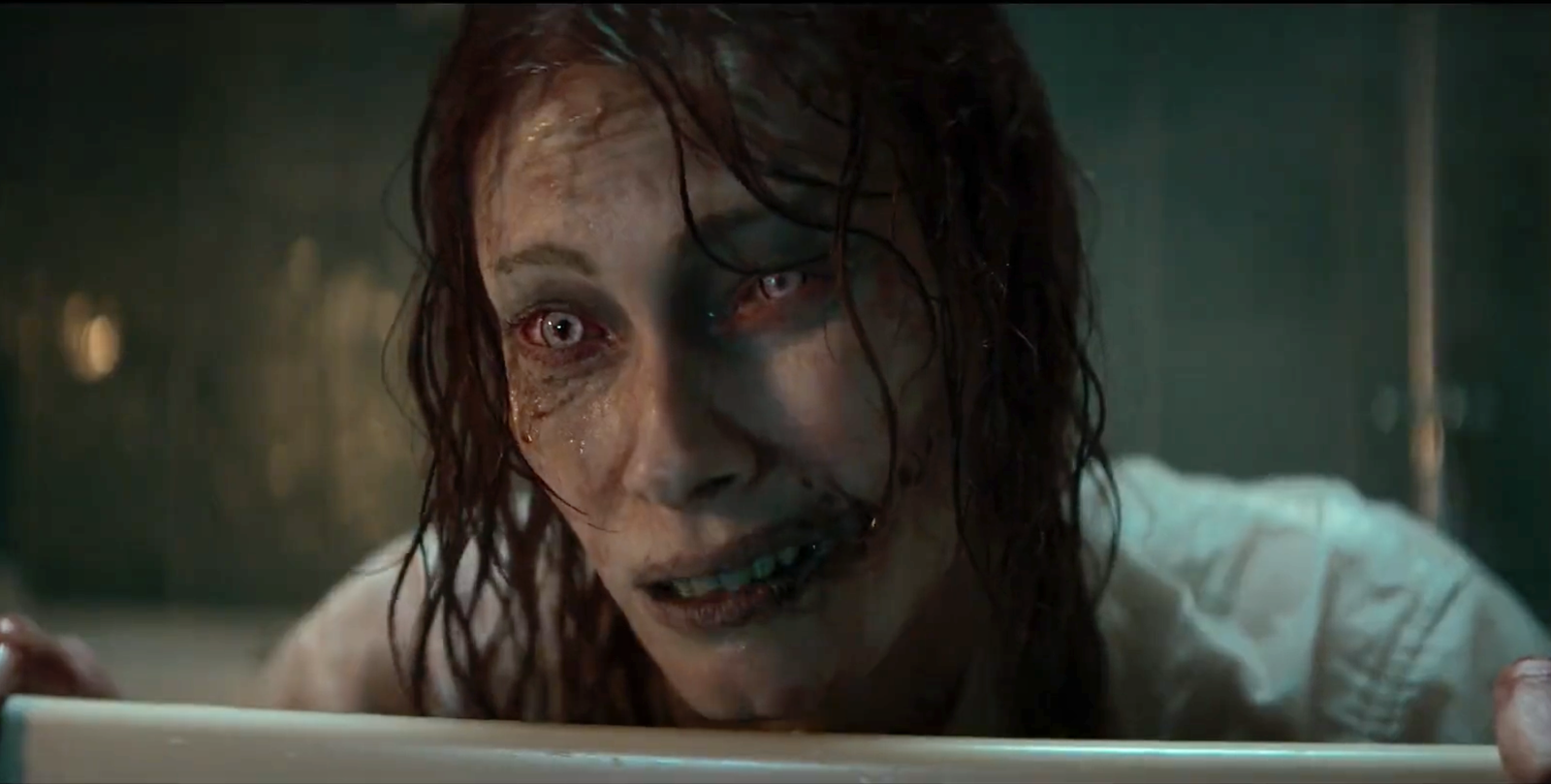
This is the fifth film in the Evil Dead franchise.  While Sam Raimi's original The Evil Dead (1981) was a fully fledged horror film, the sequel Evil Dead II (1987) was more of a comedy film influenced by Raimi's enthusiasm for the Three Stooges, and the third film in the series, Army of Darkness (1992), was pretty much a full on fantasy comedy with lead character Ash (Bruce Campbell) transported to the Middle Ages. In 2013 director Fede Álvarez released Evil Dead, a reboot of the series which returned it to its gruesome, horror original.  Evil Dead Rise continues this approach by being a full on horror film.  The blood doesn't so much flow here, as gush, pour, rain and flood.  It opens with a prologue, set in the familiar Evil Dead territory of a bucolic woodland, however the bulk of the film is set a day earlier in an unnamed rain soaked city.  The grim setting of a condemned, decaying, sparsely occupied apartment building works for the material.  It also takes it's time to set up the characters, particularly the tension between Ellie, a financially struggling tattoo artist, due to be evicted in a month, raising three children on her own, and her sister Beth, a freewheeling guitar technician, who is seen as the "cool aunt" by her nieces and nephews, but is frequently dismissed as a "groupie", a description which she angrily rejects.  It is Ellie who becomes possessed by the demonic forces, forcing Beth, who has just discovered that she is pregnant, to step into the maternal role and protect the children.  While there are some nods to the earlier Evil Dead films, this is a stand alone film, and can be watched even if you've ever seen any of the other films.  The performances are good, and the horror, when it comes in, is unrelenting.  It is graphically violent, in the best Grand Guignol tradition of splatter films, and will surely be a late night favourite for horror fans.


     Mother isn't quite herself today:  Alyssa Sutherland in Evil Dead Rise


Tuesday, 11 April 2023

Cold Light of Day

 Year:  1989

Director:  Fhiona Louise

Screenplay:  Fhiona Louise

Starring:  Bob Flag, Martin Byrne-Quinn, Geoffrey Greenhill, Mark Hawkins, Andrew Edmands, Claire King

Running Time:  81 minutes

Genre:  drama, true crime, horror


In a police interview room, unassuming middle-aged civil servant Jordan Marsh (Flag) is interrogated about a series of murders, which are depicted through a series of flashbacks.


True crime is a perennially popular genre in all kinds of media.  This film is based on the true story of serial killer Dennis Nilsen.  Sometimes dubbed "The British Jeffrey Dahmer", Nilsen murdered at least twelve young men and boys between December 1978 and January 1983.  His crimes were discovered in February 1983 when some human remains were found to be blocking drains in the building where Nilsen lived in an attic flat.  While this is not as good as the three part miniseries Des (2020) which starred David Tennant as Nilsen, this low-budget, low key drama is fairly effective in its own right.  Here Dennis Nilsen is called Jordan March and played by Bob Flag, who is probably best known as the face of Big Brother in 1984 (1984).  Saddled with a terrible wig, Flag gives a striking performance as the repellant Marsh, alternately arrogant, petulantly angry or cringing under his increasingly aggressive police interrogation.  Marsh however does have some moments of kindness, when he helps an elderly downstairs neighbour.  Written and directed by Fhiona Louise, who at the time was a 21 year old drama student, the film suffers from a very low budget, it's technically very crude, the performances are variable, sometimes the sound is hard to hear particularly under the loud soundtrack of pulsating breathing and tolling bells.  There are several flashbacks to Marsh's rural childhood and the death of his beloved grandfather (where his mother tells him that his grandfather is "just sleeping").  Even though it is short, the film seems to move at a snail's pace, and everything is bleak, depressing and grimy - which may be the best approach for a film about a serial killer.  There is stuff to admire here, but very little to really like.  


Bob Flag in Cold Light of Day


Saturday, 8 April 2023

Dracula

 Year:  1974

Director:  Dan Curtis

Screenplay:  Richard Matheson, from the novel Dracula by Bram Stoker

Starring:  Jack Palance, Simon Ward, Nigel Davenport, Pamela Brown, Fiona Lewis, Penelope Horner

Running Time:  100 minutes

Genre:  Horror

1897:  Solicitor Jonathan Harker (Murray Brown) is in Transylvania to visit mysterious nobleman Count Dracula (Palance), who plans to buy property in England.  However, Harker finds out too late, what his host's true motivations are.  In England, Arthur Holmwood (Ward) discovers that his fiancé Lucy (Lewis) is Dracula's latest victim, and it is up to him and Professor Van Helsing (Davenport) to stop the vampire for good.


The good count himself may not have proved to be immortal, but Bram Stoker's classic vampire novel has proved to be well nigh un-killable, with numerous adaptations in almost all forms of media.  Every Dracula fan has their favourite, and while this made-for-TV movie may not be one of the best, it is still a solid adaptation.  Producer and director Dan Curtis was familiar with horror having created the frankly bizarre supernatural daily soap opera Dark Shadows (1966-1971), as well as the TV movie The Night Stalker (1972) which was also scripted by Richard Matheson, and other adaptations of horror classics such as The Strange Case of Doctor Jekyll and Mister Hyde (1968) which also starred Jack Palance.  As scripted by horror writer Richard Matheson, this adaptation of Dracula remains faithful to Stoker's novel, albeit streamlining it a lot and cutting many supporting characters, including Dracula's bug-eating servant  Renfield.  Jack Palance, who was best known for playing heavies in gangster films and Westerns, may seem a strange choice for Dracula, but he does well, giving Dracula a Byronic menace, as well as a physicality often absent in other versions of the character.  The other performances are solid, and the film benefits from being filmed largely in England and Yugoslavia, despite being made for American TV.  While the film has its slow points, and there are times when the fairly low budget is obvious, it is a pretty impressive piece of work, and well worth checking out for horror fans.  The film's on-screen title is Bram Stoker's Dracula but, when Francis Ford Coppola was preparing his own film, also titled Bram Stoker's Dracula (1992), he bought the rights to the title in order to avoid comparisons, and the 1974 film is listed as either Dracula or Dan Curtis' Dracula.  There are a couple of other points of similarity between this and the 1992 film, in both Dracula is explicitly referred to as the historical Vlad Dracula (aka Vlad the Impaler) and in both versions Dracula hunts down the reincarnation of his lost love (Lucy in this film and Mina in the 1992 film).     


Jack Palance is Dracula

Sunday, 20 November 2022

The Hunger

 Year:  1983

Director: Tony Scott

Screenplay: Ivan Davis and Michael Thomas, based on the novel The Hunger by Whitley Strieber

Starring:  Catherine Deneuve, David Bowie, Susan Sarandon

Running Time:  97 minutes

Genre:  Horror

New York City, the 1980s:  Miriam Blaylock (Deneuve) is a vampire who has existed since at least Ancient Egypt, her first encountered her current partner, John (Bowie) in the 18th Century, when he became the latest in a long line of lovers.  However, while Miriam doesn't age, all of her lovers, however, while their ageing process is delayed, they do eventually begin to age very suddenly and at a highly accelerated rate, leaving behind dried out husks.  However, they do not die, but Miriam, who refuses to kill them, condemns them to a kind of living death, locking them up forever in coffin-life boxes.  This time, however, Miriam and John set their sights on research scientist Dr. Sarah Roberts (Sarandon), who is engaged on research to delay ageing.  However, the question is whether she will be able to save John, or if she will become Miriam's latest companion. 

The Hunger is a stylish, sensual vampire film, based on the novel by horror writer Whitley Strieber, who is probably best known for his book Communion (1987) which describes his allegedly true encounters with aliens.  While this is a vampire film, the word "vampire" is never mentioned in the film, and the vampires are different to the more commonly depicted bloodsuckers: John and Miriam feed off blood, but instead of biting their victim's necks with fangs, they cut the throats with daggers hidden in the ankh pendants that they both wear.  They can also survive in sunlight, and their main power is that they are stronger and harder to kill than humans, and also that their ageing is stopped or at least delayed.  This is the debut film from Tony Scott, brother of director Ridley, who went on to direct stylish action films and thrillers such as Top Gun (1986), True Romance (1993) and Man on Fire (2004).  The film feels very much a product of its time, with the stylish visuals, and the film is stylised to a fault.  Characters are often filmed backlit, so they appear as silhouettes, there are constantly billowing, diaphanous curtains and drapes, there are doves flying throughout John and Miriam's cavernous New York town house (full, of course, with antiques), there is slow motion, fragmented editing, and most of the interiors are filmed in half shadow, with shafts of light illuminating the characters.  The problem is that the film is so stylised, it never really gets scary, and despite the amount of sex and blood, there is very little actual passion, it feels like everything comes second place to the visuals.  Before making The Hunger, Tony Scott had been interested in making a film of the Anne Rice novel Interview with the Vampire, and the film does have something of an Anne Rice feel to it, with it's focus on the loneliness of immortality and the angst of becoming a predatory vampire.  Even the hospitals and research laboratories seem to favour mood lighting.  Catherine Deneuve is impressive as statuesque, bisexual vampire Miriam, David Bowie is effective as the increasingly desperate John, acting under layers of increasingly heavy make-up, and Susan Sarandon is good as the scientist Sarah, who becomes drawn into the Blaylock's world.  Willem Dafoe makes a brief, early appearance as one of a pair of teenage thugs who harasses Sarah at a phone booth.  The film had mixed reviews at the time of its release, however it has become a cult film, particularly among Goths.  The song "Bela Lugosi's Dead" by the band Bauhaus, which is sometimes cited as the first goth rock record, plays over the opening credits, and Bauhaus appear as a band in a night club.


David Bowie and Catherine Deneuve in The Hunger
  

Friday, 18 November 2022

Barbarian

 Year:  2022

Director:  Zach Cregger

Screenplay:  Zach Cregger

Starring:  Georgina Campbell, Bill Skarsgård, Justin Long

Running Time:  107 minutes

Genre:  Horror


In town for a job interview, Tess Marshall (Campbell) arrives at a rental house she has booked in a run down area of Detroit.  However, when she arrives, she discovers that the house has been double-booked and that there is already a man staying there, Keith (Skarsgård).  Despite the initial awkwardness, Tess decides that she trusts Keith enough to spend the night in the house.  However, when Tess discovers a secret passageway in the basement, it becomes clear that they are not alone on the house.

Barbarian is a film that seems to be going one way, before veering off sharply into other directions.   It takes time to build up, allowing the audience to spend time with the characters, before the horror kicks in, and when it does, it does so with some of the most surprisingly gruesome images seen in mainstream cinema for a long time.  The film boasts some fine performances from Georgina Campbell, Bill Skarsgård and Justin Long, as a charismatic actor who becomes embroiled in a sex scandal.  There is also a strong message about the threat men pose towards women.  The nervous interplay between the suspicious Tess and the friendly Keith, who can't understand why, if their places were reversed, she wouldn't have let him in out of the rain.  As well as AJ, the actor played by Justin Long, who after being accused of assault by a fellow actor, doesn't see what he did wrong, in his words "she just took some convincing".  Being played by a likeable actor such as Long, makes the character all the more disturbing.  The film also doesn't skimp on exciting horror thrills, making this one of the best new horror films I have seen this year.


Georgina Campbell in Barbarian

Censor

 Year:  2021

Director:  Prano Bailey-Bond

Screenplay:  Prano Bailey-Bond and Anthony Fletcher

Starring:  Niamh Algar, Nicholas Burns, Vincent Franklin, Sophia La Porta, Adrian Schiller, Michael Smiley

Running Time:  84 minutes

Genre:  Horror


Britain, the 1980s:  The country is in the midst of a moral panic over so-called "Video Nasties".  Enid Baines (Algar) is a film censor who takes a hard line on cutting or banning violent films.  One day Enid is assigned to classify a horror film called Don't Go in the Church which brings up distressing memories of her sister's unexplained disappearance when they were both children.  Enid becomes convinced that one of the actors in the film is her sister, and as she investigates finds the line between reality and on-screen illusion dangerously blurring.


In the late 1970s and early 1980s home video took off in Britain in a very big way, partly due to the amount of people who were being laid off from their jobs at the time, finding themselves with redundancy money and an unexpected amount of time to fill.  All the films shown in cinemas had to be classified by the British Board of Film Censors (latterly the British Board of Film Classification), but video was exempt from that, and so a lot of films that had either been cut, banned outright, or had never even been submitted to the BBFC were released uncut to buy or rent on video, often with lurid covers.  Before long, the Conservative government, right-wing media and other self-appointed moral guardians whipped up a furore over what they called "Video Nasties" resulting in notoriously strict censorship in Britain.  This is the context in which Censor takes place.  It is an effective, quietly disturbing horror film, set mostly in dull, half-lit offices and homes, with characters dressed in beige and cheap suits.  it also captures the look of the cheap horror films that were often deemed "video nasties".  Niamh Algar gives a powerful performance as Enid, who views her job as censor as a moral mission to "protect" people.  She has few if any friends, and Algar does very well with a mostly silent performance, particularly as her stern detachment starts to crack.  Prano Bailey-Bond directs with real style, although the film leaves us with more questions than answers, the ambiguous conclusion refusing to tie up the loose ends, a choice which may be tantalising to some viewers, while frustrating to others.     


Niamh Algar in Censor

Monday, 31 October 2022

Suspiria

Year:  1977

Director:  Dario Argento

Screenplay:  Dario Argento and Daria Nicolodi

Starring:  Jessica Harper, Stefania Casini, Flavio Bucci, Miguel Bosé, Barbara Magnolfi, Susanna Javicoli, Eva Axén, Alida Valli, Joan Bennett

Running Time:  99 minutes

Genre:  Horror


American ballet student Suzy Bannion (Harper) arrives at a prestigious German dance school, Tanz Akademie.  On the night she arrives, a fellow student is brutally murdered.  As Suzy settles in to the strange academy, a series of bizarre and disturbing events occur, leading her to the conclusion that the school is a front for a murderous coven of witches.

"Bad luck is not brought on by broken mirrors, but by broken minds."

Italian director Dario Argento is arguably the most influential Italian horror filmmaker.  Starting out as a film critic, and then working as a screenwriter, including working with Sergio Leone and Bernardo Bertolucci on the script for Once upon a Time in the West (1969), before making his name as a director with a series of influential giallo films (a popular mix of horror and thriller, which were forerunners of the American "slasher" films).  Suspiria, co-written with Daria Nicolodi, with whom Argento was in a romantic relationship at the time, and who had previously starred in Argento's film Deep Red (1975), marked Argento's first foray into supernatural horror.  The film was partly inspired by Thomas De Quincey's 1845 essay Suspiria de Profundis, and marked the first of a trilogy known as the "Three Mothers Trilogy" continuing with Inferno (1980) and concluding with Mother of Tears (2007).  While this is Argento's first foray into fantasy, it still has elements of his giallo work: a black-gloved killer, elaborate and gruesome death scenes, and the plot point of the lead character hearing or witnessing an important clue early in the film, which she only remembers or understands the full significance of towards the end.  Right form the start the film opens with deafening, genuinely disturbing music from rock band Goblin, which mixes atonal rock, a kind of nightmare lullaby, and distorted human voices (including Argento himself) shrieking "Witch!"  The film itself doesn't appear to take place in any recognisable real world, with lurid colours, skewed angles, sudden cuts, a swooping, mobile camera, even something as simple as an airport's automatic door opening seems loaded with dread.  The interior of the academy itself with brightly coloured rooms, in which everything seems slightly hostile and alien, becomes like another character in the film.  The dialogue has the strange stilted delivery common in many Argento films,  due in part to the fact that the dialogue was dubbed after filming, which was common practice in Italian film at the time, but that accentuates the oddness of the thing, and makes the film more alien.  Pale, wide-eyed Jessica Harper walks through the whole film like she is in a nightmare.  Argento has never really had much interest in the niceties of logic and plot, and this is one of the times where this approach really works for the material,  It is like a nightmare and so follows a strange kind of dream logic, and so it is Argento's finest work.


Jessica Harper in Suspiria

Saturday, 29 October 2022

Phenomena

 Year:  1985

Director:  Dario Argento

Screenplay:  Franco Ferrini and Dario Argento

Starring:  Jennifer Connelly, Daria Nicolodi, Dalila Di Lazzaro, Donald Pleasence, Patrick Bauchau

Running Time:  116 minutes

Genre:  Horror


American teenager Jennifer Corvino (Connelly) arrives at an exclusive Swiss boarding school and soon discovers that the nearby area is being plagued by a vicious serial killer.  Jennifer, it turns out, has the ability to psychically communicate with any kind of insect, and teams up with elderly, wheelchair-bound Scottish entomologist John McGregor (Pleasance), and his intelligent chimpanzee, to track down the killer.


Dario Argento is generally regarded as one of the greatest Italian horror filmmakers.  Despite featuring a lot of Argento hallmarks, Phenomena is far from his best work.  It feels like a mix of the giallo films that Argento made his name with (black-gloved killer stalking young women, point of view shots, the main character witnessing an important detail early one which she is afterwards unable to remember, inept police investigation, and an  overly convoluted final reveal), with dark adult fairy tale (Jennifer's mystical powers, surreal nightmare imagery) and gothic romance (Jennifer Connelly spends a lot of her time running through a dark forest at night in a billowing white nightgown, as might be seen on the covers of numerous '70s paperback originals).  While it doesn't seem to be intentionally funny, the film is so ridiculous it's hard not to laugh at Jennifer's psychic bond with bugs (including teaming up with a fly to find evidence), Donald Pleasence's Scottish accent and the heroic chimp.  The performances are pretty bad, even from normally very good actors such as Jennifer Connelly and Donald Pleasence, who seems to be playing the whole thing for comedy.  Argento's skill at creating arresting images generates some interest, but there are very few of the trademark elaborate set-pieces that Argento can be so skilled at.  While the film is gruesome, gore fans may be disappointed at the comparative lack of bloodshed on display.  The score, from regular Argento collaborators Goblin, mixes lilting fairy-tale style music with sudden bursts of loud heavy metal, along with music from Bill Wyman, Iron Maiden and Motörhead among others.  The plot makes absolutely no sense at all.  It's fun if your in the right frame of mind for it, and the climax is so over the top it's quite entertaining.  On it's original release in the US and the UK the film was retitled Creepers with 20 minutes of footage cut.


Jennifer Connelly in Phenomena


Thursday, 20 October 2022

Halloween Ends

 Year: 2022

Director:  David Gordon Green

Screenplay:  Paul Brad Logan, Chris Bernier, Danny McBride and David Gordon Green, based on characters created by John Carpenter and Debra Hill

Starring:  Jamie Lee Curtis, Andi Matichak, Rohan Campbell, Will Patton, Kyle Richards, James Jude Courtney

Running Time:  111 minutes

Genre:  Horror


Four years have passed since serial killer Michael Myers' (Courtney) latest bloodbath, and the residents of the small town of Haddonfield are starting to heal.  Corey Cunningham (Campbell) who accidentally caused the death of a young boy he was babysitting, has since become the town pariah.  Allyson (Matichak), whose parents were killed by Myers and has since been living with her grandmother Laurie Strode (Curtis), befriends Corey.  After being savagely beaten up and left for dead by some bullies, Corey encounters but survives a weakened Michael Myers, and takes it upon himself to continue Michael's murderous legacy.


Halloween Ends is the thirteenth film in the Halloween franchise, and the third and final instalment in the trilogy directed by David Gordon Green which began with Halloween (2018) and continued with Halloween Kills (2021).  The Green series carries on from the original Halloween (1978), discarding the previous umpteen sequels, and Halloween Ends is supposed to be the final Halloween films, although I, for one, very much doubt that it will be.  Halloween Ends is a disappointing entry in the series.  While it does have some very good things in it.  It feels as if the film was intended to be a serious examination of trauma, grief and guilt, but they needed to add Halloween horror elements to make it fit into the series.  The stalk-and-slash horror elements doesn't fit with the more serious and darker aspects.  Another thing is that Michael Myers barely appears in the film.  The main antagonist is Corey who kind of becomes a Michael Myers protege, and he even seems to have Myers' ability to appear and disappear suddenly, as well as surprising strength.  Corey even gets his glasses broken  early in the film and seems to manage without them with no problem whatsoever and nary a stumble.  The performances are good, particularly from Jamie Lee Curtis, and there are some enjoyable set pieces, but the whole film is not scary and, worst of all, is kind of dull.


Jamie Lee Curtis and James Jude Courtney in Halloween Ends

The Wolf House

 Year:  2018

Directors:  Cristobal León and Joaquín Cociña

Screenplay:  Cristobal León, Joaquín Cociña and Alejandra Moffat

Starring (voices):  Amalia Kassai, Rainer Krause

Running Time:  75 minutes

Genre:  Animation, horror, fantasy


Maria, a young girl in an isolated German commune in Chile, escapes into the forest where she finds a strange house.  Inside the house she discovers two pigs who slowly become human, and she raises them as her children.  Meanwhile the house itself seems to change to reflect Maria's emotional state.


This Chilean film is a strange stop-motion animation, which has it's inspirations in fairy tales, urban legends and the real-life Colonial Dignidad cult.  The film opens with a brief live action introduction, presenting the film as a production made by the cult to introduce it to new or potential recruits.  The Wolf House is the first feature length project by animators Cristobal León and Joaquín Cociña, who had previously made some well-received short films, including a music video for the rock band The Smile, an off-shoot of Radiohead.  The film is genuinely surreal and deeply disturbing.  It feels genuinely nightmarish and has something of the feel of legendary Czech animator Jan Švankmajer.  However, it is very much it's own thing, and is definitely recommended to horror and fantasy fans.


The Wolf House

Sunday, 16 October 2022

Shock

Year:  1977

Director:  Mario Bava

Screenplay:  Lamberto Bava, Francesco Barbieri, Alessandro Parenzo, Dardano Sacchetti

Starring:  Daria Nicolodi, John Steiner, David Colin Jr., Ivan Rassimov

Running Time:  95 minutes

Genre:  Horror

Dora (Nicolodi) moves back into the house where she lived with her husband who died in an apparent suicide several years before.  Dora is now remarried to Carlo (Steiner), an airline pilot, and she has a young son, Marco (Colin Jr.), from her previous marriage.  The family begin renovating the house, but Marco begins to exhibit increasingly disturbing behaviour, and as strange happenings begin to pile up Dora becomes convinced that they are being haunted by the malevolent spirit of her dead husband.

Mario Bava was one of the most important directors of Italian horror films, with his low-budget, but stylish films influencing filmmakers such as Martin Scorsese, Quentin Tarantino, Tim Burton,  and Francis Ford Coppola.  Shock was the last feature film that Bava completed before his death of a heart attack in April 1980, and his son Lamberto Bava, who co-wrote the film, served as an uncredited co-director for some scenes.  In Shock, Bava largely leaves behind the gruesome Grand Guignol excesses that had been his trademark for a slow-burning tale of supernatural horror, with gore largely absent until the final quarter of an hour.  While this is not Bava's best film, it does have a lot to recommend it.  The direction is stylish, and there are some arresting images.  Daria Nicolodi, who would become a familiar face to Italian horror fans through her appearances in five films by her then husband Dario Argento, gives a strong performance in the central role, and she pretty much dominates the film.  David Colin Jr. is fine, if not particularly impressive, in his role as the creepy child, who may, or may not, be possessed by the vengeful ghost.  There are plot holes, and the whole thing is very silly at times, and there are places where the low budget is painfully obvious, and some fans may be disappointed at the relative lack of gore, but it is a fun little spook show, which should entertain lovers of ghost stories.


Daria Nicolodi in Shock

Wednesday, 12 October 2022

Christine

Year:  1983

Director:  John Carpenter

Screenplay:  Bill Phillips, based on the novel Christine by Stephen King

Starring:  Keith Gordon, John Stockwell, Alexandra Paul, Robert Prosky, Harry Dean Stanton, Roberts Blossom

Running Time:  110 minutes

Genre:  Horror


1978:  Arnie Cunningham (Gordon), a nerdy, unpopular teenager, spots a broken down, derelict 1958 Plymouth Fury for sale.  Despite the protestations of his best friend, Dennis (Stockwell), Arnie buys the car from a sinister old man, George LeBay (Blossoms), whose deceased brother was the original owner of the Plymouth and named it "Christine".  Arnie sets to work restoring the car at a local do-it-yourself garage, and begins to exhibit strange and disturbing personality changes.  When Arnie starts dating the popular new girl in school, Leigh (Paul), Christine begins to manifest a jealous, murderous personality of her own.

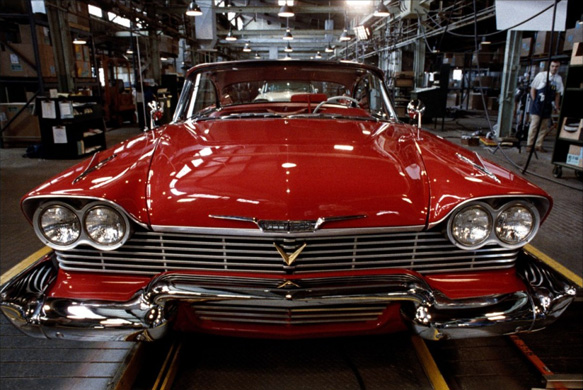
Producer Richard Kobritz snapped up the film rights to Stephen Kings 1983 novel Christine before it was even published, and it certainly looks like a sure fire winner on paper:  King, one of the world's most popular novelists; teenagers; cars; horror and rock 'n'roll.  Director John Carpenter, who had made the seminal horror film Halloween (1978), was attached to direct.  However Carpenter's previous film, The Thing (1982), had been staged by critics and was a commercial flop (even though it is now seen as one of the best films of it's type ever made), and he was not interested in Christine, commenting that he felt the book "was not very scary" but felt that he needed to do the film to help his career.  Certainly the film is a surprisingly bland, workmanlike affair.  In the novel, the car is possessed by the evil spirit of it's former owner, which begins to channel itself to Arnie, however the film opens with a short prologue set in the Detroit production line in 1957 where Christine manifests her hostile personality before she even rolls off the assembly line.  It's never explained in the film why the car has a mind of it's own.  Some of the performances are fairly bland, and some of the high school "teenagers" look as if they are well into their 30s.  In the novel much of the horror comes from Arnie's transformation, as he becomes increasingly paranoid, arrogant and angry, which would probably strike a chord with parents of teenagers, but the film centres the car.  However there are moments when the film works really well.  After Christine is trashed by Arnie's high school bullies, she resurrects herself in a hugely impressive sequence, which is one of the film's biggest set pieces, and when Christine is tracking down and murdering the bullies is really where John Carpenter comes into his own, particularly the scene where the car is on fire chasing after the leader of the gang (William Ostrander).  Roberts Blossom, who became known to horror fans for his lead in the cult film Deranged (1974) and is probably most familiar for his role in Home Alone (1990), is very good in a small role as the dirty, bleary-eyed George LeBay, and Robert Prosky is great as the bad-tempered, raspy-voiced, cigar chewing Darnell, owner of the garage where Arnie keeps Christine.  Harry Dean Stanton is wasted in a small role as the police detective who investigates the mysterious number of deaths surrounding Arnie and his car.  Kelly Preston appears in a small role as Dennis' cheerleader girlfriend.  Keith Gordon is good in the lead, but John Stockwell and Alexandra Paul give quite bland performances.  Also the red and white Plymouth herself, is an impressive looking vehicle, which manages to be genuinely sinister.  In the novel, Stephen King uses the lyrics of rock 'n' roll songs throughout, in the film the 1950s song playing on the car radio serve as Christine's language.  In the prologue she rolls off the production line, warning the world that she is "Bad to the Bone".  When she is alone with Arnie she plays "Pledging My Love" and "We Belong Together", and when she locks her doors to prevent Arnie rescuing a chocking Leigh in the front seat, she plays "Keep A-Knockin'".  While there is nothing particularly unmissable, there is certainly enough here to make recommend the film to horror fans.


Bad to the Bone: Christine

Wednesday, 5 October 2022

Scream 3

Year:  2000

Director:  Wes Craven

Screenplay:  Ehren Krueger, based on characters created by Kevin Williamson

Starring:  Neve Campbell, David Arquette, Courteney Cox Arquette, Patrick Dempsey, Jenny McCarthy, Parker Posey, Deon Richmond, Emily Mortimer, Scott Foley, Lance Henriksen

Running Time:  117 minutes

Genre:  Comedy, horror

Sidney Prescott (Campbell) is now living in self-imposed seclusion after surviving the killing sprees in her home town of Woodsboro and Windsor College.  Until, that is a new killer, once again wearing a Ghostface mask, starts picking off the cast of new horror movie Stab 3, based on Sidney's story.  Sidney has to travel to Hollywood and reunite with fellow survivors tabloid TV news journalist Gale Weathers (Cox Arquette) and former small town cop turned security guard Dewey Riley (Arquette) to uncover the new killer.

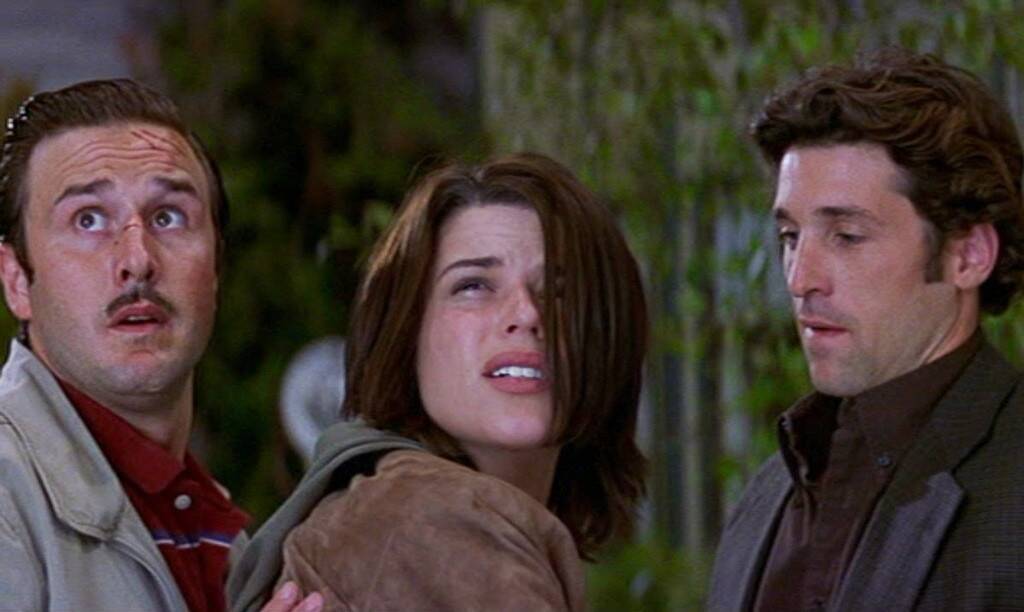
The original Scream (1996) was a true game changer in the horror field, which really revitalised the slasher film genre, at a time when it seemed to have had it's day.  Scream 2 (1997), while not as good as the original, was still a strong sequel.  However, Scream 3 was the point where the franchise dipped.  Kevin Williamson, who wrote the first two films, bowed out of screenwriting duties to be replaced by Ehren Kruger, and Williamson's distinctive voice is certainly missed here.  Wes Craven returns as the film's director and once again stages some impressive action scenes, most notably a scene where Sidney is chased by the killer through a studio mockup of Woodsboro.  Due to concerns over the portrayal of violence in media following the 1999 Columbine Massacre, the level of violence is heavily toned down from the previous films, and the film leans more towards comedy than horror.  Neve Campbell, David Arquette and Courteney Cox Arquette are as engaging as ever, even if Courteney Cox Arquette (who was married to co-star David Arquette at the time) is saddled with a a truly dreadful hairstyle.  Also in the cast is genre veteran Lance Henriksen, popular model-turned-actress Jenny McCarthy, indie film veteran Parker Posey and an early role for Emily Mortimer.  The film also features cameos from legendary B-movie producer Roger Corman, Kevin Smith and Jason Mewes as Jay and Silent Bob, and in the film's funniest moments Carrie Fisher as a washed-up actress working in the studio archives, still bitter over the fact that the role of Princess Leia went to "the one that slept with George Lucas".  Another fun element is Parker Posey as the actress playing Gale Weathers teaming up with Courteney Cox Arquette as the real Gale Weathers, in order to get into character.  The film is not as funny or suspenseful as the previous films, but the Hollywood setting adds an interesting element, and the final act of the film does work, even if it feels more like a cross between Agatha Christie and film noir than a Scream film.  There is also a character who is a creepy movie producer who preys on young actresses and delivers the line "there are plenty of criminals in this town whose careers are flourishing", which has an added resonance in the post-Weinstein world.  Ironically, Harvey Weinstein was one of the film's executive producers.


David Arquette, Neve Campbell and Patrick Dempsey in Scream 3