Showing posts with label David Bowie. Show all posts

Sunday, 20 November 2022

The Hunger

 Year:  1983

Director: Tony Scott

Screenplay: Ivan Davis and Michael Thomas, based on the novel The Hunger by Whitley Strieber

Starring:  Catherine Deneuve, David Bowie, Susan Sarandon

Running Time:  97 minutes

Genre:  Horror

New York City, the 1980s:  Miriam Blaylock (Deneuve) is a vampire who has existed since at least Ancient Egypt, her first encountered her current partner, John (Bowie) in the 18th Century, when he became the latest in a long line of lovers.  However, while Miriam doesn't age, all of her lovers, however, while their ageing process is delayed, they do eventually begin to age very suddenly and at a highly accelerated rate, leaving behind dried out husks.  However, they do not die, but Miriam, who refuses to kill them, condemns them to a kind of living death, locking them up forever in coffin-life boxes.  This time, however, Miriam and John set their sights on research scientist Dr. Sarah Roberts (Sarandon), who is engaged on research to delay ageing.  However, the question is whether she will be able to save John, or if she will become Miriam's latest companion. 

The Hunger is a stylish, sensual vampire film, based on the novel by horror writer Whitley Strieber, who is probably best known for his book Communion (1987) which describes his allegedly true encounters with aliens.  While this is a vampire film, the word "vampire" is never mentioned in the film, and the vampires are different to the more commonly depicted bloodsuckers: John and Miriam feed off blood, but instead of biting their victim's necks with fangs, they cut the throats with daggers hidden in the ankh pendants that they both wear.  They can also survive in sunlight, and their main power is that they are stronger and harder to kill than humans, and also that their ageing is stopped or at least delayed.  This is the debut film from Tony Scott, brother of director Ridley, who went on to direct stylish action films and thrillers such as Top Gun (1986), True Romance (1993) and Man on Fire (2004).  The film feels very much a product of its time, with the stylish visuals, and the film is stylised to a fault.  Characters are often filmed backlit, so they appear as silhouettes, there are constantly billowing, diaphanous curtains and drapes, there are doves flying throughout John and Miriam's cavernous New York town house (full, of course, with antiques), there is slow motion, fragmented editing, and most of the interiors are filmed in half shadow, with shafts of light illuminating the characters.  The problem is that the film is so stylised, it never really gets scary, and despite the amount of sex and blood, there is very little actual passion, it feels like everything comes second place to the visuals.  Before making The Hunger, Tony Scott had been interested in making a film of the Anne Rice novel Interview with the Vampire, and the film does have something of an Anne Rice feel to it, with it's focus on the loneliness of immortality and the angst of becoming a predatory vampire.  Even the hospitals and research laboratories seem to favour mood lighting.  Catherine Deneuve is impressive as statuesque, bisexual vampire Miriam, David Bowie is effective as the increasingly desperate John, acting under layers of increasingly heavy make-up, and Susan Sarandon is good as the scientist Sarah, who becomes drawn into the Blaylock's world.  Willem Dafoe makes a brief, early appearance as one of a pair of teenage thugs who harasses Sarah at a phone booth.  The film had mixed reviews at the time of its release, however it has become a cult film, particularly among Goths.  The song "Bela Lugosi's Dead" by the band Bauhaus, which is sometimes cited as the first goth rock record, plays over the opening credits, and Bauhaus appear as a band in a night club.


David Bowie and Catherine Deneuve in The Hunger
  

Tuesday, 1 February 2022

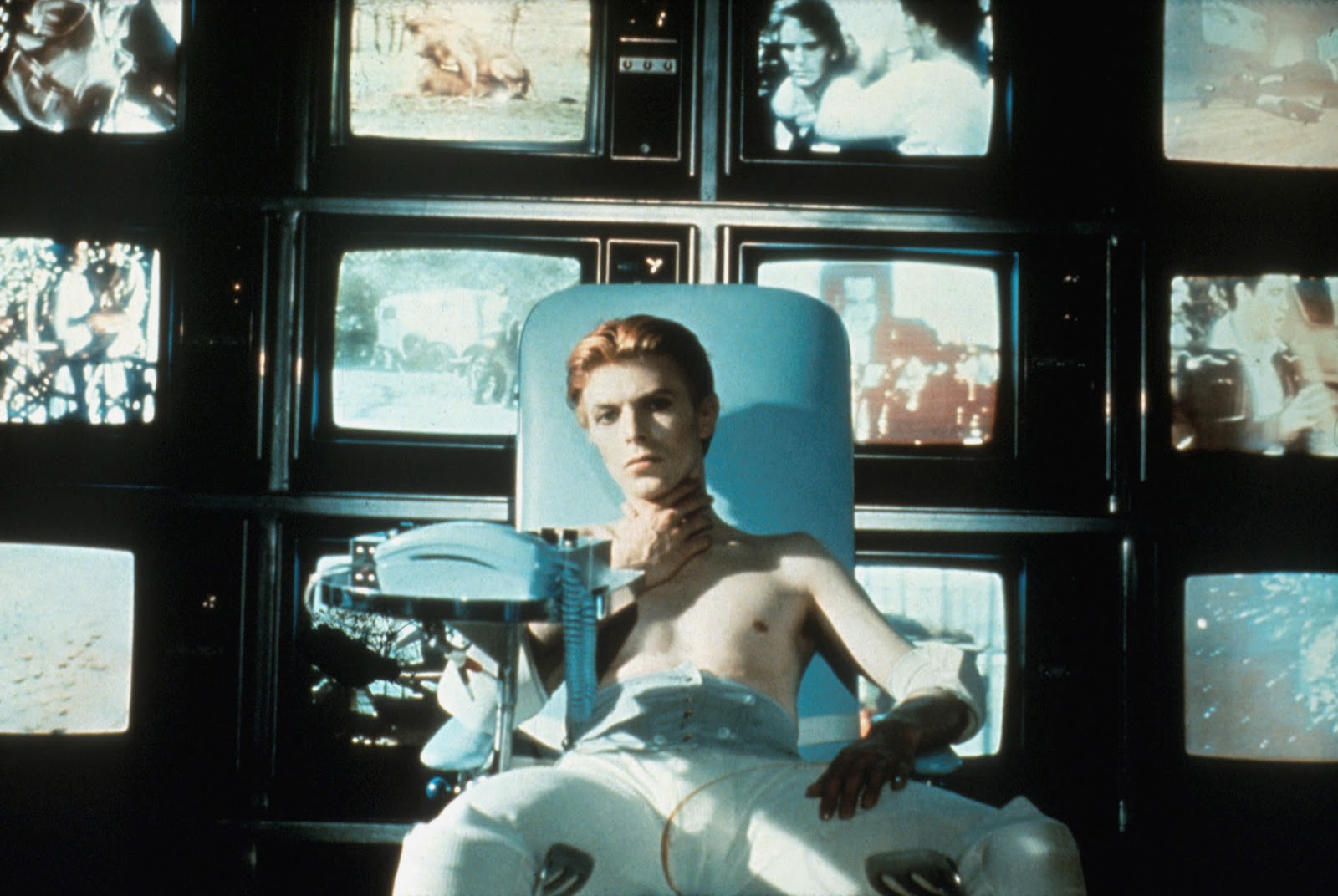
The Man Who Fell to Earth

Year:  1976

Director:  Nicolas Roeg

Screenplay:  Paul Mayersberg, based on the novel The Man Who Fell to Earth by Walter Tevis

Starring:  David Bowie, Rip Torn, Candy Clark, Buck Henry, Bernie Casey

Running Time:  139 minutes

Genre:  Science-fiction


A strange man, Thomas Jerome Newton (Bowie), stumbles into a small New Mexico town.  Within a few years he is the multi-millionaire head of World Enterprises Corporation, a company which sells innovative technological products.  However, Thomas Newton is not what he appears.  In reality he is a humanoid alien sent to Earth from a dying planet to bring back much-needed water supplies for his homeworld.  He has been using his advanced alien technology in his company's products, and plans to use the money that he is making to finance the construction of a spaceship to ship the water to his planet.  However, during his time on earth he begins to fall victim to human vices such as alcohol, sex, television and corporate greed.

This film was David Bowie's first leading role, and at the time he was at the height of his "Thin White Duke" phase.  He gives an astonishing performance, and is utterly convincing as an alien, according to Bowie he was in such a fragile state at the time that didn't need to act in the role at all, he just learned his lines for the day and acted naturally.  Rip Torn plays a creepy professor who finds the mystery of Newton and his corporation even more interesting than chasing after his female students; Buck Henry plays a patent lawyer who becomes Newton's confidante and right hand man; and Bernie Casey plays the ruthless owner of a rival company.  They all give good performances, but Candy Clark is very good as the naive hotel chambermaid who falls in love with Newton and both becoming the other's nemesis.  Based on the novel by American author Walter Tevis (who also wrote The Hustler and it's sequel The Color of Money which were both made into successful films, and The Queen's Gambit which became a miniseries on Netflix), the film was directed by British director Nicolas Roeg, who was coming off the success of the horror film Don't Look Now (1973).  Roeg was known for his innovative style, combining surreal, poetic imagery with a jagged stream-of-consciousness style of editing.  Despite a fairly conventional alien innocent on Earth storyline, The Man Who Fell to Earth is a very unconventional science-fiction film.  For one thing, there is very little traditional science-fiction imagery in the film, aside from several brief sequences where Newton remembers his homeworld.  Despite being set entirely in America, it is a British film made with an almost entirely British crew, which may help explain how the film makes America look like the alien planet, it's one of the great outsider's views of America.  The film is long, slow, and the style makes it at times difficult to follow, but it is mesmerising.  At times it is funny and it is powerful, while the technology and values on display (such as Rip Torn's professor sleeping around with students) date the film as a product of the seventies, it is still a pertinent comment on the modern world, which may be more pertinent now than in 1976.  The film is visually striking, powerful and memorable, and remains one of the highpoint of David Bowie's career and of 1970s science-fiction cinema.


David Bowie is The Man Who Fell to Earth
 

Saturday, 1 October 2016

The Man Who Fell to Earth

Year of Release:  1976
Director:   Nicolas Roeg
Screenplay:  Paul Mayersberg, based on the novel The Man Who Fell to Earth by Walter Tevis
Starring:  David Bowie, Rip Torn, Candy Clark, Buck Henry, Bernie Casey
Running Time:  138 minutes
Genre:  science-fiction, satire

A mysterious man, Thomas Jerome Newton (Bowie), comes out of nowhere an sets up a hugely successful electronics conglomerate, World Enterprises, using revolutionary technology.  In reality, Newton is a humanoid alien in disguise, who plans to use the profits he earns through his company, which he has set up with patents on his advanced alien technology, and the inventions he has developed with it, to construct a huge spaceship to ship water back to his home planet which is dying due to severe drought.  Newton does indeed become fabulously wealthy, however he soon becomes corrupted by human vices such as alcohol, television, sex and money.

This fascinating film is a science-fiction movie like no other.  It's long, frustrating, fascinating, beguiling, pretentious, funny, dark and wonderful  by turns.  It also works as a satire on modern American life.  The imagery, which is heavy on symbolism, is largely taken from outside the science-fiction genre.  This was David Bowie's debut feature film and it is the role he was born to play.  With his quiet performance as the pale, emaciated alien everything about him is otherworldly, even before he reveals his true appearance (hairless, with yellow cat's-eyes and no genitals).  Candy Clark also impresses as sweet, lonely hotel maid Mary-Lou, who falls for Newton.  As with many Nicolas Roeg films, this is full of rich, striking often surreal images and a barrage of cinematic tricks, although it's a lot more linear than many of his other works of the period.  The several brief flashback scenes to Newton's homeworld are the most traditionally science-fiction elements of the film, and create the sense of a genuinely alien world with very few props and effects.
It is also a scathing satire on human weakness, corruption and cruelty, as the delicate alien embraces and becomes victimised by the darker side of human nature.  This is a film that would probably never get made now, it's too slow, too cerebral, too allegorical, too dark, too sexual and too obscure for modern day Hollywood science-fiction.

You may not enjoy this film, but you should certainly see it, at least once.

   David Bowie is The Man Who Fell to Earth

Tuesday, 21 February 2012

Twin Peaks: Fire Walk with Me

Year:  1992
Director:  David Lynch
Screenplay:  David Lynch and Robert Engels, based on the television series Twin Peaks created by David Lynch and Mark Frost
Starring:  Sheryl Lee, Ray Wise, Moira Kelly, Chris Isaak, Kiefer Sutherland, Kyle MacLachlan
Running Time:  134 minutes
Genre:  Drama, horror, crime, surreal

The television series Twin Peaks ran to thirty episodes between 1989 and 1991, and at it's height was pretty much a cultural phenomenon with buckets of merchandise and endless references, parodies and homages throughout popular media.  The show centred on the investigation into the murder of small town high-school girl Laura Palmer (Lee) and the dark underbelly of American small town life which is stirred up by the murder.  With it's blend of crime drama, soap opera, comedy, surrealism and horror it was groundbreaking TV.  However the show suffered from steeply declining ratings and a drop in quality during it's second season, and was cancelled.  The show had been officially cancelled for less than a month when co-creator David Lynch announced the feature film.

The film serves as a prequel to the series.  The movie opens with the investigation into the murder of seventeen year old Teresa Banks (Pamela Gidley) by FBI agents Chester Desmond (Isaak) and Sam Stanley (Sutherland).  The murder is not solved and during the investigation Desmond mysteriously disappears.  The strange circumstances surrounding the case, including the bizarre reappearance of eccentric agent Philip Jeffries (David Bowie) and subsequent disappearance, lead Special Agent Dale Cooper (MacLachlan) to believe that the killer will strike again.  The film moves forward a year to the small rural town of Twin Peaks, and focuses on Laura Palmer during her last seven days alive.  On the surface Laura is the all-American Homecoming Queen, but in reality she has a severe drug habit, occasionally works as a prostitute and is threatened by an evil, abusive entity called "BOB" (Frank Silvera) who she fears has some link with her father, Leland (Wise).

The film was  ahuge commercial failure on it's original release, except, interestingly enough, in Japan where it was a box office hit playing to packed cinemas of mostly female audiences.  With it's complex narrative constantly referencing the series and obscure aspects of the show's mythology, it is very difficult for those unfamiliar with Twin Peaks to understand the movie, the film even has some references to the show's bizarre ending.  However, many fans of the series were very upset by the film, partly because many of the characters from the show were either barely glimpsed or completely absent from the film, and partly because the film lacks the series trademark warmth and humour which was always a counterbalance to the horror and darkness.  In this film, the horror and darkness is central and it plunges into areas of bleakness which the TV series could only hint at.  The original cut of the film was about five hours, and Lynch understandably had to cut a lot of material, and most of what was cut was the humour and warmth, and characters which Lynch felt were extraneous to the Laura Palmer story.  Also a number of the actors from the TV series did not want to appear in the film, due to the fact that many of them felt abandoned during the show's second season when Lynch's commitment to Wild at Heart (1990) meant that he had to take a much less hands-on role in the series.  As a result Lara Flynn Boyle declined to return as Donna Hayward, Laura's best friend, and her part was played by Moira Kelly in the film.  The series' star Kyle MacLachlan originally declined to take part in the film, but changed his mind on condition that his role was substantially reduced, as a result, Dale Cooper, who was the lead character in the show, only appears briefly in a few scenes.

Watching the film, you get the feeling, that this is Twin Peaks, as David Lynch would have liked it to have been.  Despite working in the confines of a prequel and thereby having to stick to the series continuity and mythology, the film is pure David Lynch.  The film is a dark and savage look at the heart of darkness in the neatly manicured lawns and white picket fences of small town America.  It also deserves points for turning the feature film spin-off of a TV show into an experimental, surrealistic nightmare which makes little concession to viewer's expectations.  This is a powerful and gruelling film, even though it does bear scars from the heavy editing - hopefully at some point an extended cut will be released.  Whatever, this is one of David Lynch's best.  The first time I saw it I had never seen any of the TV series, and so a lot of it completely went over my head, however I still loved it because it is so powerful and disturbing and so deeply strange.  By the way, David Lynch does make an acting appearance in the film as hard of hearing FBI chief Gordon Cole.

"Faster and faster... until after a while you wouldn't feel anything... and then your body would just burst into fire. And the angels wouldn't help you, 'cause they've all gone away..."
- Laura Palmer (Sheryl Lee) speculates on falling into space


Laura Palmer (Sheryl Lee) sees the light in Twin Peaks:  Fire Walk with Me