Showing posts with label Buck Henry. Show all posts

Tuesday, 21 June 2022

Eating Raoul

 Year:  1982

Director:  Paul Bartel

Screenplay:  Richard Blackburn and Paul Bartel

Starring:  Paul Bartel, Mary Woronov, Robert Beltran, Ed Begley Jr., Buck Henry, Richard Paul, Susan Saiger

Running Time:  83 minutes

Genre:  Dark comedy

Los Angeles:  Paul Bland (Bartel) is a wine snob who works in a cheap liquor store, his wife Mary (Woronov) is a nurse and nutritionist, who constantly has to fend off groping patients.  They live in a run down apartment building, where the neighbours frequently hold wild swinger's parties.  The presence of the swingers offends the prudish Blands, who seem to hate the whole idea of sex.  When Paul accidentally kills a drunk swinger who attacks Mary, the couple realise that these swingers tend to carry a lot of cash.  The Blands decide to lure rich swingers to their flat to rob and kill them in order to finance the couple's dreams of opening their ideal restaurant: Paul and Mary's Country Kitchen.  Professional thief Raoul (Beltran) discovers their scheme and makes a deal with them.  However things become more complicated when Raoul falls for Mary, and decides he wants Paul out of the way,


Paul Bartel was a prolific writer, actor and director who made a name for himself with cult science-fiction film Death Race 2000 (1975) for legendary B movie producer Roger Corman.  Mary Woronov first made a name for herself as one of Andy Warhol's "superstars" appearing in several of his films, including Chelsea Girls (1966), before moving on to Roger Corman films, including Bartel's Death Race 2000.  Eating Raoul is a clever, gleefully tasteless comedy, which satirises 1980s consumerism and entrepreneurship,  as well as the "permissive society".  Paul works, and is fired from, a cheap liquor store where he refuses to sell the cheap, nasty plonk that the shop is selling ("But it's so cheap!" "So's lighter fluid, but I wouldn't serve it to my dinner guests.").  Mary is a nurse and seems to be lusted after by every male she comes across.  All they want to do is to move out and open a fine dining restaurant.  Some of the film's funniest moments comes when Mary has to entertain people with a wide variety of peccadilloes in the Bland's flat, at least until Paul has a chance to whack them on the head with a frying pan.  The film is never as gruesome or offensive as it might be, although the treatment of attempted sexual assault for laughs may be problematic.  Paul Bartel and Mary Woronov make a strangely well matched odd couple, and they ended up making 17 films together, usually playing husband and wife.  Robert Beltran, who would later find stardom in the TV series Star Trek: Voyager (1995-2001), is good as the charismatic but duplicitous Raoul.  Oscar nominated writer and actor Buck Henry has a very funny role as a lecherous bank manager.  Ed Begley Jr. plays an obnoxious hippie, and Edie McClurg (who went on to scene-stealing turns in '80s comedy classics Ferris Bueller's Day Off (1986) and Planes, Trains and Automobiles (1987)) plays a guest at a swinger's party.  Movies directors John Landis and Joe Dante can also be seen in uncredited cameos.  This has become something of a cult film and it is a funny, entertaining movie which delivers consistent laughs throughout. A proposed sequel, Bland Ambition, never came to pass, but Bartel and Woronov did reprise their roles as the Blands in the science-fiction/horror film Chopping Mall (1987) about killer robots running wild in a shopping mall.


Paul Bartel and Mary Woronov in Eating Raoul

Tuesday, 1 February 2022

The Man Who Fell to Earth

Year:  1976

Director:  Nicolas Roeg

Screenplay:  Paul Mayersberg, based on the novel The Man Who Fell to Earth by Walter Tevis

Starring:  David Bowie, Rip Torn, Candy Clark, Buck Henry, Bernie Casey

Running Time:  139 minutes

Genre:  Science-fiction


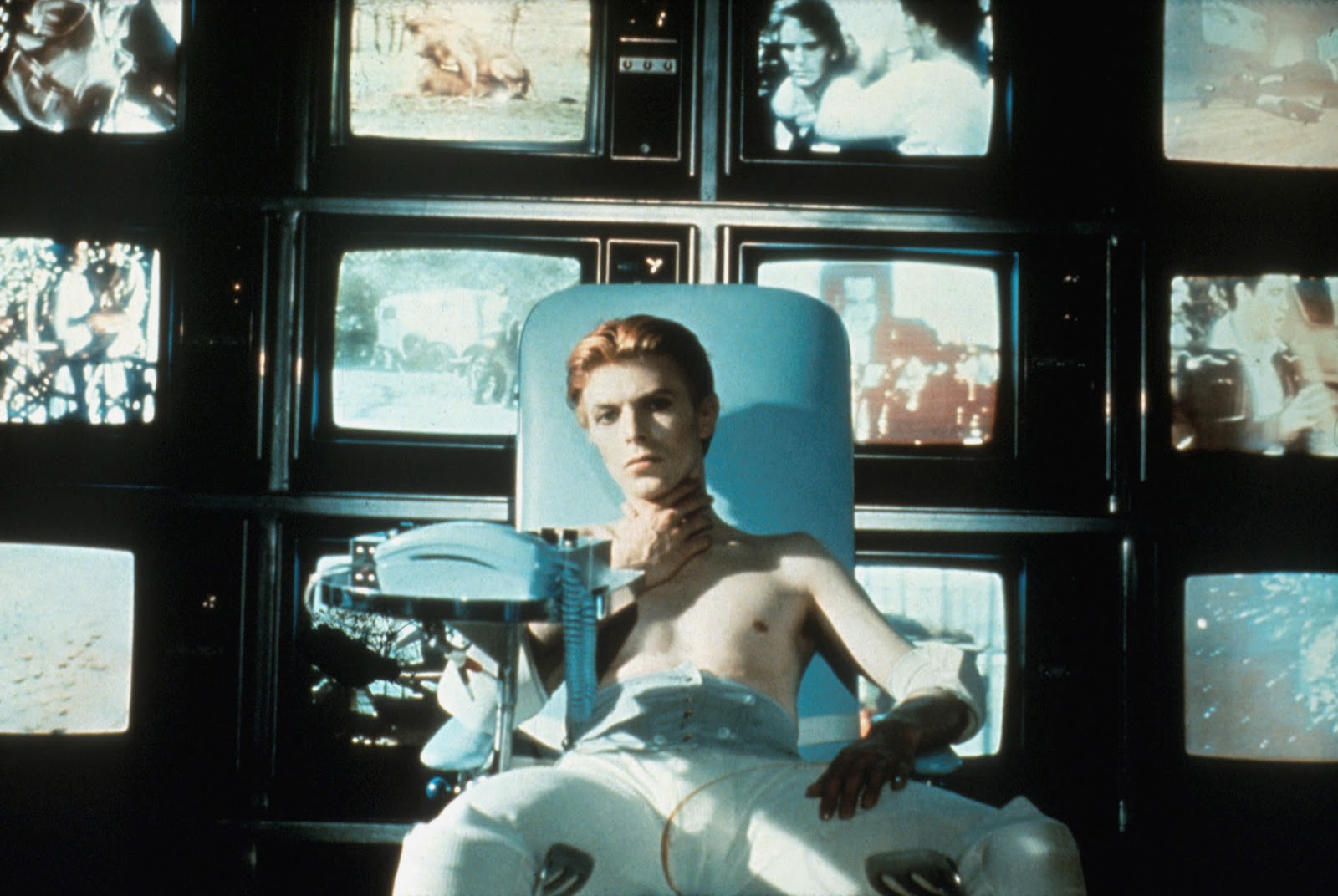
A strange man, Thomas Jerome Newton (Bowie), stumbles into a small New Mexico town.  Within a few years he is the multi-millionaire head of World Enterprises Corporation, a company which sells innovative technological products.  However, Thomas Newton is not what he appears.  In reality he is a humanoid alien sent to Earth from a dying planet to bring back much-needed water supplies for his homeworld.  He has been using his advanced alien technology in his company's products, and plans to use the money that he is making to finance the construction of a spaceship to ship the water to his planet.  However, during his time on earth he begins to fall victim to human vices such as alcohol, sex, television and corporate greed.

This film was David Bowie's first leading role, and at the time he was at the height of his "Thin White Duke" phase.  He gives an astonishing performance, and is utterly convincing as an alien, according to Bowie he was in such a fragile state at the time that didn't need to act in the role at all, he just learned his lines for the day and acted naturally.  Rip Torn plays a creepy professor who finds the mystery of Newton and his corporation even more interesting than chasing after his female students; Buck Henry plays a patent lawyer who becomes Newton's confidante and right hand man; and Bernie Casey plays the ruthless owner of a rival company.  They all give good performances, but Candy Clark is very good as the naive hotel chambermaid who falls in love with Newton and both becoming the other's nemesis.  Based on the novel by American author Walter Tevis (who also wrote The Hustler and it's sequel The Color of Money which were both made into successful films, and The Queen's Gambit which became a miniseries on Netflix), the film was directed by British director Nicolas Roeg, who was coming off the success of the horror film Don't Look Now (1973).  Roeg was known for his innovative style, combining surreal, poetic imagery with a jagged stream-of-consciousness style of editing.  Despite a fairly conventional alien innocent on Earth storyline, The Man Who Fell to Earth is a very unconventional science-fiction film.  For one thing, there is very little traditional science-fiction imagery in the film, aside from several brief sequences where Newton remembers his homeworld.  Despite being set entirely in America, it is a British film made with an almost entirely British crew, which may help explain how the film makes America look like the alien planet, it's one of the great outsider's views of America.  The film is long, slow, and the style makes it at times difficult to follow, but it is mesmerising.  At times it is funny and it is powerful, while the technology and values on display (such as Rip Torn's professor sleeping around with students) date the film as a product of the seventies, it is still a pertinent comment on the modern world, which may be more pertinent now than in 1976.  The film is visually striking, powerful and memorable, and remains one of the highpoint of David Bowie's career and of 1970s science-fiction cinema.


David Bowie is The Man Who Fell to Earth
 

Saturday, 1 October 2016

The Man Who Fell to Earth

Year of Release:  1976
Director:   Nicolas Roeg
Screenplay:  Paul Mayersberg, based on the novel The Man Who Fell to Earth by Walter Tevis
Starring:  David Bowie, Rip Torn, Candy Clark, Buck Henry, Bernie Casey
Running Time:  138 minutes
Genre:  science-fiction, satire

A mysterious man, Thomas Jerome Newton (Bowie), comes out of nowhere an sets up a hugely successful electronics conglomerate, World Enterprises, using revolutionary technology.  In reality, Newton is a humanoid alien in disguise, who plans to use the profits he earns through his company, which he has set up with patents on his advanced alien technology, and the inventions he has developed with it, to construct a huge spaceship to ship water back to his home planet which is dying due to severe drought.  Newton does indeed become fabulously wealthy, however he soon becomes corrupted by human vices such as alcohol, television, sex and money.

This fascinating film is a science-fiction movie like no other.  It's long, frustrating, fascinating, beguiling, pretentious, funny, dark and wonderful  by turns.  It also works as a satire on modern American life.  The imagery, which is heavy on symbolism, is largely taken from outside the science-fiction genre.  This was David Bowie's debut feature film and it is the role he was born to play.  With his quiet performance as the pale, emaciated alien everything about him is otherworldly, even before he reveals his true appearance (hairless, with yellow cat's-eyes and no genitals).  Candy Clark also impresses as sweet, lonely hotel maid Mary-Lou, who falls for Newton.  As with many Nicolas Roeg films, this is full of rich, striking often surreal images and a barrage of cinematic tricks, although it's a lot more linear than many of his other works of the period.  The several brief flashback scenes to Newton's homeworld are the most traditionally science-fiction elements of the film, and create the sense of a genuinely alien world with very few props and effects.
It is also a scathing satire on human weakness, corruption and cruelty, as the delicate alien embraces and becomes victimised by the darker side of human nature.  This is a film that would probably never get made now, it's too slow, too cerebral, too allegorical, too dark, too sexual and too obscure for modern day Hollywood science-fiction.

You may not enjoy this film, but you should certainly see it, at least once.

   David Bowie is The Man Who Fell to Earth