Showing posts with label Dario Argento. Show all posts

Monday, 31 October 2022

Suspiria

Year:  1977

Director:  Dario Argento

Screenplay:  Dario Argento and Daria Nicolodi

Starring:  Jessica Harper, Stefania Casini, Flavio Bucci, Miguel Bosé, Barbara Magnolfi, Susanna Javicoli, Eva Axén, Alida Valli, Joan Bennett

Running Time:  99 minutes

Genre:  Horror


American ballet student Suzy Bannion (Harper) arrives at a prestigious German dance school, Tanz Akademie.  On the night she arrives, a fellow student is brutally murdered.  As Suzy settles in to the strange academy, a series of bizarre and disturbing events occur, leading her to the conclusion that the school is a front for a murderous coven of witches.

"Bad luck is not brought on by broken mirrors, but by broken minds."

Italian director Dario Argento is arguably the most influential Italian horror filmmaker.  Starting out as a film critic, and then working as a screenwriter, including working with Sergio Leone and Bernardo Bertolucci on the script for Once upon a Time in the West (1969), before making his name as a director with a series of influential giallo films (a popular mix of horror and thriller, which were forerunners of the American "slasher" films).  Suspiria, co-written with Daria Nicolodi, with whom Argento was in a romantic relationship at the time, and who had previously starred in Argento's film Deep Red (1975), marked Argento's first foray into supernatural horror.  The film was partly inspired by Thomas De Quincey's 1845 essay Suspiria de Profundis, and marked the first of a trilogy known as the "Three Mothers Trilogy" continuing with Inferno (1980) and concluding with Mother of Tears (2007).  While this is Argento's first foray into fantasy, it still has elements of his giallo work: a black-gloved killer, elaborate and gruesome death scenes, and the plot point of the lead character hearing or witnessing an important clue early in the film, which she only remembers or understands the full significance of towards the end.  Right form the start the film opens with deafening, genuinely disturbing music from rock band Goblin, which mixes atonal rock, a kind of nightmare lullaby, and distorted human voices (including Argento himself) shrieking "Witch!"  The film itself doesn't appear to take place in any recognisable real world, with lurid colours, skewed angles, sudden cuts, a swooping, mobile camera, even something as simple as an airport's automatic door opening seems loaded with dread.  The interior of the academy itself with brightly coloured rooms, in which everything seems slightly hostile and alien, becomes like another character in the film.  The dialogue has the strange stilted delivery common in many Argento films,  due in part to the fact that the dialogue was dubbed after filming, which was common practice in Italian film at the time, but that accentuates the oddness of the thing, and makes the film more alien.  Pale, wide-eyed Jessica Harper walks through the whole film like she is in a nightmare.  Argento has never really had much interest in the niceties of logic and plot, and this is one of the times where this approach really works for the material,  It is like a nightmare and so follows a strange kind of dream logic, and so it is Argento's finest work.


Jessica Harper in Suspiria

Saturday, 29 October 2022

Phenomena

 Year:  1985

Director:  Dario Argento

Screenplay:  Franco Ferrini and Dario Argento

Starring:  Jennifer Connelly, Daria Nicolodi, Dalila Di Lazzaro, Donald Pleasence, Patrick Bauchau

Running Time:  116 minutes

Genre:  Horror


American teenager Jennifer Corvino (Connelly) arrives at an exclusive Swiss boarding school and soon discovers that the nearby area is being plagued by a vicious serial killer.  Jennifer, it turns out, has the ability to psychically communicate with any kind of insect, and teams up with elderly, wheelchair-bound Scottish entomologist John McGregor (Pleasance), and his intelligent chimpanzee, to track down the killer.


Dario Argento is generally regarded as one of the greatest Italian horror filmmakers.  Despite featuring a lot of Argento hallmarks, Phenomena is far from his best work.  It feels like a mix of the giallo films that Argento made his name with (black-gloved killer stalking young women, point of view shots, the main character witnessing an important detail early one which she is afterwards unable to remember, inept police investigation, and an  overly convoluted final reveal), with dark adult fairy tale (Jennifer's mystical powers, surreal nightmare imagery) and gothic romance (Jennifer Connelly spends a lot of her time running through a dark forest at night in a billowing white nightgown, as might be seen on the covers of numerous '70s paperback originals).  While it doesn't seem to be intentionally funny, the film is so ridiculous it's hard not to laugh at Jennifer's psychic bond with bugs (including teaming up with a fly to find evidence), Donald Pleasence's Scottish accent and the heroic chimp.  The performances are pretty bad, even from normally very good actors such as Jennifer Connelly and Donald Pleasence, who seems to be playing the whole thing for comedy.  Argento's skill at creating arresting images generates some interest, but there are very few of the trademark elaborate set-pieces that Argento can be so skilled at.  While the film is gruesome, gore fans may be disappointed at the comparative lack of bloodshed on display.  The score, from regular Argento collaborators Goblin, mixes lilting fairy-tale style music with sudden bursts of loud heavy metal, along with music from Bill Wyman, Iron Maiden and Motörhead among others.  The plot makes absolutely no sense at all.  It's fun if your in the right frame of mind for it, and the climax is so over the top it's quite entertaining.  On it's original release in the US and the UK the film was retitled Creepers with 20 minutes of footage cut.


Jennifer Connelly in Phenomena


Wednesday, 2 March 2022

Deep Red

Year:  1975

Director:  Dario Argento, 

Screenplay:  Dario Argento and Bernardino Zapponi

Starring:  David Hemmings, Daria Nicolodi, Gabriele Lavia, Macha Méril, Clara Calamai

Running Time: 126 minutes 

Genre:  Horror, thriller


One night Marcus Daly (Hemmings), a jazz pianist living in Turin, witnesses the gruesome murder of his upstairs neighbour, psychic medium Helga Ulmann (Méril).  Daly rushes to help, but is too late, however he sees the raincoat clad killer escape into the night.  Haunted by the idea that he saw something important which he cannot quite remember, Daly teams up with ambitious journalist Gianna Brezzi (Nicolodi) to hunt the killer, but the killer is hunting them.

This stylish murder-mystery is one of the classic giallo films.  Giallo was a sub-genre of horror and mystery films that came out of Italy in the 1960s and became hugely popular during the '70s.  Often seen as the fore-runner to later "slasher" films, these films were usually very stylish and showcased elaborate, stylised murders and violence, but were more focussed on the mystery and detection elements than piling up the bodycount.  The term giallo (Italian for "yellow") came from a hugely popular series of cheap paperback mystery novels which were published with distinctive yellow covers.  Deep Red features elaborate, over the top and extremely gory set pieces and a constantly moving camera, but it also has an intriguing and complex mystery plot.  As with most Argento films the dazzling, excessive visuals cover the fact that a lot of it doesn't really make any sense.  However it doesn't really matter, because as labyrinthine and bizarre as the film is, it is full of unforgettable elements, with bizarre sequences and characters, such as the mechanical killer doll (which surely must have been an influence on the Saw films) and the pulsing soundtrack from prog-rock band Goblin.  David Hemmings is charismatic in the lead role, but the film is stolen by Daria Nicolodi as the energetic and funny journalist.  Nicolodi would go on to appear in five more Argento films, and the two were married for a time.  This is definitely one of Argento's best films, and possibly the best example of the giallo genre.  Argento turned the film into a stage musical in 2007, and adopted the film's Italian title "Profondo Rosso" as the name for his horror memorabilia shop and museum in Rome.  


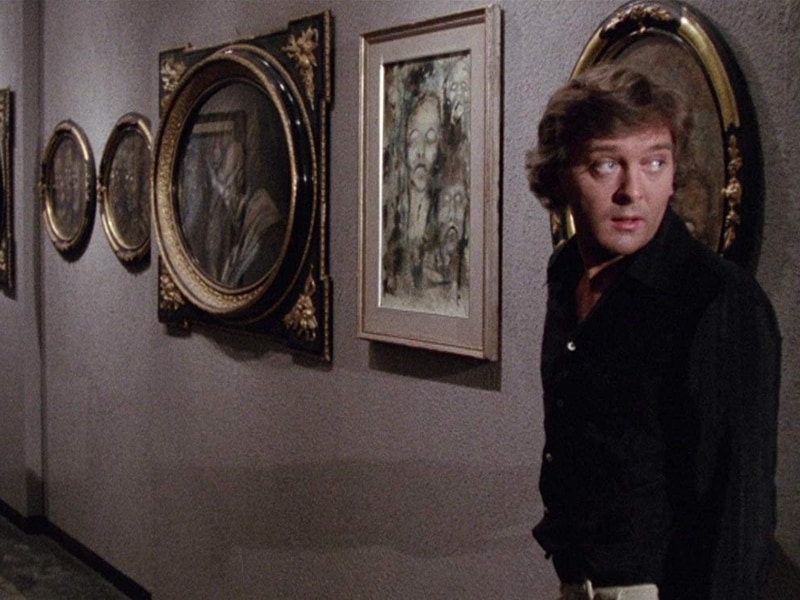
 David Hemmings in Deep Red

Sunday, 12 February 2012

Demons 2

Year:  1987
Director:  Lamberto Bava
Screenplay:  Dario Argento, Lamberto Bava and Franco Ferrini, from a story by Dardano Sacchetti
Starring:  David Edwin Knight, Nancy Brilli, Coralina Cataldi-Tassoni, Asia Argento
Running Time:  91 minutes
Genre:  Horror, supernatural, zombies

In the original Demons film, the audience at a preview screening of a horror movie are attacked by toothy monsters.  This time round, the events are set largely within the confines of a luxury high-rise apartment complex in an unnamed German city over the course of a single night.  As the residents prepare for their various evening activities, a horror movie plays on TV, apparently set in the aftermath of the original film, about a group of dim-witted teenagers investigating a walled off section of the city for remnants of "demons" (kind of zombie-like creatures), and accidentally reanimate one.  The reanimated creature then literally emerges from the TV set of spolit rich birthday girl Sally (Cataldi-Tassoni), and attacks her.  Of course anyone who is injured by a demon in any way, sooner or later becomes one themselves.  Sally turns all of her party guests into blood-crazed zombies, and they soon turn their attention to killing or infecting the rest of the building's population.

The film was co-written and produced by horror legend Dario Argento and features his then ten year old daughter, Asia Argento (who has since gone on to become an acclaimed actress and director), in her film debut.  The movie starts off well, but falls apart once the demons are really on the rampage, when it basically becomes a typical zombie monster mash full of increasingly shoddy special effects.  The film within a film provides an interesting dimension but it's not really explored, and becomes one of  a number of sub-plots which are raised only to be completely forgotten.  The acting is pretty dire (although this is an Italian film, and it is fairly obvious at least in the version that I saw, that most of the dialogue was dubbed - badly - into English) throughout and the film lacks any real conclusion, it is also full of plot holes large enough for you to throw a flesh eating zombie demon through.  Also the zombies with their green faces, bad teeth, long fingernails and wildly bulging, glowing eyes (who can not only run but turn somersaults) are more funny than anything, and when a more conventional demonic creature bursts out of someone's chest, it looks more like the puppet monster sidekick from a kid's TV show. 

However the film does have it's plus points.  There are plenty of creepy moments, when the characters are picking their way through the deserted, ruined apartments, and the opening, with it's slow character development is strong.  The soundtrack, which features mainly British New Wave bands such as The Smiths and The Cult, is good (although sometimes the pounding music coupled with the frequent billowing smoke and backlighting makes the film look like a music video).  Also the sequence where the demon initially emerges from the television set, which seems to be a homage to the David Cronenberg film Videodrome (1983), is very effective with some good special effects.  Speaking of David Cronenberg, the film with it's high-rise setting is reminiscent of Cronenberg's Shivers (1976).   

Full of unintentional humour and buckets of gloopy gore there is some fun to be had with this film, but there is plenty of better stuff out there.  It's probably best viewed late at night, when you've got your friends around, and you're all drunk and fancy a bad, gruesome movie to laugh at.


Revealed:  What TV show hosts look like without their make-up in Demons 2

Sunday, 3 April 2011

Inferno

Year: 1989
Director: Dario Argento
Screenplay: Dario Argento
Starring: Irene Miracle, Leigh McCloskey, Eleonora Giorgi, Daria Nicolodi, Sacha Pitoeff, Alida Valli, Veronica Lazar
Running Time: 107 minutes
Genre: Horror, supernatural

Summary: New York City: poet Rose Elliot (Miracle) is fascinated by a book called The Three Mothers by alchemist and architect Varelli. Varelli's book tells of three evil forces living in three houses in three different countries: Mater Suspiriorum (the Mother of Sighs) lives in Germany, Mater Lachrymarum (the Mother of Tears) lives in Italy and Mater Tenebrarum (the Mother of Darkness) lives in the USA. Rose becomes convinced that the old building she is living in is the home of Mater Tenebrarum.
She writes a letter to her brother Mark, a music student living in Rome. Mark's friend, Sarah (Giorgi) becomes fascinated by Rose's letter and decides to investigate the book The Three Mothers for herself. A decision she very quickly regrets.
Mark travels to New York and discovers that his sister has gone missing. As he investigates her disappearance he soon learns that the legend of the Three Mothers is far more than just a legend.

Opinions: This film was concieved as the middle part of a trilogy about the "Three Mothers", the first part was Suspiria (1977) and the trilogy concludes with Mother of Tears (2007), although Argento has stated that he has not ruled out making a fourth film in the series. The idea of the Three Mothers comes from a piece called "Levana and Our Ladies of Sorrow" from a book called Suspiria de Profundis by Thomas De Quincey, published in 1845.
As with Suspiria this film is more of a fairy tale for adults. It has a striking visual style, with swooping, mobile camera movements, bizarre angles and luridly coloured lighting. It also features many of Argento's trademark elaborately choreographed and gruesomely violent set-pieces. The production design is very impressive with the interiors of the old New York building a mix of bright red and gold walls and polished black wood. Despite being filmed mostly on studio sets in Rome, there are some location scenes filmed in New York.
The sheer strangeness of the film's look and frequent sudden bursts of violence and gore, along with the loud score which combines weird electronic music from Keith Emerson (of Emerson, Lake and Palmer fame) with music from a Guiseppe Verdi opera, makes for a very disconcerting experience and for the most part the film is genuinely scary, particularly if you are frightened at all of either cats or rats. It certainly delivers plenty of shocks. Some scenes are also genuinely beautiful, for example during a memorable underwater sequence featuring Irene Miracle ina submerged ballroom.
The movie suffers from stilted performances at times, in particular from Leigh McCloskey, and sometimes the special effects aren't equal to Argento's ambition. As with many other Argento films, the story doesn't make a whole lot of sense, but then that doesn't really matter. It's not about the story, it's about the mood conjured up by sounds and images.
The film was shot under difficult circumstances. Daria Nicolodi came up with the basic story, but decided not to seek credit due to her miserable experience trying to get a writing credit for Suspiria. Argento was severely ill most of the time they were filming. Also the film was made for the major Hollywood studio 20th Century Fox who were so unhappy with the finished film that they did not release it in the USA until 1985, five years after it was made, and then direct to video. It did have a limited theatrical release in the US the following year though.
In recent years, though the film has been reassessed and has become something of a cult classic. In 2005 Britain's Total Film listed it as 35 in their list of the 50 greatest horror films of all time.
This is a startling and nightmarish movie that is definitely worth checking out.


Sacha Pitoeff and Irene Miracle in Inferno