Showing posts with label John Ford. Show all posts

Tuesday, 5 April 2022

She Wore a Yellow Ribbon

 Year:  1949

Director:  John Ford

Screenplay:  Frank Nugent and Laurence Stalling, based on the stories The Big Hunt and War Party by James Warner Bellah

Starring:  John Wayne, Joanne Dru, John Agar, Ben Johnson, Harry Carey Jr.

Running Time:  103 minutes

Genre:  Western

1876: At Fort Starke, a remote US Cavalry post, Captain Nathan Brittles (Wayne), six days away from retirement, is heading out for his last patrol: to prevent a new war between the Cheyenne and Arapaho  and the white colonists following the Battle of the Little Big Horn.  However, Brittles' task is complicated by a second order: to deliver his commanding officer's wife, Abbey Allshard (Mildred Natwick), and niece, Olivia Dandridge (Dru), to an eastbound stagecoach.  To make matters worse, two of the soldiers in the patrol are vying for Olivia's affections, causing tensions among the patrol.


Named for a popular US Army marching song,  She Wore a Yellow Ribbon was the second film in director John Ford's "Cavalry Trilogy" following Fort Apache (1948) and concluding with Rio Grande (1950).  Ford originally didn't want John Wayne for the lead, partly due to the fact that Wayne would be playing a character about twenty years older than he was at the time, and partly because he didn't think that Wayne had the acting skill to play the role.  However, Ford changed his mind after seeing Wayne in the film Red River (1948), which caused Ford to exclaim "I didn't know the big son of a bitch could act!"  Wayne himself considered She Wore a Yellow Ribbon as one of his best performances.  While the film has plenty of broad humour (Victor McLaglen as the stereotypical drunk Irish soldier), it has surprisingly little of the action you might expect from a film like this, although there are a few battles between the cavalrymen and the Native American braves, they are brief and far between. The film has aged pretty badly with it's attitude towards the Native Americans (although there is a sympathetic and layered Native American character, Pony-That-Walks played by Chief John Big Tree), it's sympathetic attitude towards the Confederacy, Victor McLaglen's comic relief Irish character, and also the blood-and-thunder militarism.  The film also gets bogged down in the love triangle subplot between the two soldiers (John Agar and Harry Carey Jr.) , who are pretty much indistinguishable except one has dark hair and one is blonde, and Olivia.  However, the film has a strongly elegiac tone, as Brittles, a lifelong soldier and widower, contemplates a life away from his beloved Army.  John Wayne is at his best here, delivering an unusually thoughtful performance, and Joanne Dru is good, although she really isn't given much to do.  As always in John Ford Westerns, the locations in Monument Valley look spectacular.  
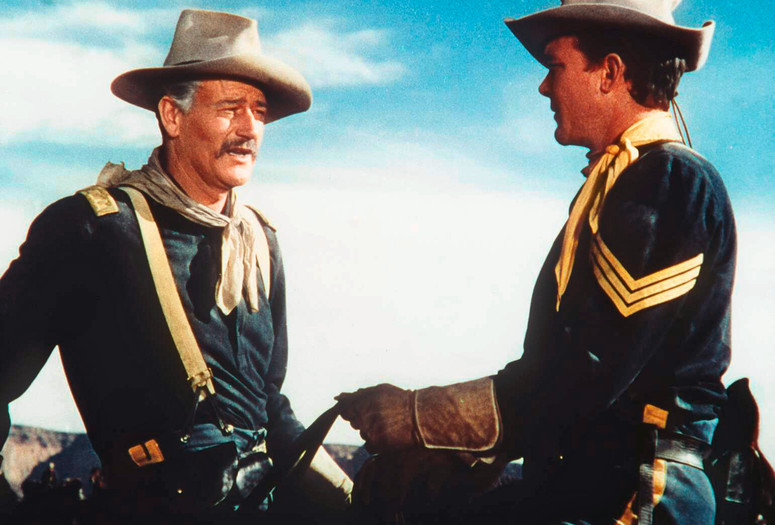

John Wayne and John Agar in She Wore a Yellow Ribbon
 

Friday, 11 February 2022

Fort Apache

Year:  1948

Director:  John Ford

Screenplay:  Frank S. Nugent, based on the short story "Massacre" by James Warner Bellah

Starring:  John Wayne, Henry Fonda, Shirley Temple

Running Time:  125 minutes

Genre:  Western

Arrogant, embittered Lieutenant Colonel Owen Thursday (Fonda) and his teenage daughter, Philadelphia (Temple), arrive at Fort Apache, an isolated U. S. Cavalry outpost, where Thursday is to assume command.  While Philadelphia adapts well to life at the Fort, Thursday's high-handed manner and strict adherence to military rule and discipline, alienate him from his troops, particularly his second in command Captain Kirby Yorke (Wayne).  To make matters worse, Thursday's ignorance and bigotry towards the indigenous Apache tribes threatens to lead to war.


This was the first of director John Ford's "Cavalry Trilogy", which also included She Wore a Yellow Ribbon (1949) and Rio Grande (1950), both of which also starred John Wayne.  For the first hour or so, the film feels almost like a comedy, as the strict, strait-laced Lieutenant Colonel finds himself at odds with the ragtag bunch of soldiers he finds himself commanding, while his daughter falls for a dashing young officer (played by John Agar), much to her father's displeasure.  However, it becomes more somber and surprisingly dark as it goes along.   Despite having star billing, John Wayne really has more of a supporting role here, with Henry Fonda's Owen Thursday being the main character.  Thursday was a General in the Civil War and is bitter at being busted down to the ranks and posted to some isolated fort in the middle of nowhere.  From his appearance here, it seems that Thursday was at best an armchair general, who might be able to recite chapter and verse of Genghis Khan's campaigns, but is terrible at the business of real leadership.  His attitude towards the local Native American tribes, in whom he is completely uninterested, veers from hostility to contempt.  In fact it's his daughter Philadelphia who is far better able to adapt to life at the Fort and, while he immediately dismisses the Fort and it's surroundings, Philadelphia is interested and curious about the country and the people who live there.  Fort Apache is notable for Westerns of it's time in taking a sympathetic view of the Native Americans.  While it is still very much from the view of the white settlers, the Native Americans are willing to come to a peaceful solution and their demands are perfectly reasonable, it's Thursday's racism that escalates the conflict.  The film was shot in Ford's favourite location, Monument Valley.  The film takes it's time to get into it's stride and the story doesn't really get into it's stride until it's second hour.  The climax is well staged and exciting and there is a moving epilogue which shows how the myth of the West was being written even while it was happening.  Henry Fonda is good as Thursday, managing to humanise a pretty unlikeable character.  John Wayne does well as Yorke, trying his best to counter Thursday's bigotry and avoid disaster for all concerned.  Shirley Temple is good as Philadelphia, and it is a pity that she isn't even more to do.   

Thursday, 5 September 2019

The Man Who Shot Liberty Valance

Year of Release:  1962
Director:  John Ford
Screenplay:  James Warner Bellah and Willis Goldbeck, from a short story by Dorothy M. Johnson
Starring:  James Stewart, John Wayne, Vera Miles, Lee Marvin, Edmond O'Brien
Running Time:  123 minutes
Genre:  Western

In the Old West, idealistic lawyer Ransom Stoddart (Stewart) arrives in the remote frontier town of Shinbone.  On the way his stagecoach is held up and Stoddart is brutally beaten by vicious local bandit Liberty Valance (Marvin).  Ransom is determined to bring Valance to justice.  However, the local marshal (Andy Devine) lacks the courage and the skill to tackle Valance and his gang.  The only one willing to stand up to the bandit is tough local cowboy Tom Doniphon (Wayne).  In Doniphon's view, the only way to stop Valance is with a bullet, but Stoddart, who doesn't even carry a gun, is determined to bring Valance in alive and by the book. 

Filmed in crisp black-and-white, this late John Ford directed Western is one of his best, and a classic of the genre.  James Stewart is in good form as the idealistic lawyer who tries to civilise the tough frontier town by opening a school, and trying to teach the townspeople about politics and Government.  John Wayne is well used as the gruff cowboy.  Wayne was not a particularly good actor, but he had a lot of presence, and Ford always managed to get the best out of him.  Vera Miles is very good as Hallie, the cook and waitress who attracts the attention of both Stoddart and Donophin.  She gives the role some real depth and emotion.  Also worthy of note is Lee Marvin as the snarling, savage Liberty Valance.  The film is bookended by sequences set twenty five years later which are effective but unnecessary.  This is a surprisingly dark film, and quite ambiguous towards the end.  It does have slow patches, but it has some real tension, and a lot of humour.  Considering it is a John Wayne Western it is surprisingly progressive, and has a real elegiac feel about the beginning of the end of an era and the beginnings of the modern United States.

Lee Marvin, James Stewart and John Wayne in The Man Who Shot Liberty Valance