Showing posts with label Max von Sydow. Show all posts

Thursday, 10 December 2020

The Touch

Year of Release:  1971

Director:  Ingmar Bergman

Screenplay:  Ingmar Bergman

Starring:  Elliot Gould, Bibi Andersson, Max von Sydow, Sheila Reid

Running Time:  112 minutes

Genre:  Drama


Karin Vergerus (Andersson) lives in a small coastal town in Sweden with her surgeon husband Andreas (Sydow) and two children.  Karin's pleasant, ordered life is turned upside down when she starts an affair with visiting American archeologist David (Gould).

This marks two first for prolific Swedish filmmaker Ingmar Bergman.  It was the first film he made for an American studio with an established Hollywood star, and his first film with English dialogue.  Bergman's preferred version of the film has Swedish and English dialogue, but the American studio insisted that he prepare a version entirely in English.  The films tends to be dismissed and overlooked.  Bergman himself regarded it as a "failure".  However I found it a powerful and beautiful film.  The story is told entirely from Karin's perspective, and there are several mysteries which are never explained.  Karin's life with Andreas is solid and nice.  Andreas is a nice, steady, polite, gentle, dependable, handsome man, and they live in a. large, airy, bright house with a lot of sunlight and Karin goes through her steady daily routine with mechanical aplomb, in some playful, early scenes we see her go about her day accompanied by bland, repetitive, irritating pop music.  David is a glamorous foreigner, promising passion and excitement.  He is however volatile, childish, sullen, angry, selfish and sometimes violent.  His large apartment is dark and bare, with a constant noise of construction outside the window.  Karin is trapped between two worlds, unwilling to commit to either.  At one point she mentions fantasising about a world in which she can move seamlessly between her two lives without hurting anyone.  Her turning point comes when she is forced to make a decision one way or another.  Karin and Andreas seem to believe in keeping up appearances and letting sleeping dogs lie.  They are essentially passive.  David however believes in living for the moment, and to hell with the consequences.  He believes in freedom, however the freedom can be a double edged sword.  throughout the film he is renovating. medieval church and excavates a wooden statue of the Virgin Mary, which has been immaculately preserved, however when David  uncovers it and puts it on display insects that were hibernating within the statue are revived and start eating it from the inside out.  Another interesting point with David that is only apparent in the bilingual version of the film is that although he has spent six months a year for two years living in Sweden, he never speaks any Swedish only English, and Karin and Andreas only talk to him in English.  It's never discussed whether he knows any Swedish or not.   Max von Sydow gives a typically dignified, restrained performance, conveying a lot while showing very little, Elliot Gould is effective as David although he seems a little uncomfortable with his visit to Bergmanland, but the film belongs to Bibi Andersson who is in almost every scene in the film, and she gives a powerful performance.  The film, which takes place in bleak autumn and winter, is beautifully shot by regular Bergman Cinematographer Sven Nykvist.

This may not be pone of Bergman's best outings, but it is powerful and deserves to be better known.    


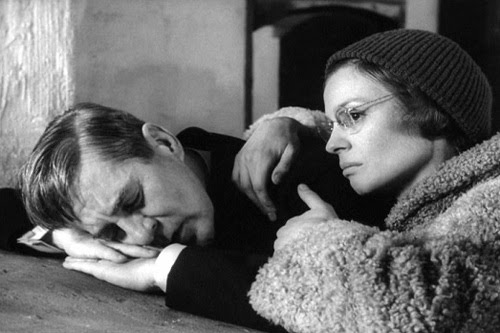
Elliot Gould and Bibi Andersson in The Touch
         

Tuesday, 20 February 2018

Hannah and Her Sisters

Year of Release:  1986
Director:  Woody Allen
Screenplay:  Woody Allen
Starring:  Mia Farrow, Michael Caine, Barbara Hershey, Dianne Wiest, Woody Allen, Max von Sydow, Carrie Fisher
Running Time:  103 minutes
Genre: Comedy drama

This film concerns the lives of three sisters over the course of two years.  Hannah (Farrow), is kind, loving, strong and stable, her husband Elliot (Caine), while he loves Hannah, is infatuated with her sister Lee (Hershey), who is living with mercurial artist Frederick (Sydow).  Meanwhile, the third sister, Holly (Wiest), a former cocaine addict, struggles to achieve her dream of becoming an actor while managing a catering company with her friend and rival, April (Fisher).  Also Hannah's ex-husband Mickey (Allen), a hypochondriac television producer experiences an existential crisis when he becomes convinced he has a brain tumor.

This is possibly one of Woody Allen's finest films, managing the very tricky art of successfully balancing both comedy and drama.  It manages to be tender and sentimental without being saccharine, profound without being pretentious, warm without being cloying and, where necessary, being biting without being cruel.  Allen manages to get good performances out of his large cast, and seems to have genuine affection for all of his characters.  If you are familiar with Woody Allen movies, than you'll know the kind of humor on display here, mostly wry, neurotic, intellectual wisecracks.  Of course, these days Woody Allen is problematic to say the least, and also this is a film almost entirely about very wealthy white people, in Allen's New York, people of colour are barely glimpsed.  Although this is a very affecting film about sisterhood, love, ambition and just trying to find a meaning to life.


Mia Farrow, Barbara Hershey and Dianne Wiest are Hannah and Her Sisters   
    

Saturday, 16 December 2017

Needful Things

Year of Release:  1993
Director:  Fraser C. Heston
Screenplay:  W. D. Richter, based on the novel Needful Things by Stephen King
Starring:  Ed Harris, Max von Sydow, Bonnie Bedelia, J. T. Walsh, Amanda Plummer
Running Time:  120 minutes
Genre:  Horror

A mysterious stranger named Leland Gaunt (von Sydow) arrives in the small Maine town on Castle Rock, where he sets up a strange antiques/curiosity shop called Needful Things.  Gaunt appears to have an uncanny knack of finding the one thing that every customer most desires, and each is priced to just what the customer can easily afford, but there is a catch:  The cash price is only half of the payment, the rest comes in the form of a deed, usually a cruel prank played on someone else in town, and all designed to point to someone other than the prankster.  Before long, the nice little town becomes torn apart with suspicion, paranoia, hate and misplaced revenge. 

While this is far from the worst movie to be based on one of Stephen King's works, it's also far from the best.  Although it really does as well as it could do at compressing King's sprawling, episodic doorstop of a novel into a coherent film.  It's well cast with solid character actors, and the story is interesting.  The problem is that the film doesn't have much of a consistent tone, the mixture of supernatural horror, dark comedy and small town soap opera worked a lot better on the page, where there was more space to go into the characters and their relationships.  The performances are good, especially Max von Sydow as the devilish Leland Gaunt, and the story is interesting enough to carry it along, but it's neither scary or funny, and the climax is ridiculous.

Max von Sydow in Needful Things         

Thursday, 6 October 2016

Dune

Year of Release:  1984
Director:  David Lynch
Screenplay:  David Lynch, based on the novel Dune by Frank Herbert
Starring:  Kyle MacLachlan, Francesca Annis, Jurgen Prochnow, Jose Ferrer, Kenneth McMillan, Sting, Sean Young, Everett McGill, Dean Stockwell, Patrick Stewart, Virginia Madsen, Max von Sydow
Running Time:  131 minutes
Genre:  science-fiction

This adaptation of Frank Herbert's 1965 science-fiction novel is generally considered a disaster, and right off the bat I have to say that it's really not that bad.  The story is set in a distant galaxy and involves two feuding families from two different planets:  The Atreides from the planet Caladan, ruled by patriarch Duke Leto (Prochnow), with his concubine Lady Jessica (Annis) and their son Paul (MacLachlan); and the Harkonnens from Geidi Prime, ruled by the sadistic and grotesque Baron Vladimir (McMillan) and his nephews, Feyd-Rautha (Sting) and the Beast Raban (Paul Smith).
The Atreides and Harkonnens are both desperate for control of the desert planet Arrakis (nicknamed Dune), a world devoid of natural water, riddled with deadly, giant subterranean sandworms,  and sparsely populated by a mysterious people known as the Fremen.  Arrakis is however vital, because it is the only source of the "spice melange", the most valuable substance in the universe, which can extend life and expand consciousness.  It's most important property is the ability to "fold space" thereby making interstellar travel possible.

This is a deeply frustrating film because there is a lot about it that is really great, and so much that is really bad.  It's worse problem is that it tries to condense Herbert's long, complex novel, which involves an intricate back-story into a too short a time, and this isn't a short film.  In the event much of the film's dialogue is purely exposition to advance the plot, with a lot of voice-over narration to explain what the hell is happening.  However it is a visually stunning film, with some of the most striking sets and production design that I have seen, and it does create a number of unique worlds and at it's best creates a genuine sense of wonder.  It also hasn't dated too much, except for some special-effects shots, and the very 1980s soundtrack by Toto and Brian Eno.  Watching it is a unique and unforgettable experience, with Kenneth McMillan creating, in Baron Harkonnen, one of the most memorable screen villains in history.  In fact, the Harkonnen scenes are genuinely nightmare fuel.  Again most of the good-looking characters are heroic, and evil is depicted by physical ugliness.  Francesca Annis is impressive as Lady Jessica, who provides the emotional heart of the film, but otherwise there are a lot of great actors standing around in fantastic costumes and sets, struggling to make an impression.

David Lynch famously repudiated the film, and dislikes even discussing it in interviews, and given the fact that he has never made any secret of the fact that he dislikes science-fiction, he was kind of an odd choice to direct it, but there is a lot of Lynch in it's visuals and style.

You may love it or you may hate it, but it is such a striking and unique experience, it is well worth checking out.

 Kyle MacLachlan versus Sting, while Patrick Stewart looks on in Dune                  

Tuesday, 5 July 2011

Winter Light

Year: 1962
Director: Ingmar Bergman
Screenplay: Ingmar Bergman
Starring: Ingrid Thulin, Gunnar Bjornstrand, Max von Sydow, Gunnel Lindblom
Running Time: 81 minutes
Genre: Drama

Summary: In a small Swedish town, Tomas Ericsson (Bjornstrand) is the local pastor. However, he has almost completely lost his faith, and merely goes through the motions of his profession. Atheist schoolteacher Marta (Thulin) loves him, however Tomas treats her with complete indifference or downright hostility. When one of his parishoners, fisherman Jonas (Sydow) comes to him for help due to his overwhelming fear of nuclear war, Tomas tries to help him, and offer some words of comfort. However, immediately after leaving him, Jonas kills himself, which causes Tomas to sink even further into existential depsair.

Opinons: This film (also sometimes known as The Communicants) is widely considered the middle part of director Ingmar Bergman's "Trilogy of Faith" which began with Through a Glass Darkly (1961) and concluded with The Silence (1963), which deal with spiritual matters, in particular the "silence of God" which was a recurring theme in Bergman's work. Bergman wrote "These three films deal with reduction. Through a Glass Darkly - conquered certainty. Winter Light - penetrated certainty. The Silence - God's silence - the negative imprint. Therefore, they constitute a trilogy."
This is one of Bergman's most autobiographical and personal films. He claimed that he "only realised who he really was" and came to terms with himself through the making of this film. Bergman's father was a pastor similar to the one in the film and Bergman struggled deeply with religious questions.
It tends to be one of Bergman's most overlooked films, which may be due to the film's frustratingly elliptical structure as well as the sheer bleakness and misery of it. Through a Glass Darkly offered a glimmer of hope at the end of the tunnel, but there is no such glimmer here.
The film is beautiful to look at, photographed in luminous monochrome by regular Bergman cinematographer Sven Nykvist, and features some startling performances from all concerned. Bjornstrand gives a haunted performance as a tormented man who has lost all belief and faith in his vocation, and is merley clocking in every day and going through the motions like a bored and disillusioned office worker, unfortunately his job is to console others at their lowest points, and there is nothing to console him. The one glimmer of hope offered to him, the love of Ingrid Thulin's Marta, he angrily rejects at every turn. Thulin turns in an intense perfomance and her heart-rending long monologue delivered staright to camera is genuinely uncomfortable to watch.
This is a bleak and merciless drama, which is definitely worth checking out, although definitely not if you're in the mood for some cheering up. You'll also probably want to stay away from sharp objects for an hour or two after you've seen it.

"Surely that must have been his greatest hardship? God's silence."
- Algot Frovik (Allan Edwall) in Winter Light


Gunnar Bjornstrand and Ingrid Thulin in Winter Light

Through a Glass Darkly

Year: 1961
Director: Ingmar Bergman
Screenplay: Ingmar Bergman
Starring Harriet Andersson, Gunnar Bjornstrand, Max von Sydow, Lars Passgard
Running Time: 89 minutes
Genre: Drama

Summary: A family of four spend their summer vacation on a remote island. Karin (Andersson) suffers from schizophrenia and has recently come out of a mental hospital. Her loving husband, Martin (Sydow) is unable to understand what is happening to her. Her father, David (Bjornstrand), a second-rate but successful novelist, is more wrapped up in his own problems. Her emotional seventeen year old brother Minus (Passgard) is the only one Karin can confide in, and he is severely out of his depth.
Sneaking a look at her father's diary, Karin discovers that her condition is incurable and that David, while sympathetic, is interested in studying the effects of the illness on her as it worsens. Feeling isolated from bother her husband and her father, and racked with guilt about her increasingly disturnbing closeness to Minus, Karin's mental state quickly deteriorates and her hallucinations become increasingly severe, as her grip on reality begins to shatter.

Opinions: This is the first of Bergman's loose "Faith Trilogy" which continued with Winter Light (1962) and concluded with The Silence (1963). This bleak and austere drama helped to seal Bergman's reputation as the master of Scandinavian gloom. However there is humour there and also some of the frequently overlooked warmth that was often present in Bergman.
Shot on the Swedish island of Faro, this is beautifully photgraphed in crisp black and white by regular Bergman cinematographer Sven Nykvist and features some superb perfomances from it's small cast (there are only four characters in the entire film) most of whom were also Bergman regulars. Harriet Andersson especially delivers a stunning perfomance in the lead role.
The film's downbeat nature certainly won't appeal to all viewers, but it is a must see for Bergman fans and is worth seeing anyway as a major work from one of the masters of cinema. Also despite the gloom it concludes with a faint glimmer of optimism. it is fair to say that you probably won't have a lot of fun with this film, but then it is not intended as entertainment, it is a piece of art.
The title refers to a passage in the Bible (1 Corinthians 13) which states that while we are alive we see God and God's plans as "through a glass, darkly" but it will all become clear after we die.

"It's so horrible to see your own confusion and understand it."
- Karin (Harriet Andersson) in Through a Glass Darkly


Max von Sydow, Harriet Andersson and Gunnar Bjornstrand in Through a Glass Darkly

Wednesday, 13 April 2011

The Seventh Seal

Year: 1957
Director: Ingmar Bergman
Screenplay: Ingmar Bergman
Starring: Max von Sydow, Bibi Andersson, Gunnar Bjornstrand, Nils Poppe, Bengt Ekerot, Inga Landgre
Running Time: 92 minutes
Genre: Drama, period, religion, allegory

Summary: A medieval knight, Antonius Block (von Sydow), and his cynical squire, Jons (Bjornstrand), return home to Sweden from the Crusades. Disillusioned and suffering a crisis of faith after what he has experienced and witnessed, Block encounters Death (Ekerot) on the shore. Death says that he has come for Block. However Block does not want to go until he has found some kind of meaning to life and concrete evidence of the existence of God, and so he challenges Death to a game of Chess. As the game progresses, Block and Jons travel through a country ravaged by the Black Death (the bubonic plague) and in the grip of religious fervor. Along the way Block meets, among others, a family of actors one of whom, Jof (Poppe), has mystical visions and a witch (Maud Hansson) who is condemned to death, as he searches for answers to his questions.

Opinions: This film is arguably the best known work from celebrated Swedish writer and director Ingmar Bergman. It has been referenced and parodied endlessly over the years, and has become seen as something of the archetypal high-brow "art" film. The film is deservedly a modern classic. Bergman grew up in an intensely Christian household. His father was a rector in the Church and as a child Ingmar Bergman would frequently accompany him on his visits to remote, rural churches where he saw medieval paintings and wood carvings which were among the chief inspirations for the film (in fact the screenplay for the film was based on a student play Ingmar Bergman wrote called Wood Painting). The film is a deeply personal one and deals with religious questions which concerned Bergman throughout his life, and some of the themes of the film, such as the "silence of God", were major preoccupations throughout his life.
The film is stunningly shot in crisp black-and-white, and some images from the film have become icons of world cinema particularly the image of the knight playing Chess with Death on the rocky shore as the sun rises. The film deals with weighty philosophical themes but it is also at times very funny. There is a strong element of bawdy comedy running through it, even Death gets a couple of one-liners. Comedy was not one of Bergman's strenghts admittedly, and he lacks the lightness of touch to make the humour work as well as it could, but it still gets some laughs. There is also plenty of suspense and drama.
The acting is good, with many of the actors being regular Bergman players. Max von Sydow is a particular standout as the anguished, searching knight knight
Powerful, complex, intriguing and entertaining, this is a masterpiece of world cinema and well worth checking out. Ultimately the film concerns itself with one of the major questions, the search for some kind of meaning to life.

Death: "Do you never stop asking questions?"
Block: "No, never"
Death: "But you get no answers."


Death (Bengt Everot) and the Knight (Max von Sydow) start their game in The Seventh Seal

Wednesday, 22 September 2010

Judge Dredd

Year: 1995
Director: Danny Cannon
Screenplay: William Wisher, Jr. and Steven E. de Souza, from a story by Michael De Luca and William Wisher, Jr. and based on characters created by Pat Mills, John Wagner and Carlos Ezquerra
Starring: Sylvester Stallone, Armand Assante, Diane Lane, Rob Schneider, Max von Sydow and Jurgen Prochnow
Running Time: 96 minutes
Genre: Science-fiction, action, adventure, thrller, crime

Summary: In the third millennium, the Earth has become a post-apocalyptic wasteland. Most of the inhabitants live in vastly overpopulated Mega-Cities, seperated by huge expanses of largely uninhabitable desolation known as "Cursed Earth", populated by small bands of brutal, cannibalistic outlaws. Law and order in the crime-ridden Mega-Cities is enforced by heavily armoured Street Judges who have the authorisation not only to enforce the law but to act as judge, jury and executioner, with the power to hand down a variety of sentences such as heavy on the spot fines, imprisonment in remote penal colonies or summary execution.
In Mega-City One, which occupies the east coast of the USA, the top Street Judge is Judge Joseph Dredd (Stallone). However, when a murderous ex-Judge (Assante) escapes from a penal colony and returns to Mega-City One, Judge Dredd finds himself accused and convicted of a murder he didn't commit. With the help of fellow Judge Hershey (Lane), and a cowardly computer hacker (Schneider), Dredd attempts to prove his innocence and uncover corruption that reaches to the top of the Justice Department.

Opinions: Judge Dredd first appeared in 1977 in the pages of British science-fiction comic-book 2000 AD and remains one of the most popular comic-book characters ever produced in the UK. It is fair to say that the film is only very loosely based on the comic-book, and the movie did have a very bad reaction from fans, most notably because of the fact that Dredd spends most of the film without his trademark helmet, in the comic Dredd very rarely removes his helmet and even when he does, his face is never shown. Also the movie ignores several important elements from the comic series, for example there is a kind of romantic element between Dredd and Hershey when in the comic romantic attachments between Judges (or between Judges and anyone else) is strictly forbidden. The movie also lacks a lot of the quirkiness of the comic.
Despite the fact that the film was mostly panned by critics and fans of the comic, the movie itself really isn't that bad. It is a mid-'90s science-fiction action movie no better and certainly no worse than many that were released at the same time. The special effects while they obviously look dated by today's standards are still pretty impressive, and there are some great effects in the film such as the Mega-City itself and the look of the deadly ABC Warrior Robot. Sylvester Stallone does what he does best providing gravel-voiced one-liners and muscle-bound action-man heroics. Max von Sydow lends the film some dignity and gravitas as Dredd's mentor. However on the negative side Rob Schneider drags the film down with misplaced comedy-relief. It makes it hard to maintain much drama, tension, suspense or excitement when they pop in Schneider to make a bad joke and drain away the drama like water when the plug is pulled from the sink. It also suffers from Armand Assante over-acting like a pantomime villain, really the only think he didn't have was a moustache to twirl.
It's a fun movie, it looks good, there are some fun action scenes and it is often entertaining, but it has been done better elsewhere. It's a pity really, because it is something of a missed opportunity. There could be a great movie made from Judge Dredd, but this isn't it.

"I never broke the law... I AM THE LAW!"
-Sylvester Stallone in Judge Dredd (1995)


Sylvester Stallone lays down the law in Judge Dredd