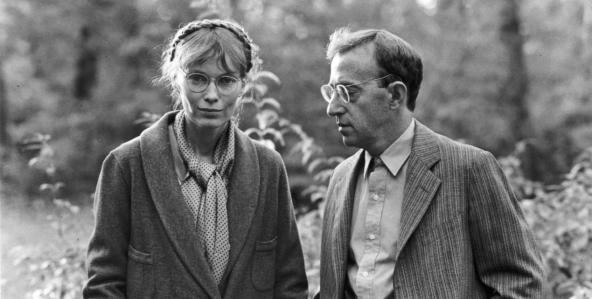
Year of Release: 1968
Director: Roman Polanski
Screenplay: Roman Polanski, based on the novel Rosemary's Baby by Ira Levin
Starring: Mia Farrow, John Cassavetes, Ruth Gordon, Sidney Blackmer, Maurice Evans, Ralph Bellamy
Running Time: 131 minutes
Genre: Horror
New York City, 1965: Rosemary Woodhouse (Farrow) and her ambitious actor husband Guy (Cassavetes) move into a spacious apartment in a classy building, which has a dark history of murder, witchcraft and cannibalism. Shortly after moving in, the Woodhouse's meet their eccentric elderly neighbours, the Castevets. When Rosemary falls pregnant, she becomes increasingly suspicious of the Castevets, and convinced that she is being targeted by a Satanic conspiracy, of which her neighbours, friends, and even her husband are part.
This is possibly one of the most influential horror films ever made. At the time, horror tended to be gruesome drive-in fare, or classier Gothic productions based on Edgar Allan Poe stories, or about Dracula, Frankenstein and other classic monsters. In this film horror is brought bang up to date and into the heart of Manhattan, it's also aimed squarely at an older audience, Rosemary and Guy are young, but they are certainly not teenagers, and the film deals with pregnancy and middle-class ennui. It also takes it's time, in a period where horror films rarely lasted much over an hour an a half, this has a generous running time of two hours plus. It also doesn't look like a horror film, with the opening shots floating over New York City, with the opening credits appearing in pink copperplate lettering to the strangely eerie lullaby, the discussions about pop culture and news events, the evil Satanists worrying about stains on the carpet and having most of the film take place in broad daylight, this is more like a comedy-drama about a disaffected young woman. The most memorable horror moments come in the genuinely disturbing surreal nightmare sequences, where Rosemary is attacked by a demonic creature, the morning after, in another deeply problematic scene Guy cheerfully informs her that he had had sex with her while she was passed out, he casually brushes off Rosemary's shock and distress at this.
The film is a very faithful adaptation of Ira Levin's book, in fact pretty much everything that is in the film is in the book. The main difference is that at the end, the film still leaves it ambiguous as to whether anything supernatural is happening at all. In fact the entire film could be read as it all being in Rosemary's mind. This was because writer / director Roman Polanski had a strong aversion to the supernatural. The horror in the film becomes more due to urban isolation and paranoia, a favourtie theme of Polanski's. Rosemary is alternately abandoned or patronised by her selfish husband, she doesn't have a job, apparently, and spends most of her time rattling around on her own.
The film boasts some fine performances, particularly Mia Farrow, sporting an iconic hairstyle, combining frailty with steel.
Baby blues: Mia Farrow in Rosemary's Baby
Showing posts with label Mia Farrow. Show all posts
Thursday, 14 June 2018
Rosemary's Baby
Labels:
drama,
horror,
Ira Levin,
John Cassavetes,
Maurice Evans,
Mia Farrow,
movie,
Ralph Bellamy,
reviews,
Roman Polanski,
Rosemary's Baby,
Ruth Gordon,
Sidney Blackmer
Tuesday, 20 February 2018
Hannah and Her Sisters
Year of Release: 1986
Director: Woody Allen
Screenplay: Woody Allen
Starring: Mia Farrow, Michael Caine, Barbara Hershey, Dianne Wiest, Woody Allen, Max von Sydow, Carrie Fisher
Running Time: 103 minutes
Genre: Comedy drama
This film concerns the lives of three sisters over the course of two years. Hannah (Farrow), is kind, loving, strong and stable, her husband Elliot (Caine), while he loves Hannah, is infatuated with her sister Lee (Hershey), who is living with mercurial artist Frederick (Sydow). Meanwhile, the third sister, Holly (Wiest), a former cocaine addict, struggles to achieve her dream of becoming an actor while managing a catering company with her friend and rival, April (Fisher). Also Hannah's ex-husband Mickey (Allen), a hypochondriac television producer experiences an existential crisis when he becomes convinced he has a brain tumor.
This is possibly one of Woody Allen's finest films, managing the very tricky art of successfully balancing both comedy and drama. It manages to be tender and sentimental without being saccharine, profound without being pretentious, warm without being cloying and, where necessary, being biting without being cruel. Allen manages to get good performances out of his large cast, and seems to have genuine affection for all of his characters. If you are familiar with Woody Allen movies, than you'll know the kind of humor on display here, mostly wry, neurotic, intellectual wisecracks. Of course, these days Woody Allen is problematic to say the least, and also this is a film almost entirely about very wealthy white people, in Allen's New York, people of colour are barely glimpsed. Although this is a very affecting film about sisterhood, love, ambition and just trying to find a meaning to life.
Mia Farrow, Barbara Hershey and Dianne Wiest are Hannah and Her Sisters
Director: Woody Allen
Screenplay: Woody Allen
Starring: Mia Farrow, Michael Caine, Barbara Hershey, Dianne Wiest, Woody Allen, Max von Sydow, Carrie Fisher
Running Time: 103 minutes
Genre: Comedy drama
This film concerns the lives of three sisters over the course of two years. Hannah (Farrow), is kind, loving, strong and stable, her husband Elliot (Caine), while he loves Hannah, is infatuated with her sister Lee (Hershey), who is living with mercurial artist Frederick (Sydow). Meanwhile, the third sister, Holly (Wiest), a former cocaine addict, struggles to achieve her dream of becoming an actor while managing a catering company with her friend and rival, April (Fisher). Also Hannah's ex-husband Mickey (Allen), a hypochondriac television producer experiences an existential crisis when he becomes convinced he has a brain tumor.
This is possibly one of Woody Allen's finest films, managing the very tricky art of successfully balancing both comedy and drama. It manages to be tender and sentimental without being saccharine, profound without being pretentious, warm without being cloying and, where necessary, being biting without being cruel. Allen manages to get good performances out of his large cast, and seems to have genuine affection for all of his characters. If you are familiar with Woody Allen movies, than you'll know the kind of humor on display here, mostly wry, neurotic, intellectual wisecracks. Of course, these days Woody Allen is problematic to say the least, and also this is a film almost entirely about very wealthy white people, in Allen's New York, people of colour are barely glimpsed. Although this is a very affecting film about sisterhood, love, ambition and just trying to find a meaning to life.
Mia Farrow, Barbara Hershey and Dianne Wiest are Hannah and Her Sisters
Labels:
Barbara Hershey,
Carrie Fisher,
comedy,
comedy drama,
Dianne Wiest,
Max von Sydow,
Mia Farrow,
Michael Caine,
movies,
reviews,
Woody Allen
Saturday, 20 January 2018
Zelig
Year of Release: 1983
Director: Woody Allen
Screenplay: Woody Allen
Starring: Woody Allen, Mia Farrow
Running Time: 72 minutes
Genre: Comedy, mockumentary
The film is structured as a documentary, exploring the phenomenon of Leonard Zelig (Allen), a nondescript individual who develops an ability to take on the personality and even the physical traits of people around him. As the "Human Chameleon" Zelig unwittingly becomes one of the biggest sensations of the 1920s and 30s.
This is one of the most innovative films Allen has made. The film has the appearance and style of the newsreels of the 1920s and 30s, interspersed with interviews from contemporary intellectuals such as Susan Sontag and Saul Bellow. Similar to Forrest Gump (1994), at various points throughout the film the actors are edited into contemporary photographs and footage from the 1920s and 30s enabling Zelig to appear with everyone from F. Scott Fitzgerald, to Charlie Chaplin, to Adolf Hitler. The effects are quite astonishing, looking extremely convincing throughout, and the documentary format works well. The film is pretty funny throughout, and there is a lot of fun to be had with the novelty songs about Zelig at the height of his popularity. Leonard Zelig really just wants to be accepted and loved, but the cost of that is he drowns his own personality and identity to take on those of the people around him, and the film does have a point to make about the dangers of being too eager to be part of the crowd that you lose who you are. One of the problems with the film is that so much of it seems to take second place to the technical aspects. Mia Farrow never really gets to make much of an impression as the kindly psychiatrist who helps Zelig, neither really does Allen as Zelig, who of course is supposed to be kind of a blank slate. It is one of Allen's most impressive films, if not one of his best.
Mia Farrow and Woody Allen in Zelig
Director: Woody Allen
Screenplay: Woody Allen
Starring: Woody Allen, Mia Farrow
Running Time: 72 minutes
Genre: Comedy, mockumentary
The film is structured as a documentary, exploring the phenomenon of Leonard Zelig (Allen), a nondescript individual who develops an ability to take on the personality and even the physical traits of people around him. As the "Human Chameleon" Zelig unwittingly becomes one of the biggest sensations of the 1920s and 30s.
This is one of the most innovative films Allen has made. The film has the appearance and style of the newsreels of the 1920s and 30s, interspersed with interviews from contemporary intellectuals such as Susan Sontag and Saul Bellow. Similar to Forrest Gump (1994), at various points throughout the film the actors are edited into contemporary photographs and footage from the 1920s and 30s enabling Zelig to appear with everyone from F. Scott Fitzgerald, to Charlie Chaplin, to Adolf Hitler. The effects are quite astonishing, looking extremely convincing throughout, and the documentary format works well. The film is pretty funny throughout, and there is a lot of fun to be had with the novelty songs about Zelig at the height of his popularity. Leonard Zelig really just wants to be accepted and loved, but the cost of that is he drowns his own personality and identity to take on those of the people around him, and the film does have a point to make about the dangers of being too eager to be part of the crowd that you lose who you are. One of the problems with the film is that so much of it seems to take second place to the technical aspects. Mia Farrow never really gets to make much of an impression as the kindly psychiatrist who helps Zelig, neither really does Allen as Zelig, who of course is supposed to be kind of a blank slate. It is one of Allen's most impressive films, if not one of his best.
Mia Farrow and Woody Allen in Zelig
Labels:
comedy,
Mia Farrow,
mockumentary,
movies,
reviews,
Woody Allen,
Zelig
Saturday, 13 January 2018
Broadway Danny Rose
Year of Release: 1984
Director: Woody Allen
Screenplay: Woody Allen
Starring: Woody Allen, Mia Farrow, Nick Apollo Forte
Running Time: 84 minutes
Genre: Comedy
Danny Rose (Allen) is an unsuccessful talent agent, who is stuck with acts such as a one-legged tap dancer, balloon animal makers, and novelty bird acts. The one act on his books that is showing any kind of promise is washed up lounge lizard, Lou Canova (Forte), who is enjoying a comeback due to a nostalgia craze. Danny manages to get Lou a very prestigious gig, but Lou, who is already married, refuses to go on stage unless his girlfriend, Tina (Farrow), is in the audience. He persuades Danny to not only go and pick up Tina but to pretend to be her boyfriend in public, in order to keep her and Lou's affair secret. To make matters even more complex, Tina's ex-boyfriend is a gangster, who is convinced that Tina left him for Danny, and puts a hit on him.
This film really is a romp. It abandons the usual intellectual, up-town Woody Allen style of comedy for a more earthy style, with the humour coming more from situation and character than the usual Allen wisecracks and quips. It also abandons the Manhattan elite setting more typical of Woody Allen films with Allen here playing the fast-talking agent, and set in the swamps of New Jersey, seedy clubs, cheap offices and warehouses. The film even has some action sequences with chases, and fights. Mostly it is a nostalgic tribute to the New York showbiz world of the 1950s, despite apparently being set in the 1980s, it's filmed in black-and-white, and is bookended by scenes set in a deli where agents and ageing comics gather to tell jokes and showbiz stories. Mia Farrow turns in a great performance as the loud, brassy Tina, all gravity-defying hairdos and huge sunglasses that hide half of her face. It's not a great film and it's not hugely funny but it is very enjoyable and features a very funny shoot-out in a warehouse.
Woody Allen and Mia Farrow in Broadway Danny Rose
Director: Woody Allen
Screenplay: Woody Allen
Starring: Woody Allen, Mia Farrow, Nick Apollo Forte
Running Time: 84 minutes
Genre: Comedy
Danny Rose (Allen) is an unsuccessful talent agent, who is stuck with acts such as a one-legged tap dancer, balloon animal makers, and novelty bird acts. The one act on his books that is showing any kind of promise is washed up lounge lizard, Lou Canova (Forte), who is enjoying a comeback due to a nostalgia craze. Danny manages to get Lou a very prestigious gig, but Lou, who is already married, refuses to go on stage unless his girlfriend, Tina (Farrow), is in the audience. He persuades Danny to not only go and pick up Tina but to pretend to be her boyfriend in public, in order to keep her and Lou's affair secret. To make matters even more complex, Tina's ex-boyfriend is a gangster, who is convinced that Tina left him for Danny, and puts a hit on him.
This film really is a romp. It abandons the usual intellectual, up-town Woody Allen style of comedy for a more earthy style, with the humour coming more from situation and character than the usual Allen wisecracks and quips. It also abandons the Manhattan elite setting more typical of Woody Allen films with Allen here playing the fast-talking agent, and set in the swamps of New Jersey, seedy clubs, cheap offices and warehouses. The film even has some action sequences with chases, and fights. Mostly it is a nostalgic tribute to the New York showbiz world of the 1950s, despite apparently being set in the 1980s, it's filmed in black-and-white, and is bookended by scenes set in a deli where agents and ageing comics gather to tell jokes and showbiz stories. Mia Farrow turns in a great performance as the loud, brassy Tina, all gravity-defying hairdos and huge sunglasses that hide half of her face. It's not a great film and it's not hugely funny but it is very enjoyable and features a very funny shoot-out in a warehouse.
Woody Allen and Mia Farrow in Broadway Danny Rose
Labels:
comedy,
crime,
Mia Farrow,
movies,
Nick Apollo Forte,
reviews,
show business,
Woody Allen
Subscribe to:
Comments (Atom)