Showing posts with label Gunnar Bjornstrand. Show all posts

Monday, 3 April 2017

Wild Strawberries

Year of Release:  1957
Director:  Ingmar Bergman
Screenplay:  Ingmar Bergman
Starring:  Victor Sjostrom, Bibi Andersson, Ingrid Thulin, Gunnar Bjornstrand
Running Time:  91 minutes 
Genre:  Drama

Professor Isak Borg (Sjostrom) is 78 years old and generally disliked by those closest to him, due to his grouchy, stubborn, arrogant nature.  He sets out on a long car journey from his home in Stockholm to his old university in Lund, where he is due to receive an honorary doctorate in recognition of his distinguished fifty year career in medicine.  He is accompanied on his journey by his daughter in law, Marianne (Thulin), who has a troubled relationship with her husband, Evald (Bjornstrand), who is very similar in temperament to his father.  During the course of the long journey (today it would take about six hours to drive between Stockholm and Lund, and it would probably have taken even longer back in 1957), they make various stops and encounter various other travelers.  Through his nostalgic reminiscences of his childhood summers, the encounters with others and strange dreams and nightmares, Borg starts to look at himself and his life.

This is possibly Ingmar Bergman's finest achievement.  It's a portrait of one man's life, and a look at ageing, regret, nostalgia and possibility.  Over the course of a single day, Isak Borg sees where he came from, what shaped him, who he now is and where he is going.  The dreams of his childhood are suffused with the silver glow of nostalgia, even while they deal with the loss of first love, contrasting with the more realistic scenes of the drive, during which he and Marianne encounter three young friends, an argumentative middle-aged married couple, and Borg's aged mother.  There are also surreal dream sequences where Borg is haunted by old age, the fact that his life is running out, and what his legacy will be.  People who see Bergman as the king of existential gloom might be surprised by the lightness of this film.  It doesn't ignore Bergman's predominant theme of the search for meaning in life, and it is very dark in many places, but it is also about the fact that change is possible and that it is never too late.              

Bibi Andersson and Victor Sjostrom in Wild Strawberries

Tuesday, 5 July 2011

Winter Light

Year: 1962
Director: Ingmar Bergman
Screenplay: Ingmar Bergman
Starring: Ingrid Thulin, Gunnar Bjornstrand, Max von Sydow, Gunnel Lindblom
Running Time: 81 minutes
Genre: Drama

Summary: In a small Swedish town, Tomas Ericsson (Bjornstrand) is the local pastor. However, he has almost completely lost his faith, and merely goes through the motions of his profession. Atheist schoolteacher Marta (Thulin) loves him, however Tomas treats her with complete indifference or downright hostility. When one of his parishoners, fisherman Jonas (Sydow) comes to him for help due to his overwhelming fear of nuclear war, Tomas tries to help him, and offer some words of comfort. However, immediately after leaving him, Jonas kills himself, which causes Tomas to sink even further into existential depsair.

Opinons: This film (also sometimes known as The Communicants) is widely considered the middle part of director Ingmar Bergman's "Trilogy of Faith" which began with Through a Glass Darkly (1961) and concluded with The Silence (1963), which deal with spiritual matters, in particular the "silence of God" which was a recurring theme in Bergman's work. Bergman wrote "These three films deal with reduction. Through a Glass Darkly - conquered certainty. Winter Light - penetrated certainty. The Silence - God's silence - the negative imprint. Therefore, they constitute a trilogy."
This is one of Bergman's most autobiographical and personal films. He claimed that he "only realised who he really was" and came to terms with himself through the making of this film. Bergman's father was a pastor similar to the one in the film and Bergman struggled deeply with religious questions.
It tends to be one of Bergman's most overlooked films, which may be due to the film's frustratingly elliptical structure as well as the sheer bleakness and misery of it. Through a Glass Darkly offered a glimmer of hope at the end of the tunnel, but there is no such glimmer here.
The film is beautiful to look at, photographed in luminous monochrome by regular Bergman cinematographer Sven Nykvist, and features some startling performances from all concerned. Bjornstrand gives a haunted performance as a tormented man who has lost all belief and faith in his vocation, and is merley clocking in every day and going through the motions like a bored and disillusioned office worker, unfortunately his job is to console others at their lowest points, and there is nothing to console him. The one glimmer of hope offered to him, the love of Ingrid Thulin's Marta, he angrily rejects at every turn. Thulin turns in an intense perfomance and her heart-rending long monologue delivered staright to camera is genuinely uncomfortable to watch.
This is a bleak and merciless drama, which is definitely worth checking out, although definitely not if you're in the mood for some cheering up. You'll also probably want to stay away from sharp objects for an hour or two after you've seen it.

"Surely that must have been his greatest hardship? God's silence."
- Algot Frovik (Allan Edwall) in Winter Light


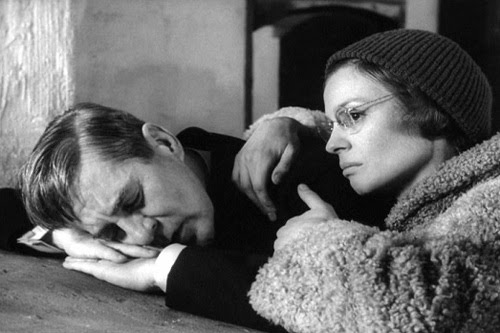
Gunnar Bjornstrand and Ingrid Thulin in Winter Light

Through a Glass Darkly

Year: 1961
Director: Ingmar Bergman
Screenplay: Ingmar Bergman
Starring Harriet Andersson, Gunnar Bjornstrand, Max von Sydow, Lars Passgard
Running Time: 89 minutes
Genre: Drama

Summary: A family of four spend their summer vacation on a remote island. Karin (Andersson) suffers from schizophrenia and has recently come out of a mental hospital. Her loving husband, Martin (Sydow) is unable to understand what is happening to her. Her father, David (Bjornstrand), a second-rate but successful novelist, is more wrapped up in his own problems. Her emotional seventeen year old brother Minus (Passgard) is the only one Karin can confide in, and he is severely out of his depth.
Sneaking a look at her father's diary, Karin discovers that her condition is incurable and that David, while sympathetic, is interested in studying the effects of the illness on her as it worsens. Feeling isolated from bother her husband and her father, and racked with guilt about her increasingly disturnbing closeness to Minus, Karin's mental state quickly deteriorates and her hallucinations become increasingly severe, as her grip on reality begins to shatter.

Opinions: This is the first of Bergman's loose "Faith Trilogy" which continued with Winter Light (1962) and concluded with The Silence (1963). This bleak and austere drama helped to seal Bergman's reputation as the master of Scandinavian gloom. However there is humour there and also some of the frequently overlooked warmth that was often present in Bergman.
Shot on the Swedish island of Faro, this is beautifully photgraphed in crisp black and white by regular Bergman cinematographer Sven Nykvist and features some superb perfomances from it's small cast (there are only four characters in the entire film) most of whom were also Bergman regulars. Harriet Andersson especially delivers a stunning perfomance in the lead role.
The film's downbeat nature certainly won't appeal to all viewers, but it is a must see for Bergman fans and is worth seeing anyway as a major work from one of the masters of cinema. Also despite the gloom it concludes with a faint glimmer of optimism. it is fair to say that you probably won't have a lot of fun with this film, but then it is not intended as entertainment, it is a piece of art.
The title refers to a passage in the Bible (1 Corinthians 13) which states that while we are alive we see God and God's plans as "through a glass, darkly" but it will all become clear after we die.

"It's so horrible to see your own confusion and understand it."
- Karin (Harriet Andersson) in Through a Glass Darkly


Max von Sydow, Harriet Andersson and Gunnar Bjornstrand in Through a Glass Darkly

Wednesday, 13 April 2011

The Seventh Seal

Year: 1957
Director: Ingmar Bergman
Screenplay: Ingmar Bergman
Starring: Max von Sydow, Bibi Andersson, Gunnar Bjornstrand, Nils Poppe, Bengt Ekerot, Inga Landgre
Running Time: 92 minutes
Genre: Drama, period, religion, allegory

Summary: A medieval knight, Antonius Block (von Sydow), and his cynical squire, Jons (Bjornstrand), return home to Sweden from the Crusades. Disillusioned and suffering a crisis of faith after what he has experienced and witnessed, Block encounters Death (Ekerot) on the shore. Death says that he has come for Block. However Block does not want to go until he has found some kind of meaning to life and concrete evidence of the existence of God, and so he challenges Death to a game of Chess. As the game progresses, Block and Jons travel through a country ravaged by the Black Death (the bubonic plague) and in the grip of religious fervor. Along the way Block meets, among others, a family of actors one of whom, Jof (Poppe), has mystical visions and a witch (Maud Hansson) who is condemned to death, as he searches for answers to his questions.

Opinions: This film is arguably the best known work from celebrated Swedish writer and director Ingmar Bergman. It has been referenced and parodied endlessly over the years, and has become seen as something of the archetypal high-brow "art" film. The film is deservedly a modern classic. Bergman grew up in an intensely Christian household. His father was a rector in the Church and as a child Ingmar Bergman would frequently accompany him on his visits to remote, rural churches where he saw medieval paintings and wood carvings which were among the chief inspirations for the film (in fact the screenplay for the film was based on a student play Ingmar Bergman wrote called Wood Painting). The film is a deeply personal one and deals with religious questions which concerned Bergman throughout his life, and some of the themes of the film, such as the "silence of God", were major preoccupations throughout his life.
The film is stunningly shot in crisp black-and-white, and some images from the film have become icons of world cinema particularly the image of the knight playing Chess with Death on the rocky shore as the sun rises. The film deals with weighty philosophical themes but it is also at times very funny. There is a strong element of bawdy comedy running through it, even Death gets a couple of one-liners. Comedy was not one of Bergman's strenghts admittedly, and he lacks the lightness of touch to make the humour work as well as it could, but it still gets some laughs. There is also plenty of suspense and drama.
The acting is good, with many of the actors being regular Bergman players. Max von Sydow is a particular standout as the anguished, searching knight knight
Powerful, complex, intriguing and entertaining, this is a masterpiece of world cinema and well worth checking out. Ultimately the film concerns itself with one of the major questions, the search for some kind of meaning to life.

Death: "Do you never stop asking questions?"
Block: "No, never"
Death: "But you get no answers."


Death (Bengt Everot) and the Knight (Max von Sydow) start their game in The Seventh Seal