Showing posts with label books. Show all posts

Friday, 25 March 2022

"The Invention of Sound" by Chuck Palahniuk

 Year of Publication:  2020

Length:  228 pages

Genre:  Horror, satire


Foster Gates has spent seventeen years trawling the very darkest corners of the internet searching for his missing daughter, and revenge on those who took her.  His quest leads him to Hollywood foley artist Mitzi Ives.  Mitzi specialises in providing screams for horror and action films.  She is the best in the business because her screams are so real, in fact they are harvested from people who are brutally murdered just for their death screams.  Mitzi realises that she has inadvertently come across the perfect scream, one so powerful that it could have potentially deadly consequences.


Since his 1996 debut novel Fight Club, which was made into the classic 1999 film, Chuck Palahniuk has explored the darkest excesses of our modern world in shocking and savage funny novels, comics, journalism and adult colouring books.  The Invention of Sound may not be Palahniuk's best book, but it is a well-written, disturbing and bleakly funny novel, which takes as it's basis one of the most ubiquitous but frequently overlooked aspects of filmmaking, the foley, which is basically creating ordinary sound effects for film and television.  The novel moves between Foster Gates' dark quest for his daughter, the story of possible serial killer Mitzi Ives, and the experiences of former horror star Blush Gentry, who is kidnapped during a Comic Con.  It's written in a fragmented, staccato prose, and is always readable, although it may be too bleak for some readers.  Palahniuk over-eggs the pudding somewhat, piling twist upon twist, particularly at the end, with the introduction of a shadowy conspiracy.


Sunday, 13 February 2022

"Luckenbooth" by Jenni Fagan

 Year of Publication:  2021

Length:  338 pages

Genre:  Horror


In 1910, Jessie MacRae, the devil's daughter, arrives at 10 Luckenbooth Court, an imposing tenement building in the heart of Edinburgh.  She is there to bear a child for the wealthy couple who own the building.  When things go horribly wrong, Jessie places a curse on the building.  As her supernatural revenge echoes through the decades it draws in the various lonely, lost souls that inhabit the building.  

This novel moves from 1910 to 1999, and is made up of a number of different narrators and stories, impacted to a greater or lesser extent by Jessie's curse.  We hear from, among others, Flora, a lovelorn trans woman, Levi, an African-American from Louisiana adrift in 1940s Scotland, Ivy, an ambitious would-be spy fuelled by revenge, famous Beat author William Burroughs, and Bee, a woman on a murderous quest for revenge.   It's a complex book, at times almost impressionistic and told in an almost stream of consciousness style.  There is a vivid, almost incantatory rhythm to the prose.  Crucially there is a lot of anger here, about long forgotten victims, dreadful crimes that go unpunished, and the depth of human cruelty, particularly male violence towards women.  It's bleak and troubling at times, but there is some light in the dark, love between people which at least provides some solace and hope.  Fagan has a real sense of time and place and it really captures Edinburgh very well.  At times it can be overwhelming and dense, and some of the stories certainly are more interesting than others.  Also it is more disturbing than actually scary, but it is worth your time.  It's a powerful and deeply resonant work.


Saturday, 29 January 2022

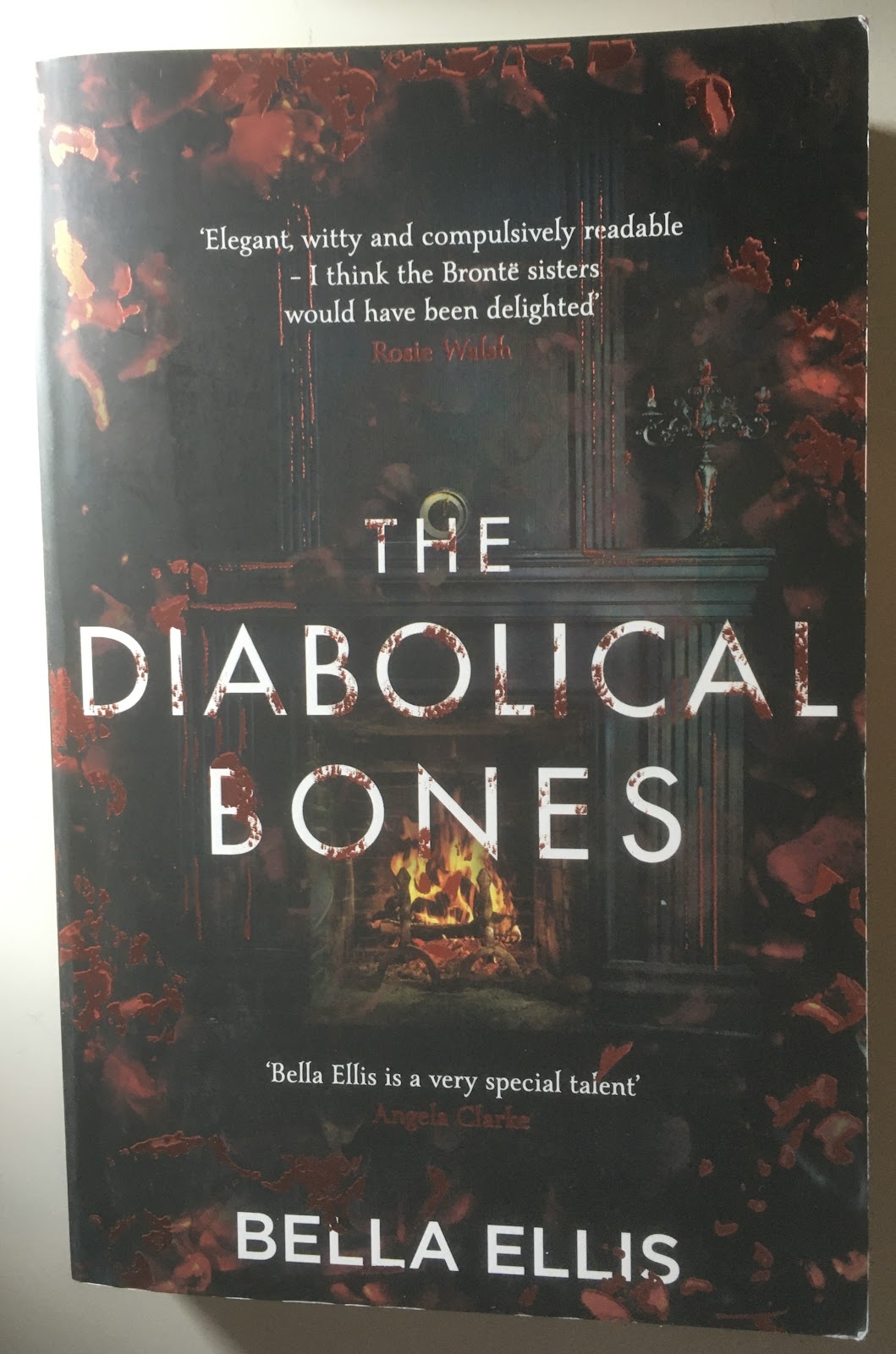
"The Diabolical Bones" by Bella Ellis

Year of Publication:  2020

Length:  340 pages

Genre:  Mystery


Haworth, December 1845:  Aspiring writers and amateur detectives (or "detectors") Charlotte, Anne and Emily Brontë are shocked when the bones of a child are discovered sealed up inside the walls of the nearby Top Withins Hall.  The prime suspect is immediately assumed to be the brutal Clifton Bradshaw, owner of Top Withins.  However, the Brontë sisters investigate and find themselves plunged into a murky world of occult rituals, human sacrifice, and a horrific orphanage, as they find themselves up against their most dangerous enemy yet.

This is the second in the "Brontë Mysteries" by Bella Ellis (the pen name of author Rowan Coleman), following The Vanished Bride (2019), which reimagine the famous literary sisters as detectives, investigating mysteries in and around the village of Haworth in Yorkshire.  As with its predecessor, The Diabolical Bones has an intriguing story, with an effectively creepy mystery at its centre.  Ellis writes with real skill, keeping the plot moving at a good pace and she has a strong feel for character and location.  Despite obviously being fiction, the book still ties in well with the known facts about the Brontë's lives and personalities, and is written with obvious love for the sisters and their work.  Even for readers unfamiliar with the Brontë's work, it's still a hugely enjoyable period mystery.


Saturday, 8 January 2022

"The Mayor of Casterbridge" by Thomas Hardy

 Year of Publication:  1886

Length:  310 pages

Genre:  Fiction


"The woman is no good to me.  Who'll have her?"

Unemployed farmworker Michael Henchard gets drunk at a country fair and impulsively sells his wife, Susan, and baby daughter to the highest bidder.  Eighteen years later, Susan and her daughter, Elizabeth Jane, track Henchard down, only to find that he is the richest and most powerful man in the town of Casterbridge.  Henchard is keen to make amends, but his attempts to make things right, coupled with his unchanged impulsiveness, lead to tragic consequences.   

Like the other Thomas Hardy novels, this is set in his fictional county of Wessex in the south-west of England.  It';s a beautifully written novel, with a real feeling for the rhythms of life among the rural poor and has a real sense of time and place.  The story is packed with incident, the story was originally serialised, and Hardy himself felt that too much stuff happens in the story, due to the need to provide incidents for each instalment.  The book works with it's powerful characters, particularly with the antihero Michael Henchard, who does a lot of really horrible things, but is almost redeemed due to the fact that he destroys himself and everything around him, but there is humanity there.  Henchard is his own worse enemy.  Things look up for the other characters in the novel when they dissociate themselves form Henchard, and he torpedoes every chance for happiness that he has, due to his pride, jealousy and greed.  For a classic novel, this is a real page-turner, if ultimately deeply tragic.   


Wednesday, 10 November 2021

"The Professor" by Charlotte Brontë

Year of Publication:  1857

Length:  223 pages

Genre:  Romance


 William Crimsworth escapes a miserable job working as a clerk in a Yorkshire mill owned by his cruel brother, to work as an English teacher at a girl's school in Brussels.  He soon captures the attentions of the school's headmistress, Mademoiselle Reuter, who determines his burgeoning romance with the penniless Frances, who is both a teacher and student in the school.


This was the first novel written by Charlotte Brontë and despite her many attempts to get it published, it wasn't available until 1857, two years after her death.  The novel was inspired by Brontë's own experiences as both a student and teacher in Brussels. This novel starts strongly, but falls down towards the middle, however it improves immensely towards the end.  While I did not like this as much as other Charlotte Brontë novels, I still believe it to be a very good book.  This is the only Charlotte Brontë novel narrated by a male character, and the main problem that the novel has is the deeply unlikeable lead character.  William Crimsworth is deeply prejudiced snob, who looks down on women, Catholics and pretty much anyone who is not English, although he does become slightly more bearable as the novel goes on and he begins to lose some of his prejudices.  The novel does have some rich supporting characters such as the mysterious Frances and Crimsworth's cynical "frenemy" Hunsden.  The story is engaging, and packed with incident, and Brontë's prose is as vivid and poetic as ever.  Charlotte Brontë's experiences in Brussels also formed the basis for her 1853 novel Villette, which is told from the point of view of a female teacher.


Saturday, 10 July 2021

"Tess of the d'Urbervilles" by Thomas Hardy

  Year of Publication:  1891

Length:  420 pages

Genre:  Fiction


In the rural English county of Wessex in the 19th Century, Tess Durbeyfield is happy but poor, living with her younger siblings and loving but feckless parents.  One day her father learns that they may actually be nobility, descended from the ancient "d'Urberville" family who were once powerful and wealthy but have fallen on hard times.  Tess is pressured to approach the wealthy d'Urbervilles that live nearby and plead ties of kinship.  However Tess unwittingly draws the attention of  libertine Alec d'Urberville, who persuades her, against her better judgement, to accept employment on his estate.  Alex persistently attempts to seduce Tess, who repeatedly rebuffs him, until late one night he overpowers her.  Things go from bad to worse for Tess, as she becomes a social pariah.  She spies the possibility of happiness through the love of free-thinking parson's son, Angel Clare, only to find that, while she is done with her past, it is far from done with her.


Like all of Thomas Hardy's major novels this is set in his semi-fictional county of Wessex in south-west England, in which all of the places are real, but given fictional names.  This is a powerful, heartbreaking novel.  Tess is slowly destroyed because she is raped by Alec d'Urberville, for which she is blamed by pretty much everyone she encounters.  D'Urberville's attack is kind of ambiguous in the novel, it is hinted at after the fact, but not actually described.  Thomas Hardy is scathing about society's double standards and how women such as Tess are treated, and it really shocked readers in the 1890s, but it is important to remember that the book is a product of the 1890s, and so it may not seem as forward thinking to modern readers as it did to contemporary readers.  Tess is a wonderful main character who is sympathetic and engaging, and you feel so sorry for her, as Hardy seems to pile on every misery he can think of upon her.  Angel Clare, our romantic hero, is actually kind of a dick.  He marries Tess about halfway through the book, and confesses to her a sexual liaison he had with a woman in London, Tess tells him her story, and he basically dumps her even though he tells her that she is "more sinned against than sinning," before heading off to Brazil without her.  The book is very well written and wrings out every kind of emotion.  it is funny, heartbreaking, and will make you angry.  The events of the narrative are set against the rhythms of 19th century rural life, and the book is this beautiful pastoral of the English countryside and farming life.


Saturday, 19 June 2021

"We Have Always Lived in the Castle" by Shirley Jackson

 Year of Publication:  1962

Length:  158 pages

Genre:  Mystery, thriller


Mary Katherine Blackwood (or "Merricat" as her sister calls her) is 18 years old and lives with her 28 year old sister Constance, and elderly, wheelchair-bound Uncle Julian in the large Blackwood family mansion.  Constance was accused of poisoning the rest of the family six years previously, but was acquitted due to lack of evidence.  The residents of the nearby village either hate the Blackwoods or regard them as objects of morbid curiosity.  One day, the sister's Cousin Charles arrives and invites himself to stay.  Constance appears to be taken in by his charm, but Merricat mistrusts and hates him.  Charles himself appears to be most interested in the contents of their father's safe.  Merricat however is determined to go to any lengths necessary to protect her family.

Author Shirley Jackson is possible best known for her novel The Haunting of Hill House (1959) and her short story "The Lottery" (1948).  As with much of Jackson's work, this deals with the cruelty of seemingly "nice" American small towns, and with outsiders finding a place for themselves, even if it is outside of life itself.  The story is told through the disarming eyes of Merricat, who despite introducing herself as being 18 years old, sounds as if she is much younger.  She is a mix of innocent but streetwise, naive but intuitive, gentle and fiercely loyal to those she loves, but also completely psychotic.  Constance never leaves the Blackwood estate, but Merricat makes trips to the village when necessary to pick up groceries and run messages.  Frequently insulted and mocked by the villagers, Merricat indulges in alarmingly vivid revenge fantasies.  She also indulges in more innocent fantasies of winged horses, and a life far away on the Moon.  A strong believer in witchcraft and magic, Merricat sets up charms, and buries special objects in order to set up protective spells around their home.  Despite taking on the mother role, Constance appears frightened of Merricat.  She seems to have an urge and possibility of emerging into the outside world, but is held back by Merricat who hates and fears any type of change.   Charles may be a thief and a monster, but it appears that he may be good for Constance, allowing her to enter the world again, and the conflict between him and Merricat is really a tug of war for the soul of Constance, less of an angel and demon, but two demons, which I suppose is as much as one may expect these days.  This isn't really a mystery, although it is kind of set up as one.  You'll probably figure out who killed the Blackwoods very early on, but it doesn't really spoil the book.  Despite her implicit monstrousness, Merricat is a likeable character, and it is a great pleasure to spend time with her and Constance in the pages of the book.  Eventually they become fairytale characters in their own castle, a happy ending for Merricat, but perhaps less so for Constance, and we leave them as we do the residents of Hill House, to walk alone.  


Saturday, 6 March 2021

"Single & Single" by John le Carre

 Year of Publication:  1999

Length:  374 pages

Genre:  Thriller


What connects the murder of an English lawyer in Istanbul, a shabby children's party magician in Devon who finds a vast fortune mysteriously deposited in his daughter's trust fund, and the disappearance of the head of a once respected financial institution with ties to organised crime?  Tenacious British customs officer Nat Brock investigates the mystery and uncovers a vast international criminal conspiracy.


The death of British author John le Carré, the pen name of David Cornwall, in December 2020 robbed the world of one of the great writers of popular fiction.  Making his name with Cold War spy thrillers in the 1960s, le Carré managed to navigate the complex and ever shifting landscape of international politics.  As with most le Carré novels this is essential of a conventional thriller and more a psychological piece about the moral and spiritual price of lives built entirely on deceit.  It's not one of his best books, the book starts well and then gets bogged down in the middle with complex debates on money laundering and other legal and financial issues, but it does pick up as it moves towards it's conclusion.  However, it ends so abruptly I thought my book was missing a chapter.  Like a lot of John le Carrè, the characters are all deeply flawed, which makes it more realistic but also means that it's really hard to care about most of them, which really isn't good for a thriller.


Wednesday, 27 January 2021

"The Unsettled Dust" by Robert Aickman

Year of Publication:  1990

Length:  362 pages

Genre:  Horror, fantasy, short stories


During his lifetime English author Robert Aickman was probably best known as a conservationist, helping to set up the Inland Waterways Association to preserve canals in Britain, but after his death in 1981 at the age of 66, his reputation has grown as an author of unique skill.  The Unsettled Dust, which was published posthumously, contains eight of his forty eight horror stories (or "strange stories" as Aickman preferred to term them).  

In "The Unsettled Dust" a visitor to an old dust-shrouded English country house, finds something there even more sinister than the two creepy sisters who live there; in "The Houses of the Russians" a man recounts how he found a magical talisman on a forbidden island in Finland; in "No Stronger than a Flower" an unhappy woman undergoes bizarre changes after a visit to a sinister beautician; in "The Cicerones" a tourist comes to regret his visit to a remote Belgian church; in "The Next Glade" a woman is haunted by a strange man she meets at a party; in "Ravissante" a young artist has a disturbing experience when he visits the elderly widow of a famous painter; in "Bind Your Hair" a woman meets some strange new friends when she visits her boyfriend's family in their remote country village; and in "The Stains" a bereaved man falls in love with a strange young woman, and loses far more than his heart.

Robert Aickman wrote beautiful prose.  His stories are well crafted, with psychologically complex characters in a carefully described, mundane world, that become increasingly strange and disturbing, until the characters are trapped with no way out.  Even at the end of the stories, it's unclear whether it is really the end.  Often the darker elements in the stories are hinted at and are more ambiguous than explicit, and very little is actually explained.  The stories have a genuinely disquieting feel to them, and some of them are really genuinely scary.  Recommended for fans of intelligent supernatural horror.  


Thursday, 19 November 2020

"The Member of the Wedding" by Carson McCullers

 Year of Publication:  1946

Length:  179 pages

Genre:  Coming-of-age


The novel takes place over a few days in August in a small town in the Southern United States during World War Two.  Twelve year old Frances Jasmine "Frankie" Addams is a lonely, bored, but highly imaginative girl.  Her closest companions are the family's African American maid, Berenice, and Frankie's six year old cousin, John Henry.  She becomes fascinated with her brother's upcoming wedding and determines to involve herself in the wedding, and run off with the happy couple on their honeymoon.


This is an economical, beautifully written tale about growing up.  While written in the third person the narrative never leaves Frankie's perception of the world around her, a world that is seemingly safe but full of darkness and sharp edges. Frankie is imaginative and very intelligent, but very impulsive and foolhardy.  Her cousin, John Henry, she regards as a nuisance and also a companion.  Her mother is dead, and her father lives in the house, but is a largely absent figure, who seems to have little to no understanding of Frankie and her needs.  Her main caregiver and probably closest friend is Berenice, who is the only one who seems to really understand Frankie, and certainly the only one who really seems to make an effort to understand her, she also presents a different and more complex world to Frankie and the reader.  Berenice is a cleverly and sensitively drawn character.  While race is not a key theme in the novel, it is definitely present.  One of the most disturbing elements in the book is Frankie's meeting with an unnamed soldier, and there is darkness throughout the book.  It has elements of gentle nostalgia, but there is cruelty at it's core.  It takes place during the Second World War, which is discussed throughout, contrasting the small seemingly unchanging town, with the chaos and tumult going on in the world outside.  The book's key incident, the wedding itself, barely features, brushed over in a few paragraphs, it exists in the world of hope and memory.  


Sunday, 30 August 2020

"Agent Running in the Field" by John le Carre

Year of Publication:  2019
Length:  366 pages
Genre:  Spy, thriller

This is the 26th book by British author John le Carré and he still has his finger on the political pulse of our troubled times.  The story revolves around Nat, a 47 year old veteran of the British Secret Service, who forms a friendship with a young man named Ed with whom he plays badminton once a week.  At first these games offer a respite from Nat's professional problems, as he is put in charge of an all but washed-up subsection of the Service, with a motley collection of spies.  However soon his personal and professional lives collide and Nat finds himself in an even murkier world of betrayal and intrigue.

This book deals with some of the most pressing political issues of our time and John le Carré is scathing against Brexit, Donald Trump, Vladimir Putin and Boris Johnson.  However, this is not a political tract.  It mixes important messages with an exciting thriller plot full of interesting and engaging characters, and the story moves forward at a fast pace.  Despite being almost 80, le Carré has lost none of his ability to tell a story or remain engaged in the times that he is living in.  If you have never read le Carré before, this is a very good place to start.


Monday, 24 August 2020

"Exhalation" by Ted Chiang

Year of Publication:  2019
Length:  350 pages
Genre:  Science-fiction, short stories

In this collection of nine short stories by author Ted Chiang, a merchant in ancient Baghdad uses a time portal to try to fix past mistakes; an investigation into a seemingly small oddity causes an alien doctor to stumble upon a secret which could threaten the entire universe; a novelty device puts the entire question of free will into question; a new type of virtual pet develops intelligence and self-awareness; a Victorian robot nanny produces unexpected and disturbing side effects; a company develops software that could give an individual perfect recall of any event in their lives; the first contact with a non-human intelligence could come from much closer to home than anyone could guess; a scientist on a highly religious alternate Earth makes a discovery that could put all their beliefs into question; and a device that allows people to see into the lives of their counterpart in parallel universes leads to positive and negative outcomes.

This is the second volume of short stories by American author Ted Chiang, who is probably best known for his story "Story of Your Life", which was adapted as the film Arrival (2016).  The stories in this volume deal with some well-known science-fiction concepts, but they are dealt with in a refreshingly unique way.  The fantastical elements are well-rendered and intelligently realised, and the stories are more concerned with their impact on  human nature.  Chiang is a very good writer, who doesn't just craft intriguing and intelligent stories, but also deeply moving ones as well.  There is a real humanity and compassion here.  This is well recommended for anyone looking for great science-fiction, and also great contemporary fiction in general.

Saturday, 18 July 2020

"Beautiful You" by Chuck Palahniuk

Year of Publication:  2014
Length:  222 pages
Genre:  Satire

Naive, ambitious Penny Harrigan, from Omaha, works as an assistant at a prestigious law firm in New York City where she meets Cornelius Linus Maxwell, the richest man in the world, known to the press as "Climax-well" due to his string of famous glamorous girlfriends. He sweeps Penny off her feet, and soon she finds herself living a jet-set lifestyle meeting the most powerful and beautiful people in the world, with every luxury she could possible want.  However Penny immediately realises that she is not Maxwell's girlfriend, but a guinea pig for his experiments in sex and sensuality, and he is using the results of his experiments to devise a groundbreaking range of sex toys for women, marketed as "Beautiful You".  As the women of the world become addicted to the extreme pleasures of the Beautiful You products, Maxwell's darker purpose becomes clear.

This is the fourteenth novel from cult American author Chuck Palahniuk, who is probably still best known for his debut novel Fight Club (1996).  Like most of his books, this is a contemporary satire, in which an aspect of modern life is take to apocalyptic extremes, notably sex and consumerism, and the exploitation of women's sexuality.  This is not one of Palahniuk's best works by any means, the ending in particular is disappointing, but it is well-written and raises some compelling themes, even if they could be explored further. 


Thursday, 16 July 2020

"If Not Now, When?" by Primo Levi

Year of Publication:  1982
Translator:  William Weaver
Introduction:  Mark Mazower
Length:  331 pages
Genre:  War

Set during the last couple of years of the Second World War, the novel follows a band of mostly Jewish partisans and resistance fighters, from Poland and Russia, as they survive in Nazi-occupied territory.  Always on the move, struggling against harsh conditions, often lacking food and supplies, and wracked by fear, personal tensions and rivalries, they try to sabotage and hamper the Nazis as much as possible, fuelled by revenge, loyalty, patriotism, and hopes for a life after the conflict.

Primo Levi was an Italian chemist and writer who is probably best known for his autobiographical works recounting his experiences as a prisoner in Auschwitz, most notably It This Is a Man (1947), and his fiction was mostly in the form of short stories.  If Not Now, When? was his only novel, and this was based on his own experiences fighting the Nazis as a partisan and the stories he was told from partisans and resistance fighters that he met in the years immediately after the war.  This is a fantastic novel.  A gripping war story, full of action and adventure, telling an often overlooked aspect of World War II, it is also a story about ordinary human beings in the most terrible situations, told with empathy and compassion.  The characters are complex, particularly the main point of view character, Mendel, a Russian watchmaker turned reluctant soldier.  While there are moments of joy and humour, this is a dark tale, and touches on the emotional and psychological consequences of killing and surviving war.


Sunday, 12 July 2020

"The Complete Cosmicomics" by Italo Calvino

Year of Publication: 2009
Introduction:  Martin McLaughlin
Length:  402 pages
Genre:  Science-fiction, fantasy

This collection of linked short stories traces the history of the universe, from the Big Bang, across billions of years and galaxies, as narrated by the "cosmic know it all" Qfwfq, a shape-shifting being who has existed since the beginning of time, in a variety of forms and lives, including an amoeba, a mollusc, a dinosaur, a ship's captain, and a moon-milk gatherer, among others.  The stories usually begin with a brief explanation of a scientific premise (some still accepted, some of which are disproved) and then spin it off into a tale told by Qfwfq to an unidentified listener.  Qfwfq also is just one of a large number of immortal shape-shifters, who make up his family, friends, enemies and lovers, and they all have an all-too-human outlook on the cosmic events they witness and participate in.  Some of the stories do not involve Qfwfq at all, and make up unconnected scientific or post-modern tales, including a hunter at the point of loosing an arrow at a leaping lion, an assassin and his quarry trapped in a stalemate by a traffic jam, and a post modern version of the Alexandre Dumas story The Count of Monte Cristo.

Italian author Italo Calvino began writing the "Cosmicomics" stories in the early 1960s and published them off an on from the 1960s to the 1980s.  The first collection, Cosmicomics was published in 1965 in Italian and 1968 in English, and was followed by t zero (1967, published in English as Time and the Hunter in 1970), and several others were published in different collections in the 1980s.  This book contains all of the stories from Cosmicomics and t zero as well as collecting other stories, some of which had never been published before.  The stories are usually very short, usually between 10 to 15 pages, with the longest being around 38 pages and made up of three interconnected segments.  The stories are often very surreal, sometimes very funny, playful. wildly inventive, some of the stories I found a little inaccessible, but usually they are fantastic short stories.  This is a wonderful book, and beautifully written. 


Saturday, 7 March 2020

"Kim Jiyoung, Born 1982" by Cho Nam-Joo

Year of Publication:  2016
 Translator:  Jamie Chung
Number of Pages:  163
Genre:  fiction

Meet Kim Jiyoung, an ordinary woman living in South Korea with a husband and young daughter.  However Kim Jiyoung is exhibiting strange behaviour, adopting the personalities of women she has met in her life.  We flash back to her earliest years and see her life marked with constant everyday sexism and institutional misogyny.

A short but powerful book exploring everyday sexism and misogyny in modern-day Korea, but there is enough in here to resonate with women throughout the world.  Kim Jiyoung is born into a family that wanted a son instead of a daughter; she is tormented by a male classmate but is told that she should be flattered; she is threatened at a bus stop and made to feel that she is the problem; she is constantly overlooked for promotion at work; she gives up her life and career for motherhood and domesticity.  All of this is presented in stark, pitiless prose, bolstered by statistics from a variety of sources.
This book was a sensation on it's first publication in Korea, and was gifted to South Korea's president, Moon Jae-in. 
An important and powerful book, this will resonate with female readers, and should make male readers think about how we should be better.


Wednesday, 26 February 2020

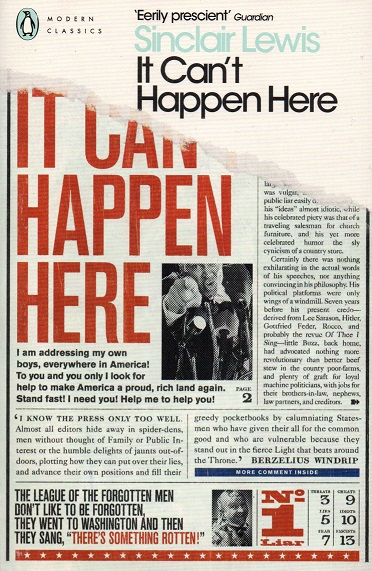
"It Can't Happen Here" by Sinclair Lewis

Year of Publication:  1935
Number of Pages:  376
Genre:  Political fiction, dystopia

Senator Berzelius "Buzz" Windrip, a vain, outlandish, racist, sexist demagogue is voted President of the Unites Sates of America, with promises that he will make angry, white voters proud, prosperous and powerful, and, more or less, that he will Make America Great Again.  Before long he becomes the dictator of a totalitarian United States.  The rise of Windrip, and America's descent into tyranny, is shown through the increasingly appalled eyes of small town newspaper editor Doremus Jessup who soon learns, to his horror, that it can happen here.

This is a powerful anti-fascist novel that, distressingly, feels possibly more timely now than it did when it was first published in 1935, at the height of fascism in Europe.  While the book is very much of it's time, it's set during the late 1930s and references several real-life people and events of the time, it is still readable today.  And this is a very readable book.  Lewis was a good writer, with a memorable turn of phrase and a dab hand in writer striking one-liners.  In the early stages of the book it is often laugh out loud funny, but as the novel progresses, and the situation becomes more serious, the laughs quickly vanish.  This book is a must read for anyone, just to see where we are and where we may be headed.  Remember, not only can it happen here, but it is happening here.


Thursday, 16 January 2020

"The Martini Shot and Other Stories" by George Pelecanos

Year of Publication:  2016
Length:  295 pages
Genre:  Crime, thriller  

This entertaining book collects seven short stories and one novella.  George Pelecanos is a crime writer who specialises in tough, urban thrillers set in and around Washington DC, and subsequently found great success as a screenwriter, writing episodes of The Wire (2002-2008) and Treme (2010-2013) among others, and was the co-creator of The Deuce (2017-2019) with regular collaborator David Simon.

The stories in this book are very much in the typical Pelecanos style:  a police informant grapples with family problems and his own conscience; a family with several adopted children find the lives of their kids taking unexpected and sometimes dark paths; a young boy finds his skill at basketball makes him some bitter enemies; a seasoned private investigator finds more than he bargained for while investigating a case in Brazil; a young drug dealer tries to get out of the life but finds it's easier said than done; three college friends find their lives going in very different directions when a drug deal goes wrong; in 1930s New York a busboy seeks vengeance for the murder of his friend; and a TV crime writer finds himself embroiled in a real-life crime drama.  Incidentally, the book's title is film industry slang for the last shot of the day, referring to the fact that the next shot is liquor.

The stories are fast moving,  tense and sometimes surprisingly funny, they showcase Pelecanos' ear for dialogue and eye for detail.  However, many of them do cover very similar ground, and plot is not Pelecanos' strong point.  His books are usually more like character pieces with the plots almost playing out in the background.


Saturday, 26 October 2019

"Growing Things and Other Stories" by Paul Tremblay

Year of Publication:  2019
Number of Pages:  476
Genre:  Horror, short stories

This is a collection of nineteen short horror stories: Two sisters struggle to survive in a world choked by lethal ever-growing plants; a school class have their lives ruined by a shocking video; a meth addict kidnaps her child while her town is seemingly destroyed by a giant monster; an aspiring journalist gets more than he bargains for when he interviews a cult author; a woman is haunted by her childhood ghosts in a Choose Your Own Adventure story; a horror writer soon regrets hiring a dog walking service and more.

As with all anthologies it's a mixed bag, although when it works it is genuinely creepy and unsettling. I have never read anything by Tremblay before, and I do think that I missed out on elements in some stores that tie in to his previous books, although I still enjoyed them.  If you like stories that answer all the questions and tie up all the loose ends, then this book probably isn't for you. Much of the horror is kept very ambiguous, with the more conventional "horror" elements happening in the background or just hinted at.  It is certainly recommended for anyone who wants a good scare.


Thursday, 24 October 2019

"The Institute" by Stephen King

Year of Publication:  2019
Number of Pages:  485
Genre:  Science-fiction, thriller, horror

Deep in the Maine woods is a top-secret Government facility known by staff and inmates alike merely as "The Institute".  Children are abducted from all over the Unites States and imprisoned in The Institute where they are subjected to a battery of brutal medical tests, designed to increase and harness their latent powers of telekinesis and telepathy.  After weeks of tests, the children are brought to the sinister "Back Half" of The Institute, and are never seen again.  Twelve year old Luke Ellis is The Institute's latest inmate.  Luke is not just smart, he is an actual genius, but his intelligence is not what The Institute is interested in. 

This is less a horror novel and more of a science-fiction/thriller, with the monsters being all too human, and disturbingly convinced that what they are doing is right.  While it is not one of Stephen King's best, it is still an exciting, page-turning thriller.  The story covers a lot of ground, and has a lot of characters, particularly towards the end when there are about three different plotlines running concurrently, but he manages to balance them them like a maestro.  The book doesn't exactly break new ground, psychic children in particular being a recurrent theme in King, and some of the smaller characters feel a bit interchangeable.  That being said, though, King fans are bound to lap this up, and it should also please anyone looking for an exciting thriller.