Saturday, 22 July 2023

She Said

 Year:  2022

Director:  Maria Schrader

Screenplay:  Rebecca Lenkiewicz, based on the book She Said by Jodi Kantor and Megan Twohey

Starring:  Carey Mulligan, Zoe Kazan, Patricia Clarkson, Andre Braugher, Jennifer Ehle, Samantha Morton, Ashley Judd

Running Time:  129 minutes

Genre:  Drama


In 2017, New York Times journalists Jodi Kantor (Kazan) and Megan Twohey (Mulligan) investigate allegations by actresses Rose McGowan, Gwyneth Paltrow and Ashley Judd against powerful film producer Harvey Weinstein.  As they investigate the claims, Kantor and Twohey uncover a history of abuse by Weinstein stretching back decades, against numerous women.

When allegations against film producer Harvey Weinstein, co-founder and one time head of Miramax Films, with his brother Bob Weinstein, and later co-head of The Weinstein Company, first hit the headlines in late 2017 it had a seismic impact not just in Hollywood but around the world, helping to ignite the #MeToo movement against sexual abuse and harassment.  Megan Twohey and Jodi Kantor, who investigated and reported on the claims for The New York Times, detailed their investigation in the 2019 book She Said.  The world of journalism has always provided a rich source for filmmakers, and the film certainly echoes the classics of the genre, such as All the President's Men (1973) and Spotlight (2015).   However, the film moves away from the some of the cliches of boozy, chain-smoking, fast-talking men, barreling down corridors, shouting, instead the journalists are depicted as hard-working, dedicated, professionals who have full lives outside the newsroom, and we see both Kantor and Twohey at home with their respective young families, and Twohey's struggle with postpartum depression, having recently given birth.  Carey Mulligan and Zoe Kazan both give strong, empathic performances in the lead roles, and Samantha Morton and Jennifer Ehle give powerful performances as two of Weinstein's victims.  With such a recent, high profile and important case, filmmakers have to perform a very delicate balancing act, between creating a compelling piece of drama, while more importantly not exploiting, or sensationalising the horrific crimes.  The film mostly plays as a docudrama and, wisely, the decision is made not to centre Weinstein, who is only glimpsed once in the film, towards the end and only seen from behind amidst a huddle of people striding through the New York Times building.  Mike Houston provides Weinstein's voice on the phone rasping insults and threats to the journalists.  Weinstein's crimes are not dramatised.  Instead we have victims giving their accounts over images of empty hallways and dishevelled hotel rooms.    At one point a recording of voice recording of Weinstein harassing and threatening Ambra Gutierrez is played.  The film's main issue is that the story is so recent, and has been so well-covered, that most viewers will already be familiar with it all.  However, even while the story may be familiar, and the pacing is sometimes uneven, this is a compassionate and gripping film.  


Zoe Kazan and Carey Mulligan in She Said

Friday, 14 July 2023

The Dunwich Horror

 Year:  1970

Director:  Daniel Haller

Screenplay:  Curtis Hanson, Henry Rosenbaum and Ronald Silkosky, based on the short story The Dunwich Horror by H. P. Lovecraft

Starring:  Sandra Dee, Dean Stockwell, Ed Begley, Lloyd Bochner, Donna Baccala, Joanne Moore Jordan, Sam Jaffe

Running Time:  90 minutes

Genre:  Horror


At the Miskatonic University in Arkham, Massachusetts, student Nancy Wagner (Dee) becomes fascinated with the strange Wilbur Whateley (Stockwell) who is desperate to get his hands on the University's copy of a very rare and valuable book knows as the Necronomicon.  Nancy accepts Wilbur's invitation to spend some time at his mansion in the nearby small town of Dunwich.  At the mansion, Nancy is disturbed by Wilbur's grandfather (Jaffe).  It turns out that the Whateley's have a very bad reputation in the town.  Wilbur is obsessed with using the Necronomicon to bring back the "Old Ones" who used to rule the earth, and plans to sacrifice Nancy in an occult ritual.

American writer H. P. Lovecraft has been hugely influential in the fields of horror and science fiction.  In particular his brand of cosmic horror known as the "Cthulhu Mythos" which postulates that long ago, Earth was ruled by monstrous creatures known  as the "Old Ones" who, due to their evil ways, were banished to another dimension by the yet more powerful "Elder Gods".  The immortal Old Ones still exist and are eternally desperate to get back and reclaim their dominion over Earth.  They can be summoned by various rituals and incantations, which have thoughtfully been written down in various ancient grimoires, most famously the Necronomicon.  While Lovecraft has certainly been influential his work has proved challenging to filmmakers.  His conception of creatures that can drive to madness any human unfortunate enough to so much as look at them is difficult to render on film, even with CGI.  Lovecraft is also controversial due to his blatant racism and misogyny.  There have been successful Lovecraft adaptations, however, such as Re-Animator (1985), From Beyond (1986) and Color Out of Space (2019).  This film, from the stable of B-movie maestro Roger Corman, is enjoyable enough, but not one of the best.  Incidentally, Roger Corman previously directed one of the first Lovecraft adaptations, The Haunted Palace, which was officially part of Corman's series of eight films based on Edgar Allan Poe, but the plot is actually from the Lovecraft story The Case of Charles Dexter Ward.  Loosely based on the 1928 short story by Lovecraft, The Dunwich Horror does a decent enough job of putting Lovecraft onto the screen.  Although Sandra Dee never really seems particularly frightened by the goings-on around her; Dean Stockwell gives an intense, quiet performances as the wicked warlock, and is really the film's highlight.  Veteran actor Ed Begley, in one of his final roles, seems slightly embarrassed in his role as the heroic professor who races to save the day.  Talia Shire (here credited as Talia Coppola), who would go on to appear in The Godfather and Rocky series, appears in a small role as a nurse.  The film is full of bizarre psychedelic effects, which are lively if unintentionally funny, and frequent dream sequences, which just really seem shoehorned in to get some nudity into the film.  The film is watchable enough, and there is enough going on that it never really gets boring, however it is likely to disappoint Lovecraft fans and is probably not enough to convert non-fans.  


Dean Stockwell in The Dunwich Horror

Saturday, 8 July 2023

Nosferatu: A Symphony of Horror

 Year:  1922

Director:  F. W. Murnau

Screenplay:  Henrik Galeen, based on the novel Dracula by Bram Stoker

Starring:  Max Schreck, Gustav von Wangenheim, Greta Schröder, Alexander Granach, Ruth Landschoff, Wolfgang Heinz

Running Time:  84 minutes

Genre:  Horror

Wisborg, 1838:  Young clerk Hutter (von Wangenheim) is sent by his sinister boss, Knock (Granach), to a remote castle high in the Carpathian Mountains in Transylvania to negotiate the purchase of a house by the mysterious nobleman Count Orlok (Schreck).  Hutter soon discovers the horrific truth that Count Orlok is a blood-thirsty vampire or nosferatu.

This classic silent horror film is technically the first adaptation of Bram Stoker's famous novel Dracula.  However the adaptation was unauthorised and unofficial.  The filmmakers approached Stoker's widow, Florence Stoker, for the rights to adapt the film, but they decided that they couldn't afford the price she was asking, and so they just decided to go ahead anyway.  When Florence Stoker found out, she was furious, and sued the filmmakers, bankrupting the studio, with the court ordering all copies of the film to be destroyed.  However it had already been exported internationally and some prints resurfaced in France and the United States.  The film is one of the most influential horror films ever made.  While not as heavily stylised as the surreal dreamscape of The Cabinet of Dr. Caligari (1919), it is part of the German Expressionist movement, in which the character's inner worlds are reflected in the outer world.  Viewed today, it does suffer from overly melodramatic acting, as well as director F. W. Murnau's decision to use sped-up motion in scenes such as the carriage driving through the forest, and Orlok loading his coffins into a cart.  Murnau, apparently thought that sped-up motion was scary, but today it looks more comical than anything else, although at this point cinema was still very new and was still trying to find it's own language and style.   In fact some of Murnau's innovations work very well, for example the novel Dracula is told through diaries, journals, newspaper cuttings, and so on, and Murnau carefully designed the intertitles of the film himself to replicate the pages of old books and documents.  Despite being 100 years old, the film is still hugely effective, and is still one of the greatest vampire films ever made.  The vampire in Nosferatu is based on the traditional European folkloric vampire, as a hideous reanimated corpse rather than a suave lounge lizard in evening dress.  Max Schreck makes an indelible impression as Count Orlok, a cadaverous figure incased in black, his hands as grotesque talons, bat-like ears, bald, with a pinched face and sharp, rodent-like fangs.  The vampire is explicitly connected with disease, arriving in the town of Wisborg, accompanied by hordes of rats, and bringing the plague.  Schreck's portrayal was so convincing that there were rumours at the time that he really was a vampire.  The rumour inspired its own film Shadow of the Vampire (2000), a fictionalised version of the filming of Nosferatu starring John Malkovich and Willem Dafoe.  The film contains some unforgettable images, such as Orlok on the death ship; the shadow of the vampire creeping up the stairs towards his victim; and also the climax where the vampire is dissolved by the rays of the sun.  Possibly the film's biggest contribution to vampire lore is the idea of the vampire being destroyed by sunlight.  In Dracula, the vampire is weakened by sunlight, but it is not lethal.    Nosferatu was remade in 1979 as Nosferatu the Vampyr, written and directed by Werner Herzog, with Klaus Kinski as the vampire, and another remake is set for release in 2024.  Although originating as an unauthorised adaptation of a popular novel, Nosferatu has grown beyond its origins, casting an indelible shadow that lingers to this day.


Max Schreck as Count Orlok in Nosferatu: A Symphony of Horror
     

Wednesday, 28 June 2023

The Killing of a Chinese Bookie

 Year:  1976

Director:  John Cassavetes

Screenplay:  John Cassavetes

Starring:  Ben Gazzara, Timothy Agoglia Carey, Seymour Cassel, Azizi Johari

Running Time:  135 minutes (cut to 109 minutes)

Genre:  Drama, thriller

Cosmo Vittelli (Gazzara) owns and operates the sleazy, failing nightclub Crazy Horse West in Los Angeles.  To make matters worse Cosmo owes a large gambling debt to the Mob.  The gangsters order Cosmo to kill a bookmaker, Harold Ling (Soto Joe Hugh).  After some less than gentle persuasion, Cosmo reluctantly accepts his task, but soon finds the hit is much more complex than he had expected.

Writer, director and actor John Cassavetes appeared as an actor in a number of big Hollywood movies such as The Dirty Dozen (1967), for which he received an Academy Award nomination for Best Supporting Actor, and most notably a starring role as Mia Farrow's traitorous husband in Rosemary's Baby (1968).  However, he is most influential as a writer and director, and his echo is still felt today in the world of Independent Cinema.  Despite its seemingly conventional thriller plot, in terms of style and approach, The Killing of a Chinese Bookie is anything but conventional.  More a character study than a thriller, the film focuses on the dilemmas and pressures of Cosmo Vittelli, a man whose entire world is this sleazy club, and who puts all of the money he earns back into the club, as well as spending a lot of time and effort writing and directing the cheesy cabaret acts, hosted by the club compere "Mr. Sophistication" (Meade Roberts), even though he knows that the audience only care about seeing naked women.  He also has a severe gambling problem.  To celebrate making his last payment on a previous debt to a loan shark, he immediately goes out on a night on the town and ends up losing everything on poker.  Ben Gazzara, who saw Vittelli as a kind coded version of Cassavetes himself, gives a great performance, giving Vittelli a kind of down-at-heels charm, and a cocktail of hope and despair.  As is common with Cassavetes' work, the film has a loose, documentary style look, filmed guerrilla-style on the streets and in nightclubs, restaurants and homes.  The performances, which include Cassavetes regular Seymour Cassel and veteran gangster movie actor Timothy Carey, have a naturalistic, improvised feel about them.  The film was originally released in 1976 with a running time of 135 minutes, and immediately tanked at the box office, being withdrawn from general release after a week, with even Gazzara stating that it "was too long".  Cassavetes re-released the film in 1978 in a much shortened version of 109 minutes, with scenes drastically rearranged and some new footage.  For a long time this was the only version available, but in 2004 the 109 minute and 135 minute versions were released on DVD, so now you can watch both, should you care to.

The eagle-eyed viewer may notice a familiar face in some of the crowd scenes.  David Bowie sat in on much of the filming, just to watch Cassavetes at work, although he was not involved in the film.  However he can be glimpsed in the audience during some of the nightclub scenes.


Ben Gazzara in The Killing of a Chinese Bookie


Monday, 8 May 2023

Star Trek: The Motion Picture

 Year:  1979

Director:  Robert Wise

Screenplay:  Harold Livingston, from a story by Alan Dean Foster, based on Star Trek created by Gene Roddenberry

Starring:  William Shatner, Leonard Nimoy, DeForest Kelley, Stephen Collins, Persis Khambatta, James Doohan, Nichelle Nichols, George Takei, Walter Koenig

Running Time:  132 minutes

Genre:  Science-fiction


When a mysterious alien cloud possessed of powerful destructive capabilities is detected on a course heading directly for Earth, Admiral James T. Kirk (Shatner) is put in charge of the newly overhauled USS Enterprise, and reunites his old crew to investigate and stop the cloud's path of destruction by any means necessary.

When the original television series of Star Trek ended in 1969 after three seasons and 79 episodes, it looked like it would be one more cancelled TV show that would exist for evermore in the fuzzy afterlife of repeats.  However, as the 1970s progressed, Star Trek became a major success in syndication, as well as attracting increasing numbers of devoted fans.  A 14 episode Saturday morning cartoon version was broadcast in the mid '70s, but Paramount Studios were becoming interested in a new live-action Star Trek.  In the late '70s Paramount announced plans for a new cable TV  network, to be imaginatively named The Paramount Network, and the flagship programme on launch night would be Star Trek: Phase II, which would feature some of the original cast alongside new characters.  Pre-production was already well advanced on Star Trek: Phase II, scripts had been written, sets had been built, parts had been cast, costumes designed and some special effects footage had already been shot, when Paramount pulled the plug on The Paramount Network, and Star Trek: Phase II was cancelled.  Rather than waste the considerable amount of money and time that had been spent on the new Star Trek, Paramount decided to remount what would have been the pilot episode of Star Trek: Phase II as a stand-alone feature film.  The script was rewritten and veteran director Robert Wise was hired to helm the project.  The resulting film boasts some very impressive special effects, but is hindered by a slow pace, and a drab feeling to the whole thing, from the colourlessness of the Enterprise interiors, to the new uniforms which all seem to be in varying shades of light blue, white and beige.  There is also the pretentiousness and po-faced philosophising which hampered Star Trek at its worse, with very little of the action and humour of the TV series at its best.  Many of the returning actors have little more than cameo roles, and the two new additions Stephen Collins as Kirk's rival for the Enterprise, Captain Decker, and Persis Khambatta at the alien Deltan Ilia, never really get the chance to make much of an impression.  Despite the plot being a race against time to save the earth, there is very little dynamism, and the story essentially calls for the actors to do little more than react to what they see on monitor screens.  It's clear that what the producers were going for was a serious cerebral science-fiction epic along the lines of 2001: A Space Odyssey (1968), but that is the wrong approach for Star Trek.  The film does have its good points though.  The opening sequence, where the alien cloud encounters three Klingon spaceships is exciting, the special effects are still impressive even after all this time, and there are moments when that create a genuine sense of wonder.  Also the climax, with its clear sexual metaphor is quite daring.  


William Shatner, DeForest Kelley and Leonard Nimoy in Star Trek: The Motion Picture
  

Wednesday, 26 April 2023

Evil Dead Rise

 Year:  2023

Director:  Lee Cronin

Screenplay:  Lee Cronin, based on characters created by Sam Raimi

Starring:  Lily Sullivan, Alyssa Sutherland, Morgan Davies, Gabrielle Echols, Nell Fisher

Running Time:  97 minutes

Genre:  Horror

Guitar technician Beth (Sullivan) goes to visit her sister Ellie (Sutherland), who is a single mother to teenagers Bridget (Echols) and Danny (Davies), and pre-teen Kassie (Fisher).  Following a minor earthquake, a hole opens up in the ground of the underground parking garage of Ellie's condemned apartment building.  Curious, Danny investigates and discovers an abandoned subterranean bank vault in which he finds three phonograph records from 1923 and a strange old book.  When Danny plays the phonograph records he discovers that they have been made by a strange priest, who has discovered one of  three surviving volumes of the Naturom Demonto, a book bound in human flesh and inked in blood, which has the power to resurrect evil demonic forces.  The priest thoughtfully recites these spells on the records, and the family soon find themselves assaulted by terrifying supernatural forces.

This is the fifth film in the Evil Dead franchise.  While Sam Raimi's original The Evil Dead (1981) was a fully fledged horror film, the sequel Evil Dead II (1987) was more of a comedy film influenced by Raimi's enthusiasm for the Three Stooges, and the third film in the series, Army of Darkness (1992), was pretty much a full on fantasy comedy with lead character Ash (Bruce Campbell) transported to the Middle Ages. In 2013 director Fede Álvarez released Evil Dead, a reboot of the series which returned it to its gruesome, horror original.  Evil Dead Rise continues this approach by being a full on horror film.  The blood doesn't so much flow here, as gush, pour, rain and flood.  It opens with a prologue, set in the familiar Evil Dead territory of a bucolic woodland, however the bulk of the film is set a day earlier in an unnamed rain soaked city.  The grim setting of a condemned, decaying, sparsely occupied apartment building works for the material.  It also takes it's time to set up the characters, particularly the tension between Ellie, a financially struggling tattoo artist, due to be evicted in a month, raising three children on her own, and her sister Beth, a freewheeling guitar technician, who is seen as the "cool aunt" by her nieces and nephews, but is frequently dismissed as a "groupie", a description which she angrily rejects.  It is Ellie who becomes possessed by the demonic forces, forcing Beth, who has just discovered that she is pregnant, to step into the maternal role and protect the children.  While there are some nods to the earlier Evil Dead films, this is a stand alone film, and can be watched even if you've ever seen any of the other films.  The performances are good, and the horror, when it comes in, is unrelenting.  It is graphically violent, in the best Grand Guignol tradition of splatter films, and will surely be a late night favourite for horror fans.


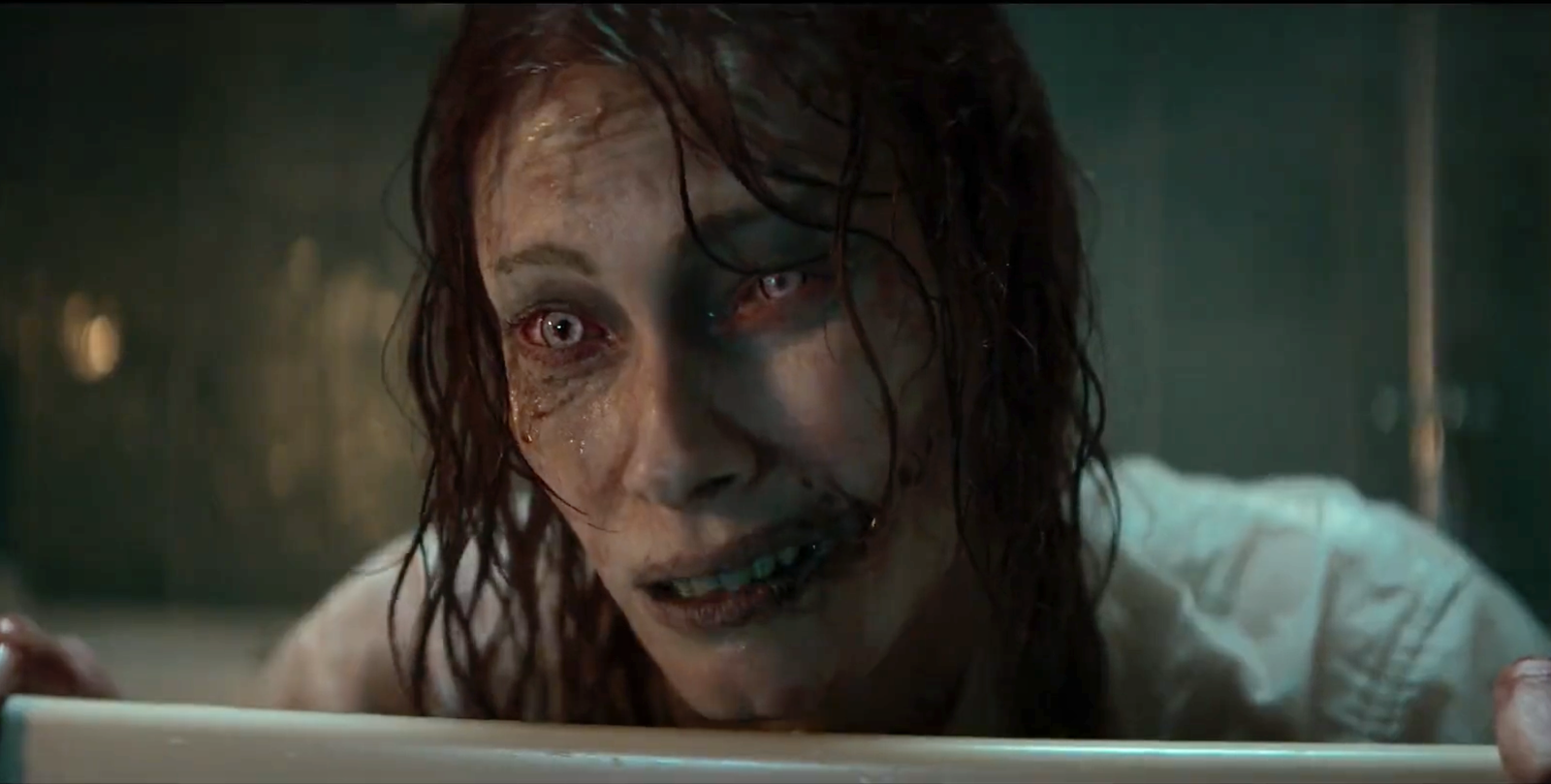
     Mother isn't quite herself today:  Alyssa Sutherland in Evil Dead Rise


Saturday, 22 April 2023

Searching

Year:  2018

Director:  Aneesh Chaganty

Screenplay:  Aneesh Chaganty and Sev Ohanian

Starring:  John Cho, Debra Messing, Michelle La, Sara Sohn, Joseph Lee, Steven Michael Eich

Genre:  Thriller

Running Time:  102 minutes


San Jose, California:  David Kim (Cho) desperately searches for his missing 16 year old daughter, Margot (La).


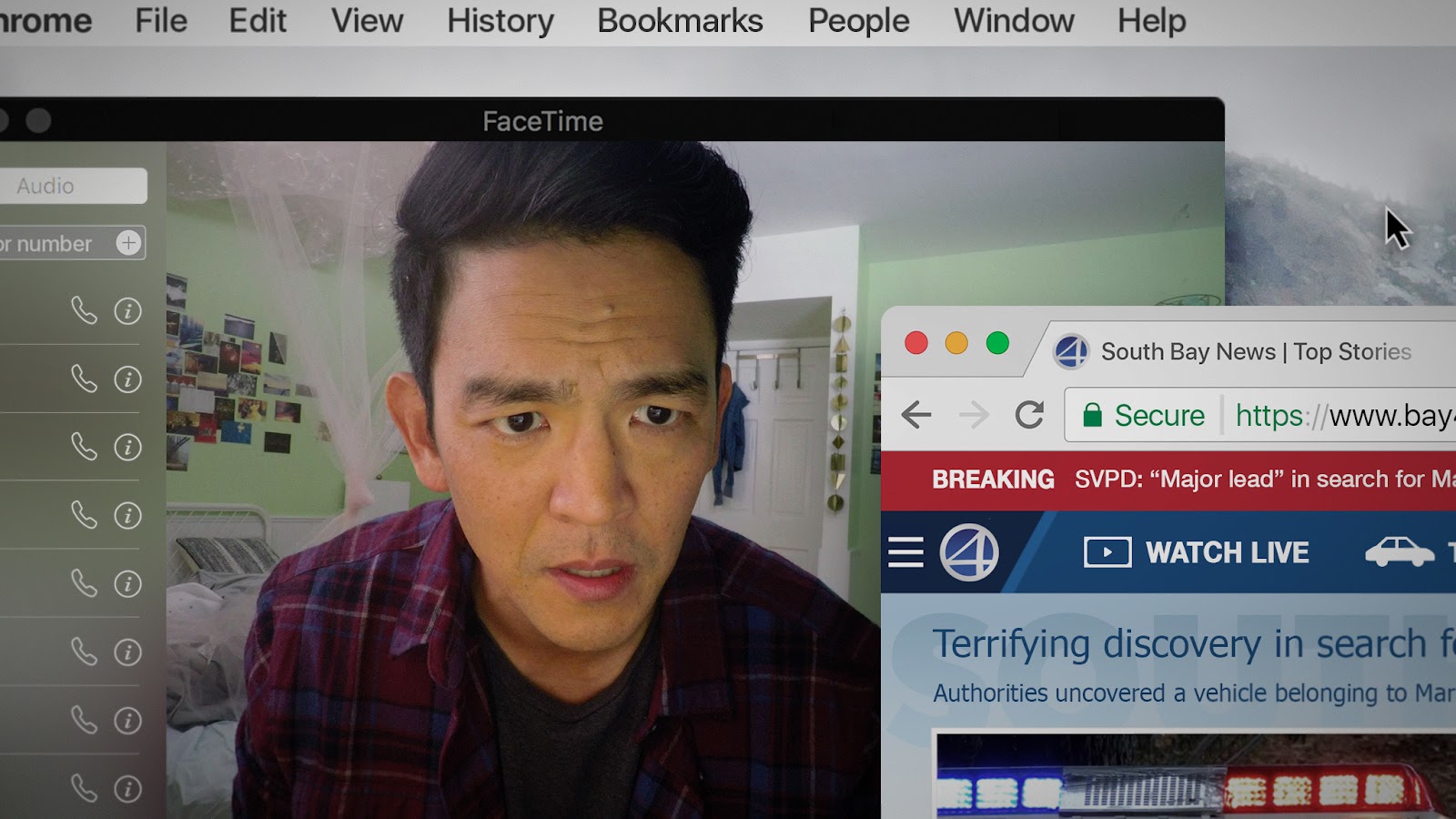
There is very little that you can say about the plot of this film without giving away one of its many twists.  The storyline is, in many ways, a traditional mystery thriller in which a widowed father desperately searches for his missing daughter, following clues, chasing down red herrings, and investigating suspects. However, what is innovative here is that the whole film takes place on computer screens.  David conducts his investigation mostly from his own home, searching through his daughter's social media feeds, Skypeing and WhatsApping potential witnesses and suspects, and finding clues through CCTV footage that he has been sent by the detective investigating the case (Debra Messing).  The film opens with a moving sequence of the family in happier times before David's wife and Margot's mother's death by cancer, depicted through the family's various screens, setting up family accounts on their new computer, videos of birthdays and holidays, online posts and calendar appointments.  Although the film was released two years before Covid, in a way it feels more pertinent in a covid and post-Covid world, now that we are living our lives more online than ever.  John Cho gives a strong performance as the tormented father, who for most of the film is sitting looking directly at the camera (his various screens).  The film mixes traditional detective story elements with modern technology, and at times the many twists and turns of the narrative strain credulity, but it is involving throughout, and the style manages to be more than just a gimmick.  The computer screen subgenre of found footage film is a difficult one to make work, partly because they look dated very quickly, due to how quickly computer technology moves forward.  Searching, however, is well worth the time.  


John Cho in Searching