Wednesday, 28 June 2023

The Killing of a Chinese Bookie

 Year:  1976

Director:  John Cassavetes

Screenplay:  John Cassavetes

Starring:  Ben Gazzara, Timothy Agoglia Carey, Seymour Cassel, Azizi Johari

Running Time:  135 minutes (cut to 109 minutes)

Genre:  Drama, thriller

Cosmo Vittelli (Gazzara) owns and operates the sleazy, failing nightclub Crazy Horse West in Los Angeles.  To make matters worse Cosmo owes a large gambling debt to the Mob.  The gangsters order Cosmo to kill a bookmaker, Harold Ling (Soto Joe Hugh).  After some less than gentle persuasion, Cosmo reluctantly accepts his task, but soon finds the hit is much more complex than he had expected.

Writer, director and actor John Cassavetes appeared as an actor in a number of big Hollywood movies such as The Dirty Dozen (1967), for which he received an Academy Award nomination for Best Supporting Actor, and most notably a starring role as Mia Farrow's traitorous husband in Rosemary's Baby (1968).  However, he is most influential as a writer and director, and his echo is still felt today in the world of Independent Cinema.  Despite its seemingly conventional thriller plot, in terms of style and approach, The Killing of a Chinese Bookie is anything but conventional.  More a character study than a thriller, the film focuses on the dilemmas and pressures of Cosmo Vittelli, a man whose entire world is this sleazy club, and who puts all of the money he earns back into the club, as well as spending a lot of time and effort writing and directing the cheesy cabaret acts, hosted by the club compere "Mr. Sophistication" (Meade Roberts), even though he knows that the audience only care about seeing naked women.  He also has a severe gambling problem.  To celebrate making his last payment on a previous debt to a loan shark, he immediately goes out on a night on the town and ends up losing everything on poker.  Ben Gazzara, who saw Vittelli as a kind coded version of Cassavetes himself, gives a great performance, giving Vittelli a kind of down-at-heels charm, and a cocktail of hope and despair.  As is common with Cassavetes' work, the film has a loose, documentary style look, filmed guerrilla-style on the streets and in nightclubs, restaurants and homes.  The performances, which include Cassavetes regular Seymour Cassel and veteran gangster movie actor Timothy Carey, have a naturalistic, improvised feel about them.  The film was originally released in 1976 with a running time of 135 minutes, and immediately tanked at the box office, being withdrawn from general release after a week, with even Gazzara stating that it "was too long".  Cassavetes re-released the film in 1978 in a much shortened version of 109 minutes, with scenes drastically rearranged and some new footage.  For a long time this was the only version available, but in 2004 the 109 minute and 135 minute versions were released on DVD, so now you can watch both, should you care to.

The eagle-eyed viewer may notice a familiar face in some of the crowd scenes.  David Bowie sat in on much of the filming, just to watch Cassavetes at work, although he was not involved in the film.  However he can be glimpsed in the audience during some of the nightclub scenes.


Ben Gazzara in The Killing of a Chinese Bookie


Monday, 8 May 2023

Star Trek: The Motion Picture

 Year:  1979

Director:  Robert Wise

Screenplay:  Harold Livingston, from a story by Alan Dean Foster, based on Star Trek created by Gene Roddenberry

Starring:  William Shatner, Leonard Nimoy, DeForest Kelley, Stephen Collins, Persis Khambatta, James Doohan, Nichelle Nichols, George Takei, Walter Koenig

Running Time:  132 minutes

Genre:  Science-fiction


When a mysterious alien cloud possessed of powerful destructive capabilities is detected on a course heading directly for Earth, Admiral James T. Kirk (Shatner) is put in charge of the newly overhauled USS Enterprise, and reunites his old crew to investigate and stop the cloud's path of destruction by any means necessary.

When the original television series of Star Trek ended in 1969 after three seasons and 79 episodes, it looked like it would be one more cancelled TV show that would exist for evermore in the fuzzy afterlife of repeats.  However, as the 1970s progressed, Star Trek became a major success in syndication, as well as attracting increasing numbers of devoted fans.  A 14 episode Saturday morning cartoon version was broadcast in the mid '70s, but Paramount Studios were becoming interested in a new live-action Star Trek.  In the late '70s Paramount announced plans for a new cable TV  network, to be imaginatively named The Paramount Network, and the flagship programme on launch night would be Star Trek: Phase II, which would feature some of the original cast alongside new characters.  Pre-production was already well advanced on Star Trek: Phase II, scripts had been written, sets had been built, parts had been cast, costumes designed and some special effects footage had already been shot, when Paramount pulled the plug on The Paramount Network, and Star Trek: Phase II was cancelled.  Rather than waste the considerable amount of money and time that had been spent on the new Star Trek, Paramount decided to remount what would have been the pilot episode of Star Trek: Phase II as a stand-alone feature film.  The script was rewritten and veteran director Robert Wise was hired to helm the project.  The resulting film boasts some very impressive special effects, but is hindered by a slow pace, and a drab feeling to the whole thing, from the colourlessness of the Enterprise interiors, to the new uniforms which all seem to be in varying shades of light blue, white and beige.  There is also the pretentiousness and po-faced philosophising which hampered Star Trek at its worse, with very little of the action and humour of the TV series at its best.  Many of the returning actors have little more than cameo roles, and the two new additions Stephen Collins as Kirk's rival for the Enterprise, Captain Decker, and Persis Khambatta at the alien Deltan Ilia, never really get the chance to make much of an impression.  Despite the plot being a race against time to save the earth, there is very little dynamism, and the story essentially calls for the actors to do little more than react to what they see on monitor screens.  It's clear that what the producers were going for was a serious cerebral science-fiction epic along the lines of 2001: A Space Odyssey (1968), but that is the wrong approach for Star Trek.  The film does have its good points though.  The opening sequence, where the alien cloud encounters three Klingon spaceships is exciting, the special effects are still impressive even after all this time, and there are moments when that create a genuine sense of wonder.  Also the climax, with its clear sexual metaphor is quite daring.  


William Shatner, DeForest Kelley and Leonard Nimoy in Star Trek: The Motion Picture
  

Wednesday, 26 April 2023

Evil Dead Rise

 Year:  2023

Director:  Lee Cronin

Screenplay:  Lee Cronin, based on characters created by Sam Raimi

Starring:  Lily Sullivan, Alyssa Sutherland, Morgan Davies, Gabrielle Echols, Nell Fisher

Running Time:  97 minutes

Genre:  Horror

Guitar technician Beth (Sullivan) goes to visit her sister Ellie (Sutherland), who is a single mother to teenagers Bridget (Echols) and Danny (Davies), and pre-teen Kassie (Fisher).  Following a minor earthquake, a hole opens up in the ground of the underground parking garage of Ellie's condemned apartment building.  Curious, Danny investigates and discovers an abandoned subterranean bank vault in which he finds three phonograph records from 1923 and a strange old book.  When Danny plays the phonograph records he discovers that they have been made by a strange priest, who has discovered one of  three surviving volumes of the Naturom Demonto, a book bound in human flesh and inked in blood, which has the power to resurrect evil demonic forces.  The priest thoughtfully recites these spells on the records, and the family soon find themselves assaulted by terrifying supernatural forces.

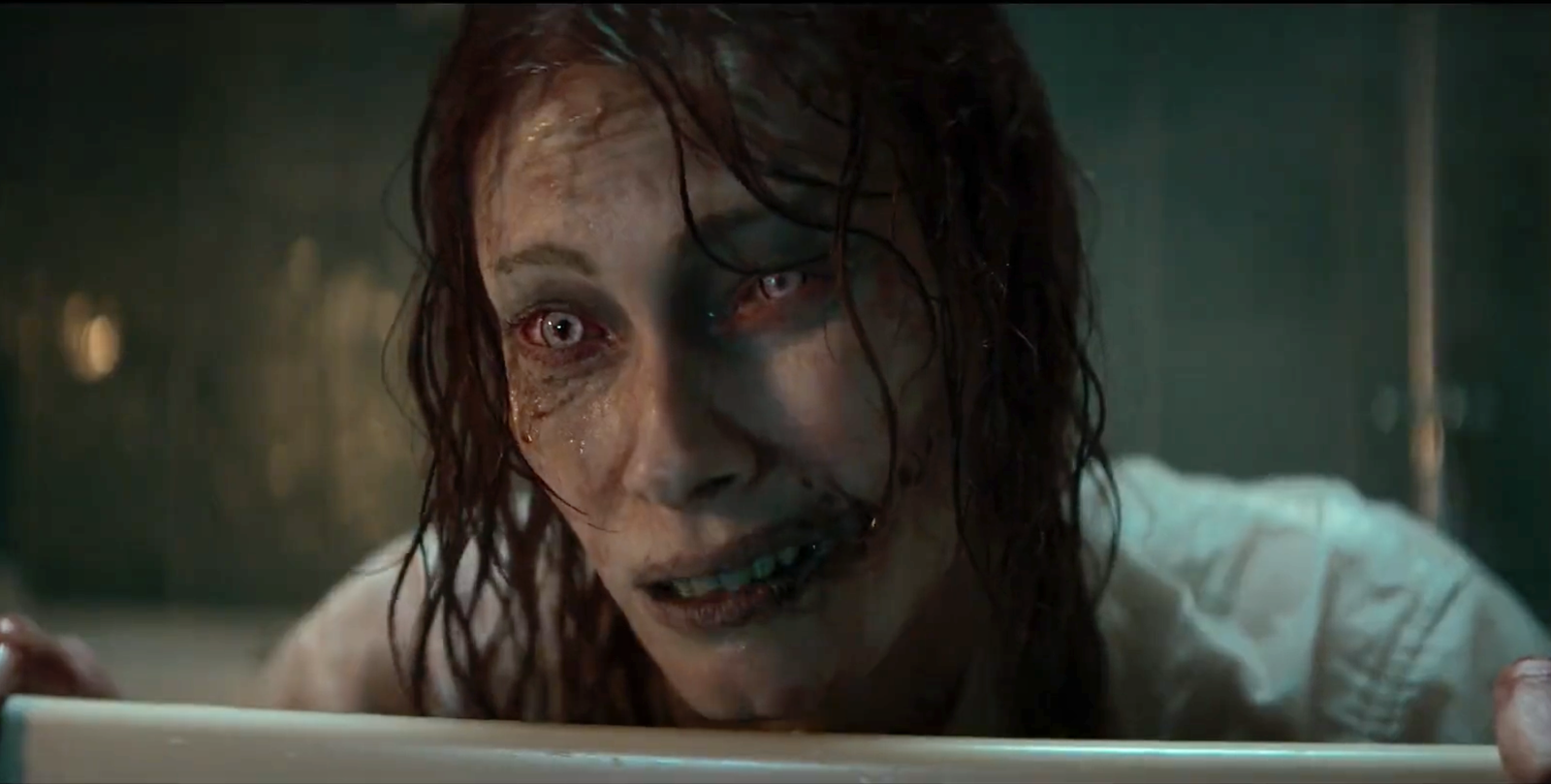
This is the fifth film in the Evil Dead franchise.  While Sam Raimi's original The Evil Dead (1981) was a fully fledged horror film, the sequel Evil Dead II (1987) was more of a comedy film influenced by Raimi's enthusiasm for the Three Stooges, and the third film in the series, Army of Darkness (1992), was pretty much a full on fantasy comedy with lead character Ash (Bruce Campbell) transported to the Middle Ages. In 2013 director Fede Álvarez released Evil Dead, a reboot of the series which returned it to its gruesome, horror original.  Evil Dead Rise continues this approach by being a full on horror film.  The blood doesn't so much flow here, as gush, pour, rain and flood.  It opens with a prologue, set in the familiar Evil Dead territory of a bucolic woodland, however the bulk of the film is set a day earlier in an unnamed rain soaked city.  The grim setting of a condemned, decaying, sparsely occupied apartment building works for the material.  It also takes it's time to set up the characters, particularly the tension between Ellie, a financially struggling tattoo artist, due to be evicted in a month, raising three children on her own, and her sister Beth, a freewheeling guitar technician, who is seen as the "cool aunt" by her nieces and nephews, but is frequently dismissed as a "groupie", a description which she angrily rejects.  It is Ellie who becomes possessed by the demonic forces, forcing Beth, who has just discovered that she is pregnant, to step into the maternal role and protect the children.  While there are some nods to the earlier Evil Dead films, this is a stand alone film, and can be watched even if you've ever seen any of the other films.  The performances are good, and the horror, when it comes in, is unrelenting.  It is graphically violent, in the best Grand Guignol tradition of splatter films, and will surely be a late night favourite for horror fans.


     Mother isn't quite herself today:  Alyssa Sutherland in Evil Dead Rise


Saturday, 22 April 2023

Searching

Year:  2018

Director:  Aneesh Chaganty

Screenplay:  Aneesh Chaganty and Sev Ohanian

Starring:  John Cho, Debra Messing, Michelle La, Sara Sohn, Joseph Lee, Steven Michael Eich

Genre:  Thriller

Running Time:  102 minutes


San Jose, California:  David Kim (Cho) desperately searches for his missing 16 year old daughter, Margot (La).


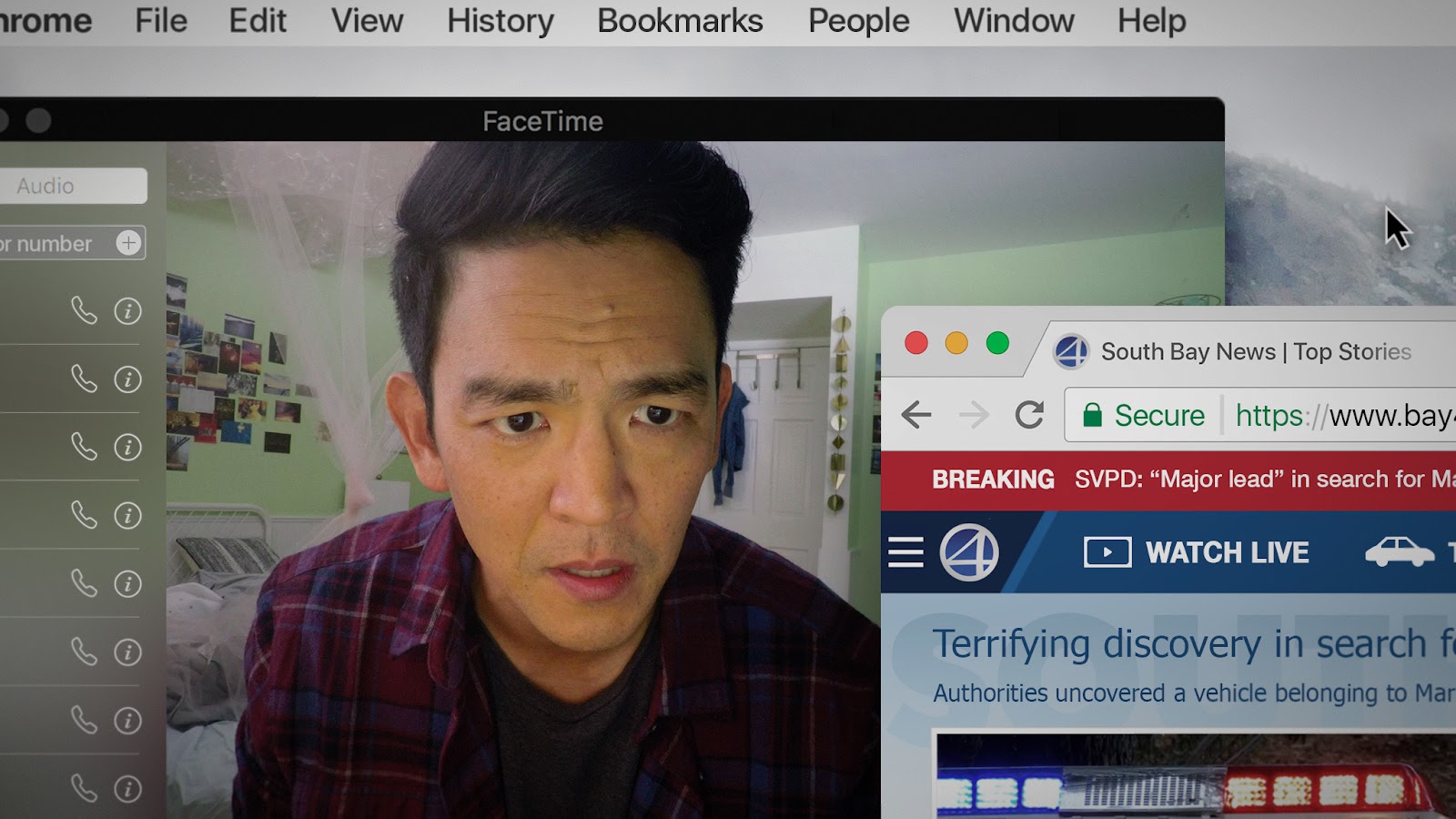
There is very little that you can say about the plot of this film without giving away one of its many twists.  The storyline is, in many ways, a traditional mystery thriller in which a widowed father desperately searches for his missing daughter, following clues, chasing down red herrings, and investigating suspects. However, what is innovative here is that the whole film takes place on computer screens.  David conducts his investigation mostly from his own home, searching through his daughter's social media feeds, Skypeing and WhatsApping potential witnesses and suspects, and finding clues through CCTV footage that he has been sent by the detective investigating the case (Debra Messing).  The film opens with a moving sequence of the family in happier times before David's wife and Margot's mother's death by cancer, depicted through the family's various screens, setting up family accounts on their new computer, videos of birthdays and holidays, online posts and calendar appointments.  Although the film was released two years before Covid, in a way it feels more pertinent in a covid and post-Covid world, now that we are living our lives more online than ever.  John Cho gives a strong performance as the tormented father, who for most of the film is sitting looking directly at the camera (his various screens).  The film mixes traditional detective story elements with modern technology, and at times the many twists and turns of the narrative strain credulity, but it is involving throughout, and the style manages to be more than just a gimmick.  The computer screen subgenre of found footage film is a difficult one to make work, partly because they look dated very quickly, due to how quickly computer technology moves forward.  Searching, however, is well worth the time.  


John Cho in Searching
  

Tuesday, 11 April 2023

Cold Light of Day

 Year:  1989

Director:  Fhiona Louise

Screenplay:  Fhiona Louise

Starring:  Bob Flag, Martin Byrne-Quinn, Geoffrey Greenhill, Mark Hawkins, Andrew Edmands, Claire King

Running Time:  81 minutes

Genre:  drama, true crime, horror


In a police interview room, unassuming middle-aged civil servant Jordan Marsh (Flag) is interrogated about a series of murders, which are depicted through a series of flashbacks.


True crime is a perennially popular genre in all kinds of media.  This film is based on the true story of serial killer Dennis Nilsen.  Sometimes dubbed "The British Jeffrey Dahmer", Nilsen murdered at least twelve young men and boys between December 1978 and January 1983.  His crimes were discovered in February 1983 when some human remains were found to be blocking drains in the building where Nilsen lived in an attic flat.  While this is not as good as the three part miniseries Des (2020) which starred David Tennant as Nilsen, this low-budget, low key drama is fairly effective in its own right.  Here Dennis Nilsen is called Jordan March and played by Bob Flag, who is probably best known as the face of Big Brother in 1984 (1984).  Saddled with a terrible wig, Flag gives a striking performance as the repellant Marsh, alternately arrogant, petulantly angry or cringing under his increasingly aggressive police interrogation.  Marsh however does have some moments of kindness, when he helps an elderly downstairs neighbour.  Written and directed by Fhiona Louise, who at the time was a 21 year old drama student, the film suffers from a very low budget, it's technically very crude, the performances are variable, sometimes the sound is hard to hear particularly under the loud soundtrack of pulsating breathing and tolling bells.  There are several flashbacks to Marsh's rural childhood and the death of his beloved grandfather (where his mother tells him that his grandfather is "just sleeping").  Even though it is short, the film seems to move at a snail's pace, and everything is bleak, depressing and grimy - which may be the best approach for a film about a serial killer.  There is stuff to admire here, but very little to really like.  


Bob Flag in Cold Light of Day


Saturday, 8 April 2023

Dracula

 Year:  1974

Director:  Dan Curtis

Screenplay:  Richard Matheson, from the novel Dracula by Bram Stoker

Starring:  Jack Palance, Simon Ward, Nigel Davenport, Pamela Brown, Fiona Lewis, Penelope Horner

Running Time:  100 minutes

Genre:  Horror

1897:  Solicitor Jonathan Harker (Murray Brown) is in Transylvania to visit mysterious nobleman Count Dracula (Palance), who plans to buy property in England.  However, Harker finds out too late, what his host's true motivations are.  In England, Arthur Holmwood (Ward) discovers that his fiancé Lucy (Lewis) is Dracula's latest victim, and it is up to him and Professor Van Helsing (Davenport) to stop the vampire for good.


The good count himself may not have proved to be immortal, but Bram Stoker's classic vampire novel has proved to be well nigh un-killable, with numerous adaptations in almost all forms of media.  Every Dracula fan has their favourite, and while this made-for-TV movie may not be one of the best, it is still a solid adaptation.  Producer and director Dan Curtis was familiar with horror having created the frankly bizarre supernatural daily soap opera Dark Shadows (1966-1971), as well as the TV movie The Night Stalker (1972) which was also scripted by Richard Matheson, and other adaptations of horror classics such as The Strange Case of Doctor Jekyll and Mister Hyde (1968) which also starred Jack Palance.  As scripted by horror writer Richard Matheson, this adaptation of Dracula remains faithful to Stoker's novel, albeit streamlining it a lot and cutting many supporting characters, including Dracula's bug-eating servant  Renfield.  Jack Palance, who was best known for playing heavies in gangster films and Westerns, may seem a strange choice for Dracula, but he does well, giving Dracula a Byronic menace, as well as a physicality often absent in other versions of the character.  The other performances are solid, and the film benefits from being filmed largely in England and Yugoslavia, despite being made for American TV.  While the film has its slow points, and there are times when the fairly low budget is obvious, it is a pretty impressive piece of work, and well worth checking out for horror fans.  The film's on-screen title is Bram Stoker's Dracula but, when Francis Ford Coppola was preparing his own film, also titled Bram Stoker's Dracula (1992), he bought the rights to the title in order to avoid comparisons, and the 1974 film is listed as either Dracula or Dan Curtis' Dracula.  There are a couple of other points of similarity between this and the 1992 film, in both Dracula is explicitly referred to as the historical Vlad Dracula (aka Vlad the Impaler) and in both versions Dracula hunts down the reincarnation of his lost love (Lucy in this film and Mina in the 1992 film).     


Jack Palance is Dracula

The Long Good Friday

 Year:  1980

Director:  John Mackenzie

Screenplay:  Barrie Keeffe

Starring:  Bob Hoskins, Helen Mirren

Running Time:  114 minutes

Genre:  Thriller


Harry Shand (Hoskins) is a powerful, ruthless gangster, who has plans to go legitimate with a scheme to redevelop the London Docklands with the aid of mafia investors from New York.  However, on the day of the mafiosi fly into London, Harry's empire is threatened by a series of bombings, and the stabbing of one of his closest associates.  Tasking his mistress, Victoria (Mirren) with handling the negotiations, Harry sets out on a violent quest to put a stop to the attacks.


This is one of the great, underrated classics of British gangster films.  The film mixes themes of political and police corruption, and the IRA, as well as an optimism about Britain becoming a European powerhouse, which in these days rings bitterly hollow.  Bob Hoskins had made a name as the star of the 1979 TV series Pennies from Heaven, but this was his first major film role.  He gives a fantastic performance as the brutal Harry Shand, mixing affability with menace, presenting himself as a legitimate, reasonable businessman but turning on friend or foe alike with brutal ferocity when crossed.  Helen Mirren is also memorable as the icy, intelligent Victoria, who serves almost as Shand's PA, and the acceptable face of his organisation.  The rest of the cast is full of now familiar faces from British TV and film, including Pierce Brosnan in his film debut as an IRA hitman.  The script is intelligent, with moments of dark humour, and the direction is slick, and the film maintains tension throughout, along with frequent, and often shocking moments of explosive violence.


Bob Hoskins in The Long Good Friday