Showing posts with label LGBT. Show all posts

Friday, 25 March 2022

I've Heard the Mermaids Singing

Year:  1987

Director:  Patricia Rozema

Screenplay:  Patricia Rozema

Starring:  Sheila McCarthy, Paule Baillargeon, Ann-Marie MacDonald

Running Time:  83 minutes

Genre:  Comedy, drama


Toronto:  Quirky dreamer Polly (McCarthy) is an aspiring photographer who works as a temp.  Her latest job involves being a secretary for art gallery owner Gabrielle (Baillargeon).  As their professional relationship develops into something like a friendship, Polly becomes increasingly fascinated by her.  However, when she meets Gabrielle's younger lover, Mary(MacDonald), she learns a surprising secret.


This very low-budget Canadian indie film is almost the epitome of quirky, indie comedy-dramas.  It's rough around the edges, and at times it's too whimsical for it's own good, but it does have enough charm and invention to sustain it, and make it something quite special.  The film moves from the "real" world (in colour) to black-and-white fantasy sequences depicting Polly's inner world.  It has it's own kind of grammar and style, for example, Gabrielle's own painting, which are supposed to be extremely beautiful, are never shown, being depicted instead as illuminated square panels, and the transition to Polly's dream worlds are depicted by fading out to red, instead of the traditional fade to black.  The performances are strong, with Polly in particular being an intriguing character, artistic and charming, but also impulsive, socially awkward, clumsy and with a habit of taking anything anyone says to her literally, she could be seen as a forerunner of the "Manic Pixie Dream Girl" trope of the '90s and 2000s.  The film does enter darker territory as it progresses, but it maintains it's charm.  It doesn't always work, it was originally conceived as an hour long TV film, before writer-director Patricia Rozema decided to lengthen it to feature length, and it does feel stretched in places.  However it's certainly worth checking out.    
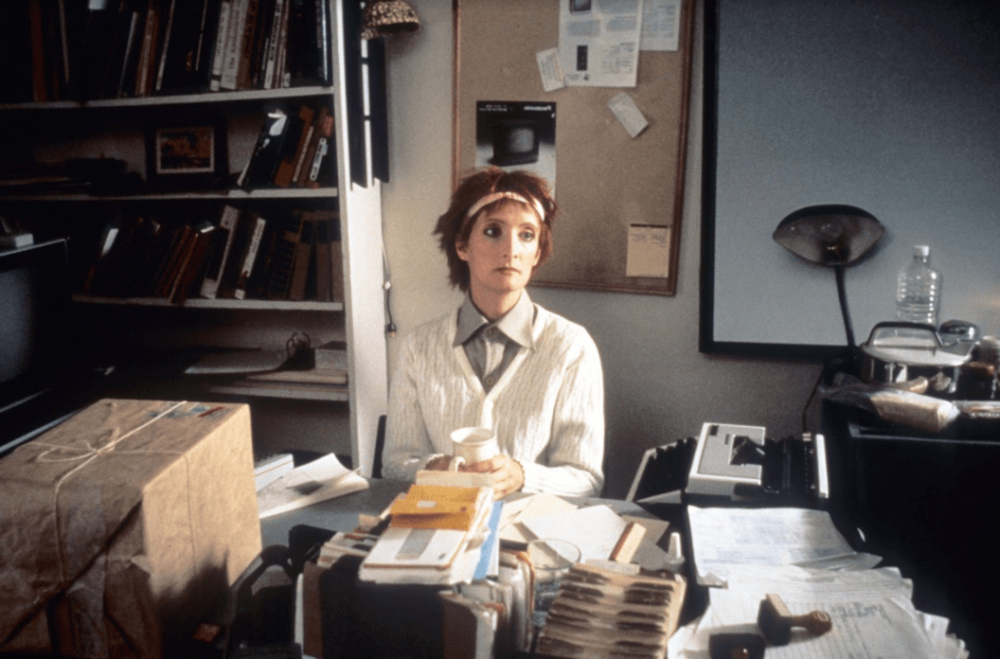


Sheila McCarthy in I've Heard the Mermaids Singing

Friday, 27 August 2021

Sebastiane

Year of Release:  1976

Director:  Derek Jarman and Paul Humfress

Screenplay:  Derek Jarman, Paul Humfress and James Whaley

Starring:  Leonardo Treviglio, Barney James, Richard Warwick, Neil Kennedy

Running Time:  85 minutes

Genre:  Historical drama


Third Century AD:  Sebastian (Treviglio) is one of the Praetorian Guards for Emperor Diocletian (Robert Medley).  When he intervenes to stop a servant form being strangled by one of the Emperor's bodyguards, Sebastian is reduced in rank to private and exiled to a remote coastal garrison.  Sebastian's religious faith and pacifism, not to mention his celibacy, incense his commanding officer Severus (James), who becomes increasingly obsessed with Sebastian, with tragic results.


Inspired by the life and death of early Christian martyr Saint Sebastian, this homoerotic fantasia, is starling, sexy and more than a little dull.  Despite sharing a co-directing credit with Paul Humfress, the film opens with the title "Derek Jarman's Film", and this is how it is seen today.  Beginning his career in the film industry as a set designer (most notably for the Ken Russell film The Devils (1971)) Sebastiane marked Jarman's directorial debut, and he would go on to become a notable name in British independent film throughout the 1980s and early '90s.  The male gaze has become increasingly controversial, but this film celebrates the gay male gaze.  Filmed under the blazing Sardinian sun, the film mostly consists of bronzed, sweaty men, either naked or mostly naked lolling around on the rocks, wrestling, hitting each other, washing or caressing each other in languorous slow motion.  Despite being successful, the film was controversial for it's copious nudity (when asked about the nudity Jarman responded "we couldn't afford costumes") and also for the fact that, despite being a British film, the dialogue is entirely in Latin.  The acting is variable, with many of the cast seemingly chosen more for their looks than their acting ability, it's an important film in the history of gay cinema.  While it's a powerful film, with some memorable images, if you're not tuned into Jarman and Humfress' brand of homoeroticism, you may find it a long slog.


Richard Warwick and Leonardo Treviglio in Sebastiane 


Thursday, 26 August 2021

Madchen in Uniform

Year of Release:  1931

Director:  Leontine Sagan

Screenplay:  Christa Winsloe and Freidrich Dammann, based on the stage play Gesten und heute (Yesterday and Today) by Christa Winsloe

Starring:  Hertha Thiele, Dorothea Wieck

Running Time:  98 minutes

Genre:  Drama


Following the death of her mother, sensitive teenager Manuela von Meinhardis (Thiele) is enrolled at a strict Prussian boarding school, run with an iron fist by a stern, penny-pinching headmistress (Emilia Unda).  Manuela forms a bond with kindly teacher Fräulein von Berberg (Wieck), but as the connection between the two deepens, it threatens to bring ruin for both of them.


Based on a stage play by Christa Winsloe, Mädchen in Uniform is notable for it's sympathetic treatment of lesbianism and all-female cast.  The film is about the love of a fourteen year old for her adult schoolteacher, who also seems to have inappropriate feelings for her, however the creepy factor is considerably lessened by the fact that Hertha Thiele, who plays Manuela, is obviously much older than 14 (she was was 22 at the time of filming, and was, in fact the same age as Dorothea Wieck, who plays her teacher).  A key theme on the film is the conflict between two forms of authority:  The headmistress rules through strict discipline and demands blind, unquestioning obedience.  She also deliberately makes the girls go hungry and has them wear hand-me-down clothes until they fall apart, partly to save money and partly to build character, and, ruling by fear, is hated by her pupils.  Fräulein von Berberg, however, treats her charges with kindness and respect, which is reciprocated by the girls, many of whom develop crushes on her, partly due to her habit of kissing each of them goodnight.  They each receive the chaste kiss on the forehead as almost a sacrament, except Manuela who embraces von Berberg, and kisses her fully on the mouth.  Considering this was a German film, which was released in 1931 when Hitler and the Nazis were on the rise, makes the anti-authoritarian angle even more powerful.  The film is well performed, and visually stylish, using a lot of clever camera angles, and sensitivity to light and shadow, that bring to mind German Expressionism, although this is certainly not an Expressionist film.  It is a heartbreaking and beautiful film, and. milestone in LGBT cinema.


Dorothea Wieck and Hertha Thiele in Mädchen in Uniform