Thursday, 28 July 2022

The Master

 Year:  2012

Director:  Paul Thomas Anderson

Screenplay:  Paul Thomas Anderson

Starring:  Joaquin Phoenix, Philip Seymour Hoffman, Amy Adams

Running Time:  137 minutes

Genre:  Drama


Freddie Quell (Phoenix), a troubled, heavy drinking World War Two veteran, finds it difficult to adjust to postwar American society.  His drinking, coupled with his violent, erratic behaviour, causes him to be fired from several jobs, as he drifts across the States.  In San Francisco, Freddie meets Lancaster Dodd (Hoffman) the founder and leader of a movement known as "The Cause", which claims to help people using a confrontational technique called "Processing".  Freddie becomes fascinated by The Cause and the charismatic Dodd, and soon becomes a devoted follower.


This complex and often bleak drama, inspired by the early years of Scientology, is a powerful and sometimes disturbing piece of work.  Joaquin Phoenix gives one of his best performances as the violent alcoholic Freddie Quell.  The lecherous, mercurial Quell is often a deeply unlikeable character, but Phoenix gives us a glimpse of the humanity at his core.  Philip Seymour Hoffman is perfectly cast the charming, garrulous Dodd.  With Hoffman you can see how someone might fall for Dodd's line.  Dodd and Quell form a kind of father-son relationship, with Dodd frequently talking to him as if he's a small child, despite the fact that Hoffman was only seven years older than Phoenix.  There are moments, however, when Dodd's genial facade slips in brief explosions of rage.  Amy Adams plays Dodd's wife, Peggy, a quiet woman, who is a true believer in Dodd and The Cause, who is a mixture of charm, calm rage and steely determination.  There are also appearances from Laura Dean, Jesse Plemons and Rami Malek.  The film is far more than just a drama about a cult, it deals with America in the late 1940s early 1950s, the need to belong and the deep human will to believe in something.   Most of all it's about the strange connection between two men who are polar opposites and yet have a strange attachment.  Even when Freddie's bad behaviour alienates almost everyone around him, Dodd still insists in bringing him back into the fold.  The film's principal weakness is that it is quite meandering, it's one of those films where the story seems to have reached a conclusion, but there is still more to come.  However, this is a small criticism, since this is a truly great film.


Joaquin Phoenix, Philip Seymour Hoffman and Rami Malek in The Master
  

Monday, 25 July 2022

5x2

Year:  2004

Director:  François Ozon

Screenplay:  François Ozon and Emmanuèle Bernheim

Starring:  Valeria Bruni Tedeschi, Stéphane Freiss

Running Time:  90 minutes

Genre:  Drama

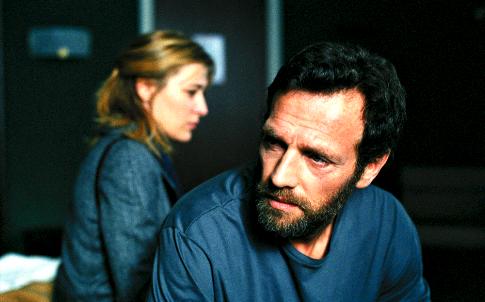
Over the course of five episodes, the film tells the story of a married couple in reverse.  It opens with Marion (Tedeschi) and Gilles (Freiss) in a lawyer's office finalising their divorce, and then moves back to  tense dinner with Gilles' brother (Antoine Chappey) and his partner (Marc Ruchmann),   the birth of Marion and Gilles' son, their wedding and concluding with their meeting in an idyllic Spanish seaside resort.  


This French film, the title of which is Five Times Two in English, is a dark drama which uses a reverse chronology to chart the gradual disintegration of a marriage.  Going from the acrimonious divorce, and a shocking scene where Gilles sexually assaults Marion, to their initial holiday romance.  With the benefit of hindsight we can see how things go wrong, and where the cracks form in the relationship.    The reverse structure had been used in a couple of other films that came out in the early 2000s, most notably the thriller Memento (2000) and the controversial Irréversible (2002), but Ozon's stated inspiration was the 1986 Australian TV movie Two Friends, directed by Jane Campion, that depicted the end of a friendship in reverse.  Valeria Bruni Tedeschi and Stéphane Freiss are perfectly cast as the couple.  Ozone directs with style and the script is clever and witty.  There is s lot to admire in the film, however I would proceed with caution, it's very bleak.  For one thing this is arguably one of the least romantic films ever made.  Every couple in the film is miserable and/or doomed.  It's not a film for Date Night.  If you are single however, this might make you feel a bit better about it.


Valeria Bruni Tedeschi and Stéphane Freiss in 5x2

Tuesday, 19 July 2022

The Great Outdoors

 Year:  1988

Director:  Howard Deutch

Screenplay:  John Hughes

Starring:  Dan Aykroyd, John Candy, Stephanie Faracy, Annette Bening

Running Time:  90 minutes

Genre:  Comedy


Chicago resident Chester "Chet" Ripley (Candy), his wife Connie (Faracy) and their two sons are spending their summer at a bucolic lake resort.  However, their holiday takes a turn for the worse when Connie's sister Kate Craig (Bening) arrives uninvited with her obnoxious investment broker husband Roman (Aykroyd) and their twin daughters.  Soon a peaceful lakeside vacation turns into a catalogue of misadventures and disasters.


This is a moderately funny family comedy.  John Candy plays the gentle Chicagoan who just wants a peaceful holiday for some family bonding and Dan Aykroyd is well-cast as his annoying yuppie brother in law.  Stephanie Faracy and Annette Bening, in her film debut, really don't have much to do as the supportive wives and mothers.  Scripted by John Hughes, who became something of a celebrity in the 1980s, with scripts including National Lampoon's Vacation (1983), Pretty in Pink (1986) and Some Kind of Wonderful (1987), as well as writing and directing The Breakfast Club (1985), Weird Science (1985), Ferris Bueller's Day Off (1986) and the John Candy starring Planes, Trains and Automobiles (1987).  The film feels like a watered-down Vacation film with the same episodic structure moving from comic set-piece to comic set-piece, before a heart-warming conclusion.  None of the cast has anything to stretch themselves, and there are moments where the film looks surprisingly cheap, like a scene where they are fishing at dawn and the lake is very clearly a stage set.  However there are some very funny and memorable scenes, such as Candy's disastrous trip on water skis, and a scene where Roman persuades Chet to take the "Old 96" challenge in a local restaurant and eat a 96 pound steak.  From Candy's reaction when the crazed-looking chef in a blood stained apron sets down the huge slab of meat in front of him and his mute pleading and suffering as he is forced to finish this mass of food, is a wonderful piece of silent comic acting.  By the way, there is a restaurant in California that does serve an "Old 96" in tribute to this movie.  It's recommended for between four to six people.  One of the funniest things in the film are the racoons that periodically try and get inside the tourist's rubbish bins, and talk in their own chittering language, which is subtitled.  The romantic sub-plot between Chet's teenage son Buck (Chris Young) and local girl Cammie (Lucy Deakins) is done well and is actually quite moving, but there is not enough of it for it not to feel like it was just shoe-horned in at the last minute.  Director Howard Deutch, who previously worked with Hughes on Pretty in Pink, does a serviceable job.  It's not a great film, but it is  enjoyable enough, and there are enough laughs to make it an entertaining diversion.


John Candy and Dan Aykroyd in The Great Outdoors
.   

Monday, 18 July 2022

Bonnie and Clyde

 Year:  1967

Director:  Arthur Penn

Screenplay:  David Newman and Robert Benton

Starring:  Warren Beatty, Faye Dunaway, Michael J. Pollard, Gene Hackman, Estelle Parsons

Running Time:  111 minutes

Genre:  Crime


Texas, 1930s:  Bored waitress Bonnie Parker (Dunaway) is desperate for some excitement in her life.  She thinks that she has found what she is looking for when she meets charismatic thief Clyde Barrow (Beatty).    Along with dim-witted mechanic C. W. Moss (Pollard), Clyde's tough older brother Buck (Hackman) and Buck's highly strung wife, Blanche (Parsons), Bonnie and Clyde embark on a violent crime spree across the southern United States, robbing banks and shops.  Along the way they become celebrities, as well as the target of every lawman in the USA.

"They're young.  They're in love.  And they kill people."

- Poster tagline for Bonnie and Clyde

Loosely based on the real life exploits of Depression era bank-robbers Clyde Barrow and Bonnie Parker, this became one of the most iconic films of the 1960s.  Heavily criticised at the time for it's then groundbreaking violence, as well as it's glamorising of the ruthless duo, this nevertheless became a smash hit, helping to usher the so-called "New Hollywood" of the 1970s as well as influencing any number of "lovers on the run" films such as Badlands (1973), Wild at Heart (1990), True Romance (1993) and Natural Born Killers (1994).  Screenwriters Robert Benton and David Newman were heavily influence by the French New Wave movement, and their original choice to direct the film was François Truffaut, who passed on the project.  However, Truffaut and the French New Wave influenced several elements of the film, including the changes in tone, the choppy editing, and slow-motion sequences.  Warren Beatty, who produced the film, is perfectly cast as is Faye Dunaway, and the two have real chemistry.  Michael J. Pollard plays naive, moon-faced C. W. Moss, the gang's getaway driver and mechanic.  Pollard, who was pretty much unknown at the time, and was nominated for the Academy Award, Golden Globe and BAFTA got so much attention for the role that he announced a joke candidacy for President of the Unites States, which inspired a novelty song by Jim Lowe called "Michael J. Pollard for President".  Gene Hackman was also Oscar nominated for his role as Clyde's older brother Buck.  Estelle Parsons plays preacher's daughter Blanche, who is married to Buck, and becomes a reluctant a reluctant member of the gang.  Blanche and Bonnie's mutual hatred of each other threatens to undo the group from within.  After viewing the film, the real Blanche Barrow complained about her depiction saying: "That film made me look like a screaming horse's ass!"  Comedian Gene Wilder makes his screen debut in the film as a nerdy undertaker who is kidnapped by the gang.  

While the film is not now as shocking as it was in 1967, it is still a striking film, which has aged surprisingly well.  The tone of the film moves from humour to tragedy, from warmth to cold, stylised violence.  The tone changes in the same scene, the action scenes are often shown as comical slapstick, which then moves into shocking, graphic violence.  Amongst the brutality there are moments of humanity and tenderness, the gang joke around and okay games, take photographs of themselves and Bonnie immortalises their adventures in poetry.  The romance between Bonnie and Clyde is genuinely moving.  The film was released by Warner Bros., who specialised in gangster movies throughout the thirties, and Bonnie and Clyde brings together Old Hollywood glamour, with European experimentalism, to create a new type of American film.      


"I'm Miss Bonnie Parker, this here's Clyde Barrow.  We rob banks."  Faye Dunaway and Warren Beatty as Bonnie and Clyde

Friday, 24 June 2022

Tucker: The Man and His Dream

 Year:  1988

Director:  Francis Ford Coppola

Screenplay:  Arnold Schulman and David Seidler

Starring:  Jeff Bridges, Joan Allen, Martin Landau, Frederic Forrest, Mako, Elias Koteas, Christian Slater, Dean Stockwell

Running Time:  110 minutes

Genre:  Comedy, drama, biography

The Man:  Preston Tucker (Bridges), ambitious engineer who made his fortune designing and building gun turrets for aircraft during World War II.

His Dream:  To manufacture the 'car of the future'.  His "Tucker Torpedo" features an engine mounted in the rear of the car, and revolutionary safety features, such as seatbelts.  

However, the manufacture of the car is plagued with issues, and as enthusiasm for the car mounts, Tucker runs afoul of the "Big Three" car manufacturers (Ford, General Motors and Chrysler) as well as accusations of fraud from the U. S Securities and Exchange Commission.


You might not think of Francis Ford Coppola, director of such films as The Godfather (1973) and Apocalypse Now (1979), as the person to direct a gentle, charming comedy-drama based on real-life failed automobile entrepreneur Preston Tucker.  Coppola had first conceived of the project in the 1970s, and originally envisioned Marlon Brando or Jack Nicholson in the title role, and later planned to make the film as a musical, although the plan collapsed.  With Coppola's friend, George Lucas, serving as executive producer the project eventually came to fruition in 1988, to good reviews but poor box office receipts.  Jeff Bridges brings all of his considerable charisma to bear as the charming, confident Preston Tucker, and Joan Allen is very good, in the slightly underwritten role as Tucker's loyal wife Joan, although she has a great scene where she confronts a boardroom full of patronising men.  Martin Landau was nominated for an Academy Award for his role as financier Abe Karatz, who helps Tucker raise funds for his dream, and Christian Slater has a small role as Tucker's teenage son.  Dean Stockwell has a memorable cameo as a creepy Howard Hughes.  The film looks great with a real feel for the 1940s style, and the action is punctuated by amusing 1940s style adverts for Tucker's car.  While this is not a great film by any means, and far from Coppola's best, it actually deserves to be a lot better remembered than it is, because it is a good film.  In the end, Tucker made 51 of his Tucker Torpedoes.  Francis Ford Coppola and George Lucas each own two.

Jeff Bridges in Tucker: The Man and His Dream


Primal Fear

 Year:  1996

Director:  Gregory Hoblit

Screenplay:  Steve Shagan and Ann Biderman, based on the novel Primal Fear by William Diehl

Starring:  Richard Gere, Edward Norton, Laura Linney, John Mahoney, Alfre Woodard, Frances McDormand

Running Time:  130 minutes

Genre:  Thriller 

Chicago:  A beloved archbishop is brutally murdered in his apartment.  Shy, polite 19 year old altar boy Aaron Stampler (Norton) is found covered in blood, fleeing the crime scene, and is arrested for the murder.  Given the evidence and the lack of any other suspects, a conviction seems a certainty.  Ambitious, arrogant defence attorney Martin Vail (Gere) decides to defend Aaron, and becomes increasing convinced of his innocence. As he digs into the case to find evidence, Vail discovers some dark secrets.


This courtroom thriller, based on a 1993 novel by author William Diehl, is a genuinely gripping mystery, and elevated by strong performances and well-rounded characters.  Richard Gere is ideally cast as the slick, arrogant and often quite unlikeable lawyer, who nevertheless is redeemed by his strong belief in justice.  Edward Norton, in his film debut, was nominated for the Academy Award for Best Supporting  Actor for his intense performance as the tormented, stammering Aaron Stampler, who spends most of the film either in the courtroom or in a jail cell, verbally sparring with Gere or Frances McDormand, who plays a psychiatrist sent to analyse him.  Laura Linney really elevates what could be a one-note role as the attorney for the prosecution, who has a history with Vail.  Some of the various plot twists probably won't surprise many mystery aficionados, but the story moves along well, and there is plenty of real tension.  Director Gregory Hoblit, a veteran of TV dramas such as Hill Street Blues, L.A. Law and NYPD Blue, as well as the notorious '80s police musical Cop Rock, directs with style and keeps the plot moving along, even while the narrative diverges into more conspiratorial elements.  The script is clever with some sharp, witty dialogue.  


 Edward Norton and Richard Gere in Primal Fear

Wednesday, 22 June 2022

As Good as It Gets

 Year:  1998

Director:  James L. Brooks

Screenplay:  Mark Andrus and James L. Brooks

Starring:  Jack Nicholson, Helen Hunt, Greg Kinnear, Cuba Gooding Jr., Skeet Ulrich, Shirley Knight

Running Time:  139 minutes

Genre:  Romantic comedy, drama

New York City:  Best-selling romance novelist Melvin Udall (Nicholson) is bigoted, misanthropic and suffers from obsessive compulsive disorder.  Every day he eats lunch at the same Manhattan restaurant where he insists on sitting at the table and being served by the same server, Carole Connelly (Hunt), the only one who can tolerate his obnoxious behaviour.  Carole herself is struggling to make ends meet while caring for her ill son.  When Melvin's neighbour, gay artist Simon (Kinnear) is beaten and robbed in his apartment, Melvin is pressured into caring for his pet dog while Simon is in hospital, despite the fact that Melvin frequently bullies Simon and hates the dog.  However, Melvin and the dog end up bonding, and, in spite of himself, he finds himself increasingly drawn into the lives of the people around him.


This is an enjoyable, romantic comedy-drama, in the Woody Allen mould, which doesn't really break much new ground.  Jack Nicholson is ideal as the grouchy, offensive Melvin.  Helen Hunt, who at the time was probably best known for the sitcom Mad About You (1994-1999), won an Academy Award for Best Actress for her role as Carole, and she has real spark as the troubled, but loving Carole who is able to find some kind of humanity in Melvin.  Greg Kinnear is good as the sensitive artist, Simon, who becomes something of a tragic character as his life collapses following his attack.  The film is often uneven in tone, being really quite dark in places, which sometimes sits uneasily with the more broadly comic scenes, and sentiment.  It's also too long, with a running time of two hours and twenty minutes, and the conclusion seems very unlikely.  However, the characters are engaging, and there are some great performances and it's often very funny.  There is nothing new here, but it is an engaging and ultimately warm film, although you kind of wonder how happy the characters will be in the long term.  Also, Melvin is so obnoxious and offensive for most of the film it may be hard for some viewers to warm to him at all, even if he's ultimately shown to be warm hearted softy.  


Jack Nicholson in As Good as It Gets