Saturday, 25 February 2023

A Streetcar Named Desire

 Year:  1951

Director:  Elia Kazan

Screenplay:  Tennessee Williams, Elia Kazan and Oscar Saul, based on the play A Streetcar Named Desire by Tennessee Williams

Starring:  Vivien Leigh, Marlon Brando, Kim Hunter, Karl Malden

Running Time:  125 minutes

Genre:  Drama


Faded Southern belle Blanche DuBois (Leigh) leaves her hometown under a cloud and arrives at the home of her sister Stella (Hunter) and brother-in-law Stanley (Brando), in a rundown tenement in the French Quarter of New Orleans.  Under pressure from the brutal Stanley, Blanche begins a slow descent into insanity.


This is the best known of several screen adaptations of Tennessee Williams' Pulitzer Prize winning 1947 play.  Retaining most of the cast of the original Broadway play, with the exception of Jessica Tandy, who played Blanche on Broadway, and was replaced in the film by Vivien Leigh, because the studio wanted a bigger name.  Vivien Leigh, in an Oscar winning performance, is fantastic as the brittle Blanche, clinging to the past, with her affected gentility and manners and shunning the light to mask her true age.  The film however belongs to Marlon Brando as Stanley Kowalski, a controlling, suspicious, violent man, who buses his wife Stella and treats Blanche with varying degrees of contempt, suspicion and violence.  Blanche often refers to Stanley as an "ape" and Brando has an animalistic quality in his performance, while Blanche wants to escape into a world of dreams and magic, Stanley is all ferocious physicality and violent sexual energy.  There is almost. strange vulnerability to him at times, such as in the film's most famous scene, where Stella leaves him and goes to the flat upstairs and Stanley stands at the bottom of the staircase, his tee-shirt torn to shreds, bellowing her name over and over again, like a wounded animal, falling to his knees as she appears and slowly walks down to him.  Kim Hunter is good as Stella torn between the love of and fear for her sister and the love of and fear of her husband.  While Blanche wanted to retain the faded dreams of youth, she went for the more physical charms of Stanley Kowalski and her own nightmare.  Karl Malden plays Stanley's poker buddy Mitch who falls for Blanche.  Mitch is a very different type of man to Stanley, seemingly more sensitive and intelligent, and yet just as capable of cruelty.  Stylishly directed by Elia Kazan, the film has a fecund, overheated quality, in fact the heat seems to radiate from the screen, the actors all seemingly drenched in sweat, and the sultry jazz score by Alex North.  This is one of the greatest of all American films.


Vivien Leigh and Marlon Brando take A Streetcar Named Desire

Wednesday, 22 February 2023

Women Talking

Year:  2022

Director:  Sarah Polley

Screenplay:  Sarah Polley, based on the novel Women Talking by Miriam Toews

Starring:  Rooney Mara, Claire Foy, Jessie Buckley, Judith Ivey, Ben Whishaw, Frances McDormand

Running Time:  104 minutes 

Genre:  Drama


In an isolated Mennonite colony women are drugged and raped over a period of years.  Their claims are dismissed by the colony's authorities as either supernatural attacks or "wild female imagination".  Until, that is one of the attackers is caught, and he promptly names the others.  The attackers are arrested and taken to the nearest city to stand trial.  The other men of the colony accompany them in order to pay their bail.  The colony elders order the women to forgive their attackers by the time they return in two days or be banished from the colony.  Left alone, the women debate how to proceed:  Should they stay and obey their orders?  Stay and fight the men?  Or leave and found a new colony?


Based on the 2018 novel by Miriam Toews, which itself was based on a real life incident that occurred in a Mennonite colony in Bolivia.  The film doesn't focus on the attacks, instead it focuses on the women's response, and most of the film is the debate on how they should proceed.  In fact men are more or less entirely absent from the film with the notable exception of August (played by Ben Whishaw), the gentle schoolteacher who was educated away from the colony, and takes the minutes of the meetings, because none of the women have been taught how to read and write.  In the novel he narrates the story, but in the film the voice-over narrator is the yet unborn daughter of one of the women. The other exception is Melvin (played by August Winter) a transgender man who was raped and refuses to speak except to the youngest children who he cares for while the women are debating.  However men and male violence is the spectre that haunts the entire film.  The women live in an extremely patriarchal society where they are completely subservient to the men.  The film doesn't really come down against the Mennonite way of life, none of the women want to abandon their faith they just want to interpret it in a better and more fair way.  The film has a muted, washed out colour scheme, that evokes old photographs from the 19th century.  It is briefly mentioned that the year is 2010, but the only vision of modernity is a census taker driving through the colony in an old truck, with a loudspeaker on the roof playing the song "Daydream Believer".  The film boasts excellent performances, particularly from Rooney Mara, Claire Foy, Jessie Buckley and Ben Whishaw.  This is a great film, wonderfully directed by Sarah Polley, who keeps the drama tight and intense, but provides enough brief glimpses of the world away from the meetings, so it doesn't feel to claustrophobic, and also lets up the tension with some flashes of mordant humour.  It's a moving and powerful piece of quiet rebellion.


Women Talking

Thursday, 9 February 2023

The Swimmer

Year:  1968

Director:  Frank Perry

Screenplay:   Eleanor Perry, based on the short story by "The Swimmer" by John Cheever

Starring:  Burt Lancaster, Janet Landgard, Janice Rule

Running Time:  95 minutes

Genre:  Drama 


Middle-aged businessman Ned Merrill (Lancaster) is visiting with some friends when he gets the idea to swim home, using the outdoor swimming pools of his neighbours as a makeshift "river".  As his journey progresses his interactions with his neighbours, become increasingly strained and confrontational, as it appears that they know troubling things about himself and his family that Ned either can't, or won't, remember.

Based on an acclaimed short story by John Cheever, which was first published in The New Yorker in 1964, this surreal film, did not do well on it's original release, and yet it's reputation has grown, and it has come to be seen as something of a cult film.  The film starts on a bright, sunny summer afternoon, with Ned Merrill, a fit, middle-aged man emerging from the forest, wearing only a set of swimming trunks.  Merrill comes across a pool party hosted by friends, all of whom are nursing hangovers, but still knocking back the gin and martinis.  They seem surprised, but happy to see Merrill, who has apparently been away somewhere (although it is not revealed where he has been or for how long).  Looking out over the valley that houses the wealthy, suburban neighbourhood, Merrill works out that all the various swimming pools make a kind of river, that he can use to go home.  Right from the start it becomes apparent that there is some secret which his friends know, but that Merrill is seemingly oblivious to.  The journey becomes increasingly uncomfortable, as it appears from his interactions with others that Merrill is in severe personal and financial difficulties, although the nature of it is never made clear.  It also becomes apparent that Merrill's family life is not as idyllic as he claims.  As the film progresses the weather seems to change as well, becoming increasingly colder and more autumnal.  If you want to plunge in the deep end, you could read the film as being about American masculinity, the middle-class, suburban life, middle-aged disillusionment, or anything.  While the film may be too strange for some tastes, it has a strange, nightmarish power, with scenes such as Merrill's frantic dash across a busy motorway, a busy public pool becoming a wet and wild inferno, and the powerful final image packing a punch that lingers for a long time.  Burt Lancaster, who spends the entire film barefoot and clad only in swimming trunks, gives a powerful performance as a man who falls apart before our eyes, and what starts as a seeming jape becoming a grim odyssey into a suburban heart of darkness.  Lancaster subsequently rated The Swimmer as his best film.  The film boasts an impressive score by Marvin Hamlisch, and features the acting debut of comedian Joan Rivers.  


Burt Lancaster in The Swimmer
   

Tuesday, 31 January 2023

Tár

 Year:  2022

Director: Todd Field

Screenplay:  Todd Field

Starring: Cate Blanchett, Noémie Merlant, Nina Hoss, Sophie Kaur, Julian Glover, Allan Corduner, Mark Strong

Running Time:  158 minutes

Genre:  Drama

Lydia Tár (Blanchett), an acclaimed American conductor, prepares for a live recording of Mahler's Fifth Symphony with the Berlin Philharmonic Orchestra.  While living in Berlin and rehearsing the orchestra, Tár receives a series of increasingly disturbing communications from a former lover, who blames Tár for blacklisting her from various orchestras.  Meanwhile Tár becomes attracted to young Russian cellist Olga (Kaur).  However, as the pressures on Tár mount up, her personal and professional reputation is threatened by allegations of sexual impropriety.


This intense psychological drama is basically a character piece, portraying composer Lydia Tár, a driven, charismatic, talented, ruthless woman who is capable of both great kindness and extreme cruelty.  Cate Blanchett, who is on screen for pretty much the entire film, gives possibly her best ever performance.  Classical cellist Sophie Kaur plays Olga, the latest object of Tár's affections.  The film opens unconventionally, with most of what would usually be the closing credits, being placed at the beginning of the film, with only the cast and music credits at the end.  The film focuses entirely on Lydia Tár, even when she is not on screen, scenes are filmed as if from her point of view,  and she is a fascinating monster, accused of abusing her position to seduce young hopefuls with promises of plum roles in the orchestra, and cruelly vindictive to anyone who crosses her, as well as ruthlessly discarding friends, lovers and colleagues, when they are no longer of any use to her.  In Berlin she seems to lead two lives, living with her wife Sharon (played by Nina Hoss) and their adopted daughter Petra (played by Mila Bogojevic), while keeping a furnished flat which she uses for composing and rehearsals.  Despite being dominated by Cate Blanchett's performance, the rest of the cast are all excellent.  Staring as an actor, with roles in films by Woody Allen and Stanley Kubrick among others, this is only writer/director Todd Field's third film as a director and his first in 15 years.  Slow-moving, with a stylish, almost documentary style look, contrasted with surreal dream sequences, and an increasingly fragmented editing style, matching Lydia Tár's increasingly disintegrating sense of reality.  This is a great film.


Cate Blanchett in Tár


Monday, 2 January 2023

Glass Onion: A Knives Out Mystery

 Year: 2022

Director:  Rian Johnson

Screenplay:  Rian Johnson

Starring:  Daniel Craig, Edward Norton, Janelle Monáe, Kathryn Hahn, Leslie Odom Jr., Jessica Henwick, Madelyn Cline, Kate Hudson, Dave Bautista

Running Time:  139 minutes

Genre:  Mystery, comedy

May 2020:  Tech billionaire Miles Bron (Norton) invites some of his closest friends and rivals to play a murder mystery game on his private greek island.  Celebrated detective Benoit Blanc (Craig) also receives an invitation .  As the weekend progresses it becomes apparent that everyone present has motive to murder Bron, but it becomes increasingly unclear who is the victim and who is the perpetrator.

This enjoyable, lighthearted murder mystery piles on twists and laughs in roughly equal measure.  Daniel Craig reprises his role as detective Benoit Blanc from writer/director Rian Johnson's previous film Knives Out (2019).  The cast, which includes a number of celebrity cameos, including Ethan Hawke, Hugh Grant, Stephen Sondheim, Yo-Yo Ma, Angela Lansbury, Kareem Abdul-Jabbar, Natasha Lyonne and Serena Williams, all seem to be enjoying themselves immensely, particularly Edward Norton as obnoxious Elon Musk-alike "tech bro" Miles Bron, and Daniel Craig once more adopting an extraordinary Southern accent as the detective Benoit Blanc.  Among the eclectic cast,  Janelle Monáe is the standout as Bron's enigmatic former partner.  Despite a generous running time the film still manages to be consistently funny, as well as having enough twists and turns to satisfy fans of traditional murder-mysterys.  


Daniel Craig and Janelle Monáe in Glass Onion: A Knives Out Mystery

Monday, 19 December 2022

Touch of Evil

 Year:  1958

Director:  Orson Welles

Screenplay:  Orson Welles, based on the novel Badge of Evil by Whit Masterson

Starring:  Charlton Heston, Janet Leigh, Orson Welles, Joseph Calleia, Akim Tamiroff, Marlene Dietrich, Zsa Zsa Gabor

Running Time:  111 minutes

Genre:  Crime, thriller, film noir

In an unnamed town on the Mexican-U.S. border, a wealthy American businessman and his girlfriend are killed by a bomb planted in the car.  Upstanding Mexican cop Miguel Vargas (Heston) and his new bride, Susie (Leigh), witness the explosion and cut short their honeymoon while Vargas becomes drawn into the investigation, coming up against powerful, corrupt police captain Hank Quinlan (Welles).


This is one of the best, as well as one of the last, of the classic film noir.  The term film noir was coined by French film critics to describe a run of stylish American thrillers and crime dramas that featured bleak, cynical and often nihilistic attitudes, and which flourished in the 1940s and '50s.  Based on the 1956 novel Badge of Evil by Whit Masterson, this is a surprisingly dark thriller, with it's striking visuals, including run-down locations, off-kilter camera angles, extreme close-ups, grotesque characters, and stark, black and white photography, the film has a genuinely nightmarish feel.  The main flaw is its racially insensitive casting, with white actors, such as Charlton Heston and Marlene Dietrich, cast as Mexican characters.  Although it is worth pointing out that the Mexican Vargas (albeit played by Heston) is the noble hero, while the white American Quinlan is the chief antagonist.  In the character of Hank Quinlan, Orson Welles creates one of the screen's most memorable monsters.  A racist, corrupt cop who plants evidence to frame suspects, and has all the powerful people in the town in his pocket, and who seem to orbit him like satellites around a planet.  The ageing, gargantuan Quinlan, an alcoholic, who constantly eats candy bars, and walks with a cane, he seems almost to be falling apart in front of our eyes, and yet there are flickers of the tattered remnants of nobility in his small, narrow eyes, and in his relationship with ex-lover Tana (Marlene Dietrich under very heavy makeup), who appears to be the only person who really knows and cares about him, there is a kind of tenderness, making him more damaged than truly evil.  A miscast Charlton Heston (who looks kind of like a young Sean Connery here) is okay, and Janet Leigh is good as Vargas' new wife, Susie, even if she doesn't have much to do.  The scene where she is attacked in a remote motel almost foreshadows her most famous role in Psycho (1962).  The film was taken away from Welles and re-edited by the studio without his approval.  For example, in Welles' version there are no opening credits, and the film opens with a famous sequence where a ticking time bomb is placed in the boot of a car.  An unsuspecting couple get in the car and drive off.  We follow the car through the streets, there is no score, instead we hear street sounds:  Music spilling from bars and restaurants, police whistles, car noises, muffled conversations, and then the car explodes.  In the release version, the credits are splashed over Welles' carefully composed shots, and the street sounds replaced by loud, brassy music.  A furious Welles penned a 58 page memo outlining his vision for the film.  In 1998, the film was restored and re-edited according to Welles' instructions.  Now it can be seen for the masterpiece it is.


Orson Welles, Victor Millan, Joseph Calleia and Charlton Heston in Touch of Evil


Saturday, 17 December 2022

The Wonder

Year:  2022

Director:  Sebastián Lelio

Screenplay:  Emma Donoghue, Sebastián Lelio and Alice Birch, based on the novel The Wonder by Emma Donoghue

Starring:  Florence Pugh, Tom Burke, Kila Lord Cassidy, Niamh Algar, Elaine Cassidy, Dermot Crowley, Josie Walker, Ciarán Hinds, Toby Jones

Running Time:  103 minutes

Genre:  Period drama

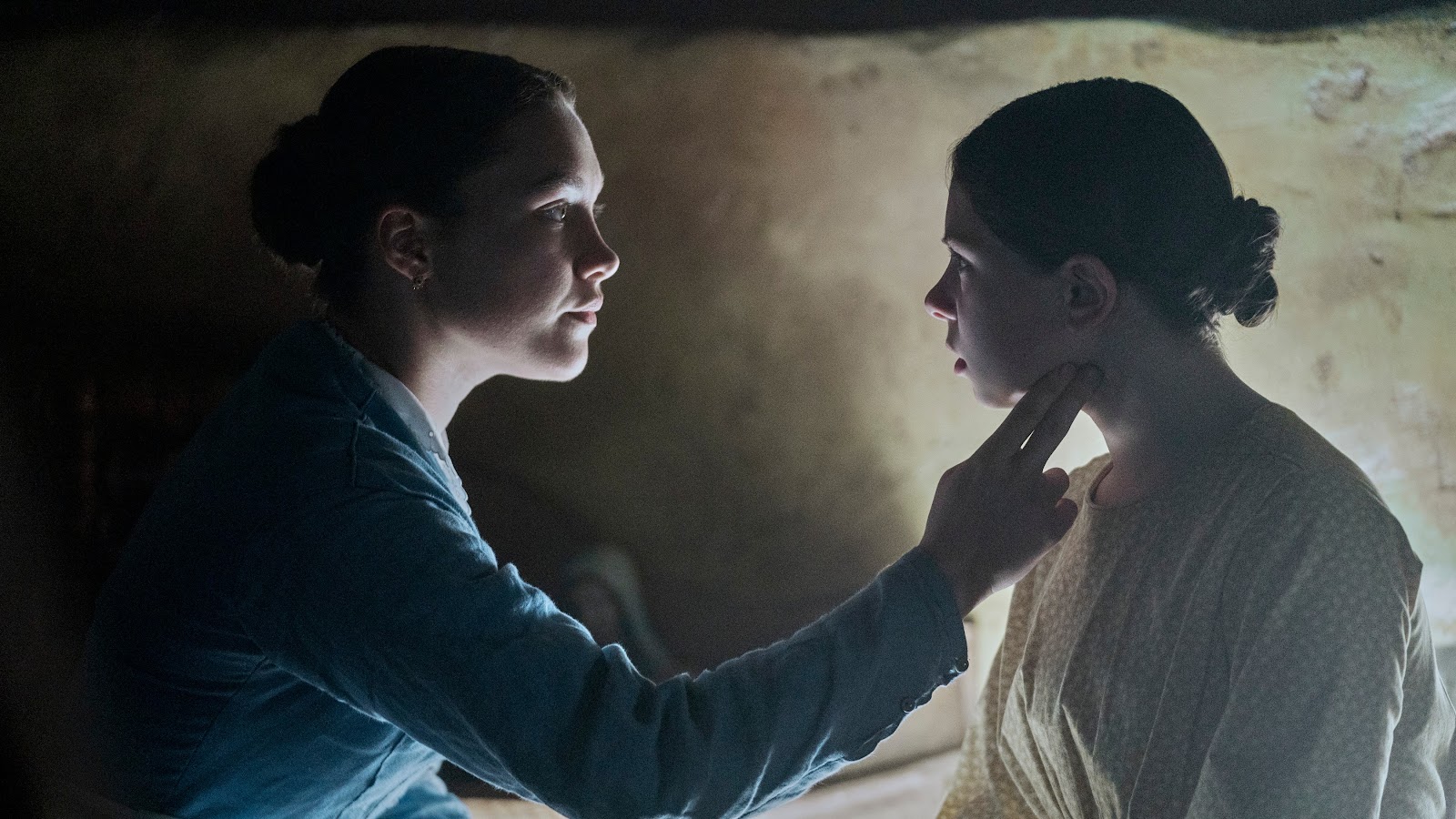
1862: English nurse Elizabeth Wright (Pugh) travels to a remote rural village in Ireland to investigate a young girl, Anna O'Donnell (Kila Lord Cassidy) who, according to her family, has not eaten for four months, and yet still appears to be in good health.  

Based on Emma Donoghue's 2016 novel, The Wonder is a dark and powerful psychological period drama. Its slow moving, meditative pace with bleak, windswept vistas of moorland and dark, cramped interiors, cast a powerful spell.  The film's message of belief and the stories that we tell ourselves and each other is hammered home a little too much, including a strange prologue in a film studio emphasising to the viewer that, yes, we are being told a story.  It is also about the dangers of belief, and even in this day and age, it is unusual to see a film that has such a strongly secular message.  However it also deals with how much people need stories and need something to hold on to.  Elizabeth has previously lost her baby and has been abandoned by her husband, she is also traumatised by her experiences nursing the sick and injured in the Crimean War, and copes with her trauma and despair by taking laudanum and also pricking herself with pins.  The O'Donnell family and the village itself are still suffering the after effects of the Great Famine, and feel like they need a miracle, as well as living in a devoutly religious and patriarchal society, cut off from much of the rest of the world.  Florence Pugh gives a powerful performance as the skeptical, grieving nurse.  Kila Lord Cassidy is very good as the "fasting girl", and her real-life mother, Elaine Cassidy, plays her character's devout mother, paralysed with grief for the loss of her teenage son.  Niamh Algar plays the taciturn and slightly sinister elder O'Donnell daughter, and Tom Burke plays the charismatic newspaper reporter who originally came form the village, and is immediately convinced that Anna is faking, but also understands the way the villager's minds work.  While some of the film's more offbeat touches don't always work, it is a beautiful, dark and troubling film, with fantastic performances. 


  Florence Pugh and Kila Lord Cassidy in The Wonder