Tuesday, 11 October 2022

Death in Venice

 Year:  1971

Director: Luchino Visconti

Screenplay:  Luchino Visconti and Nicola Badalucco, based on the novella Death in Venice by Thomas Mann

Starring:  Dirk Bogarde, Björn Andrésen, Mark Burns, Romolo Valli, Nora Ricci, Marisa Berenson, Carole André, Silvana Mangano

Running Time:  130 minutes

Genre:  Drama


At the dawn of the 20th Century, ailing composer Gustav von Aschendbach (Bogarde), finding his physical and mental health suffering after a disastrous concert, travels to Venice for a quiet holiday to recuperate.  In a palatial hotel on the Lido, Aschenbach notices teenager Tadzio (Andrésen) and becomes increasingly obsessed with him.  Meanwhile, Aschenbach becomes aware of rumours of an outbreak of cholera sweeping Venice.

Based on a 1912 novella by German writer Thomas Mann, this is possibly one of the best known films of celebrated Italian filmmaker Luchino Visconti.  British actor Dirk Bogarde, who previously worked with Visconti on The Damned (1969), plays fastidious German composer Gustav von Aschenbach, who is obsessed with the pursuit of ideal beauty.  Failing to find it in his music, he believes he has found it in the adolescent Tadzio.  The film is seen more or less through Aschenbach's eyes, and Tadzio is seen as an object of desire, and it is unclear as to whether Aschenbach's fixation on Tadzio is carnal or if he sees Tadzio as having the perfect beauty of a statue or painting.  The two never speak, Aschenbach stays watching Tadzio in hotel dining rooms, on the beach just outside the hotel, and takes to following Tadzio and his family through the winding streets of Venice.   The two exchange glances, but that is it.  However Aschenbach does at one point fantasise about warning Tadzio's mother, played by Silvana Mangano, of the outbreak in Venice.  The film's narrative in Venice is broken by flashback to Aschenbach's past and dreams.  Dirk Bogarde gives a great performance as Aschenbach, snapping at hotel staff and guards in a train station, discussing aesthetics with a friend, he becomes ultimately a pathetic and rather tragic figure, with his face painted white, lips painted red and hair dyed black to make himself look younger.  Bogarde manages to convey a lot without dialogue, depicting his yearning through longing looks.  The film looks beautiful with every frame carefully composed and features some beautiful images, complemented by a classical score, famously featuring Gustav Mahler's Third and Fifth Symphonies.  This is a slow, languid film, which is nevertheless surprisingly moving.  The story's premise of an adult's infatuation with an adolescent is, to put it mildly, uncomfortable and problematic, although it is a powerful work of art.  Aschenbach is a man who knows he is dying, who knows that his time has passed, alone and forgotten in the stately grandeur of a bygone age, in a place where even the air is making him feel increasingly sick, he sees in Tadzio the youth, life and beauty that he craves but that he can never have.

Björn Andrésen, who plays Tadzio, and who was 16 at the time of the film's release, has since criticised the film and the unwelcome and often predatory attention that he received during it's production and following it's release.  The Most Beautiful Boy in the World, a documentary about Andrésen, was released in 2019.


Dirk Bogarde in Death in Venice


Thursday, 6 October 2022

Scum

Year:  1979

Director:  Alan Clarke

Screenplay:  Roy Minton

Starring:  Ray Winstone, Mick Ford, Julian Ford, John Blundell, Phil Daniels, Ray Burdis, Alrick Riley

Running Time:  97 minutes

Genre:  Drama

Three teenage boys arrive at a British "borstal" (a type of youth detention centre):  Carlin (Winstone) is being transferred for assaulting an officer at his previous borstal, Angel (Riley) has been convicted of stealing cars, and Davis (Ford) escaped from an open borstal.  Once in the prison Angel suffers racist abuse from both inmates and guards, and Davis, who is perceived as weak, is also victimised.  Meanwhile Carlin is targeted by the inmates, for his tough reputation, and the guards, who want revenge for the officer he hit.  In order to survive carlin embarks on a desperate, violent struggle to become the top dog, or "daddy", in the borstal.

Scum started out as a television movie made in 1977 for the BBC's groundbreaking Play for Today series.  However, the BBC got cold feet due to the violent content and pulled it form transmission.  Prolific TV director Alan Clarke, who directed the original TV play, and writer Roy Minton decided to remake Scum as a feature film, with most of the original cast of the play returning.  Scum was intended as an indictment of a failing prison system,  Despite the fact that borstal was supposed to be more about rehabilitation than punishment, there is very little attempt at rehabilitation shown, with the staff just as cruel and brutal as the prisoners (or "trainees" as they are called).  The borstal staff are almost all depicted as brutal thugs in suits, the elderly governor is portrayed as a hypocrite who insists that "there is no violence here" despite the fact that violence is almost constant in the institution.  Even the staff who deem to genuinely want to help their charges, such as the Matron (played by Jo Kendall), the film's only female character, don't have the resources, freedom or skill to do anything,  This is a very brutal film, the filmmakers took full advantage of the greater freedom a feature film allowed them to increase the level of violence.  There is a lot of racism and homophobia, frequent violent scenes, a brutal rape scene and a very bloody suicide.  The actors are disturbingly good, particularly Ray Winstone as the film's nominal hero, and Mick Ford as the intelligent, eccentric Archer, one of the film's few likeable characters, whose deadpan humour brings a little light into the darkness.  The film is shot in an almost documentary style, with the stark, white interiors and bleak wintery landscapes outside emphasising the hopelessness of the characters.  In the years since it's release, Scum has become something of a cult film in Britain.  It's worth watching, although I would advise to approach with caution.  It's a harrowing experience.


Ray Winstone in Scum

Wednesday, 5 October 2022

Scream 3

Year:  2000

Director:  Wes Craven

Screenplay:  Ehren Krueger, based on characters created by Kevin Williamson

Starring:  Neve Campbell, David Arquette, Courteney Cox Arquette, Patrick Dempsey, Jenny McCarthy, Parker Posey, Deon Richmond, Emily Mortimer, Scott Foley, Lance Henriksen

Running Time:  117 minutes

Genre:  Comedy, horror

Sidney Prescott (Campbell) is now living in self-imposed seclusion after surviving the killing sprees in her home town of Woodsboro and Windsor College.  Until, that is a new killer, once again wearing a Ghostface mask, starts picking off the cast of new horror movie Stab 3, based on Sidney's story.  Sidney has to travel to Hollywood and reunite with fellow survivors tabloid TV news journalist Gale Weathers (Cox Arquette) and former small town cop turned security guard Dewey Riley (Arquette) to uncover the new killer.

The original Scream (1996) was a true game changer in the horror field, which really revitalised the slasher film genre, at a time when it seemed to have had it's day.  Scream 2 (1997), while not as good as the original, was still a strong sequel.  However, Scream 3 was the point where the franchise dipped.  Kevin Williamson, who wrote the first two films, bowed out of screenwriting duties to be replaced by Ehren Kruger, and Williamson's distinctive voice is certainly missed here.  Wes Craven returns as the film's director and once again stages some impressive action scenes, most notably a scene where Sidney is chased by the killer through a studio mockup of Woodsboro.  Due to concerns over the portrayal of violence in media following the 1999 Columbine Massacre, the level of violence is heavily toned down from the previous films, and the film leans more towards comedy than horror.  Neve Campbell, David Arquette and Courteney Cox Arquette are as engaging as ever, even if Courteney Cox Arquette (who was married to co-star David Arquette at the time) is saddled with a a truly dreadful hairstyle.  Also in the cast is genre veteran Lance Henriksen, popular model-turned-actress Jenny McCarthy, indie film veteran Parker Posey and an early role for Emily Mortimer.  The film also features cameos from legendary B-movie producer Roger Corman, Kevin Smith and Jason Mewes as Jay and Silent Bob, and in the film's funniest moments Carrie Fisher as a washed-up actress working in the studio archives, still bitter over the fact that the role of Princess Leia went to "the one that slept with George Lucas".  Another fun element is Parker Posey as the actress playing Gale Weathers teaming up with Courteney Cox Arquette as the real Gale Weathers, in order to get into character.  The film is not as funny or suspenseful as the previous films, but the Hollywood setting adds an interesting element, and the final act of the film does work, even if it feels more like a cross between Agatha Christie and film noir than a Scream film.  There is also a character who is a creepy movie producer who preys on young actresses and delivers the line "there are plenty of criminals in this town whose careers are flourishing", which has an added resonance in the post-Weinstein world.  Ironically, Harvey Weinstein was one of the film's executive producers.


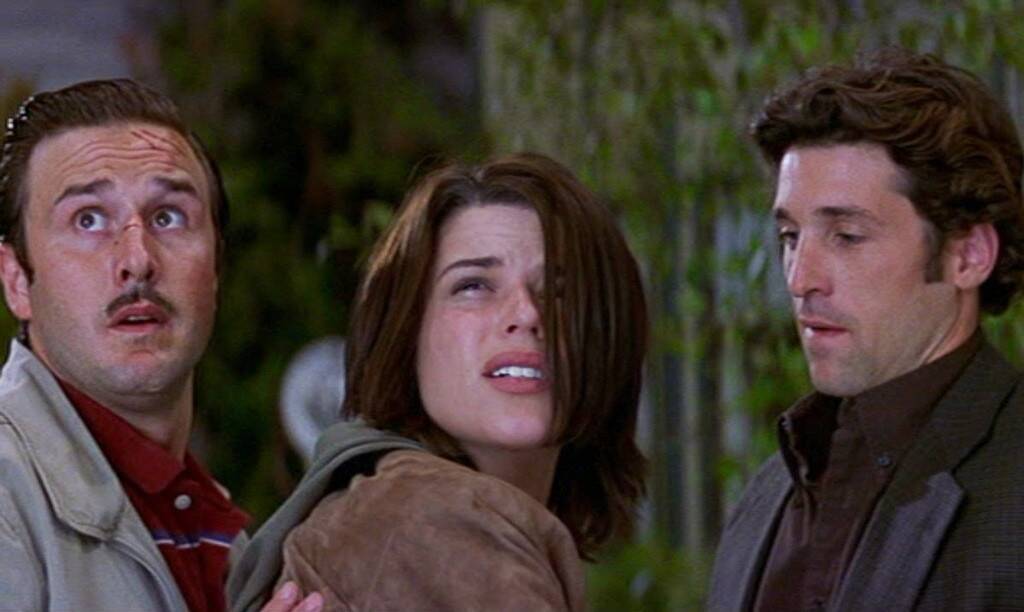
David Arquette, Neve Campbell and Patrick Dempsey in Scream 3


Tuesday, 4 October 2022

Scream 2

Year:  1997

Director:  Wes Craven

Screenplay:  Kevin Williamson

Starring:  Neve Campbell, Courteney Cox, David Arquette, Jamie Kennedy, Jerry O'Connell, Timothy Olyphant, Laurie Metcalfe, Jada Pinkett, Sarah Michelle Gellar, Liev Schreiber

Running Time:  120 minutes

Genre:  horror, comedy

 Two Windsor College students are brutally murdered at a preview of the new horror film Stab, based on the serial murders in the small town of Woodsboro.  Sidney Prescott (Campbell), one of the survivors of the Woodsboro murders, is also a student at Windsor and soon realises that she is once more being targeted by a ghost-mask wearing killer.  As the bodies and suspects mount up, it becomes clear that someone is trying to make a sequel to the previous killing spree.

Given the immense success of Scream (1996) a sequel was almost inevitable, and the filmmakers certainly didn't waste any time, with Scream 2 in cinemas only a year after the original.  Given the short time between the films it is surprising that Scream 2 is as good as it is.  While the original film both celebrated and commented on the tropes of traditional slasher horror films, this film does the same with horror sequels, including a scene which mirrors a famous sequence in the original where the film nerd Randy (played by Jamie Kennedy) outlines the rules of sequels.  Horror veteran Wes Craven returns to directing duties and orchestrates everything on a much bigger scale with some memorable set pieces, the opening sequence in the cinema, featuring Omar Epps and Jada Pinkett, is one of the highlights of the whole Scream series, and the ensemble cast, which features a number of future stars, as well as veterans such as David Warner, all give good performances.  Neve Campbell is good in the lead, and there is real connection between Courteney Cox and David Arquette, who were in a relationship at the time and later got married. The script by Kevin Williamson is witty, clever and full of pop-culture references.  This film also introduced film-within-a-film Stab, which would become a recurring feature in the Scream franchise, allowing the filmmakers to comment on and poke fun at the franchise itself.  the film inevitably lacks the freshness of the original.  There also some glaring plot holes, and a reliance on red-herring scares.  It is still a very good film, and definitely a superior sequel.


Neve Campbell and Courteney Cox in Scream 2


Tuesday, 27 September 2022

My Friend Dahmer

 Year: 2017

Director:  Marc Meyers

Screenplay:  Marc Meyers, based on the graphic novel My Friend Dahmer by John "Derf" Backderf

Starring:  Ross Lynch, Anne Heche, Alex Wolff, Dallas Roberts, Tommy Nelson, Vincent Kartheiser

Running Time:  107 minutes

Genre:  Drama

1970s Ohio:  High school student Jeffrey Dahmer (Lynch) is a strange young man, with an unhealthy interest in dissecting animals.  Jeffrey and his younger brother David (Liam Koeth) have a difficult family life with their mentally ill mother (Heche) and a father (Roberts) who tries but fails to connect to Jeffrey.  Jeffrey's acting out at school soon draws the attention of a group of students, including aspiring artist John "Derf" Backderf (Wolff) who befriend him and persuade him to participate in a variety of pranks.  However as time goes on, Jeffrey begins to go down a far darker path.


Jeffrey Dahmer is one of the most notorious serial killers in American history who murdered at least 17 boys and young men before his arrest in 1991.  My Friend Dahmer is an unconventional true crime film, because it doesn't concern itself with any of his crimes.  It's based on an acclaimed 2012 graphic novel by cartoonist John "Derf' Backderf about his teenage friendship with Jeffrey Dahmer, and the bulk of the film concentrates on their senior year at high school in 1978.  The film is almost like a low-key domestic drama, about a troubled teenager, it really depends a lot on the audience's familiarity with Dahmer and his crimes for it's full effect.  The film has some very good performances, particularly from Ross Lynch, who gives a creepy performance as the dead eyed Dahmer.  The film humanises a monster, showing his troubled life and portraying him as a weird, unhappy teenager.  The film mentions the fact that Derf and his gang are arguably exploiting Dahmer by really using him for their entertainment, they use the term "doing a Dahmer" for his attention-seeking pranks such as impersonating a local interior designer with cerebral palsy, suddenly making loud noises, and sneaking into yearbook photos, among other things.  This is an effective, and chilling look at what makes a monster, that manages to feel empathetic and not exploitative.


       Ross Lynch as Jeffrey Dahmer in My Friend Dahmer

Saturday, 24 September 2022

Wings of Desire

Year:  1987

Director:  Wim Wenders

Screenplay:  Wim Wenders, Peter Handke, Richard Reitinger

Starring:  Bruno Ganz, Solveig Dommartin, Otto Sander, Curt Bois, Peter Falk

Running Time:  127 minutes

Genre:  Fantasy

West Berlin:  Two angels, Damiel (Ganz) and Cassiel (Sander), watch over the affairs of humans.  The immortal angels are able to hear the thoughts of humans, however they are physically unable to intervene, or even interact with the physical world, and remain invisible to humans, although some can sense their presence.  Suffering from existential angst over his immortal existence set apart from the physical plane, Daniel falls in love with trapeze artist Marion (Dommartin) and decides to renounce his angelic existence for a mortal, human life.

In the years since it's release this philosophical romantic fantasy has become seen as one of the classics of world cinema.  While the film is long, slow, and arguably pretentious, it is intriguing, often funny and ultimately becomes profoundly moving.  The film is visually impressive, most of it is in sepia tinged black-and-white, with sequences in colour, and brief flashes of vintage newsreel footage.  The locations in Berlin range from the more familiar tourist areas such as the Victory Column where the angels frequently gather at the top to observe human life, to more run-down and industrial areas of the city, as well as the Berlin Wall. We also follow the stories of various characters that the angels observe, including an elderly poet, a suicidal young man, and American actor Peter Falk (playing himself) who is filming a war movie in Berlin.  The film has some fantastic performances from Bruno Ganz and Solveig Dommartin in particular, and a warm, funny performance from Peter Falk.  The film also gives a glimpse of life in West Berlin in the years immediately before reunification, including a look at the underground rock clubs with a cameo from Nick Cave and the Bad Seeds.  It is really more a film about a city than about angels.  It is interesting how little traditionally angelic imagery is used, the angels have wings that appear occasionally, but usually appear as normal humans in long overcoats, and there are no references to Heaven or God.  The angels with their ability to pass over the city and hear thoughts provide an insight into the city and the people who live there.  Ultimately it becomes a celebration of the small, transient joys and pains of life, and the beauty of existence.  The film was followed by a sequel Faraway, So Close! (1993) and was remade in 1997 as City of Angels, starring Nicolas Cage and Meg Ryan.  


Bruno Ganz in Wings of Desire

Wednesday, 7 September 2022

Rope

 Year:  1948

Director:  Alfred Hitchcock

Screenplay:  Hume Cronyn, based on the stage play Rope by Patrick Hamilton

Starring:  James Stewart, John Dall, Farley Granger, Joan Chandler, Sir Cedric Hardwicke, Constance Collier, Douglas Dick, Edith Evanson

Running Time:  80 minutes

Genre:  Thriller

New York City:  Two students, Brandon (Dall) and Philip (Granger), murder their friend David (Dick Hogan) for no other reason than the thrill of it.  After hiding the body in a large antique chest, they throw a party to which they invite David's family and friends, as well as their former teacher (Stewart).

Based on a 1928 stage play by Patrick Hamilton, which was itself loosely based on the notorious 1924 Leopold and Loeb murder case, this is one of Alfred Hitchcock's most experimental films.  Aside from the opening credit sequence, the entire film is set within the confines of Brandon and Philip's palatial New York apartment, and it is filmed to appear as if it is almost one continuous take.  The camera moves are impressive, although due to the fact that the cameras of the time could only hold a maximum of ten minutes worth of film, the camera frequently has to move close into the backs of people's jackets or furniture in order to hide the edit when the film had to be replaced.  This was the first of three films that James Stewart made for Hitchcock and he was critical of the film, commenting that the "really important thing being rehearsed here is the camera, not the actors," and stating much later that "it was worth trying... But it really didn't work."  Hitchcock himself dismissed the continuous take technique as "a stunt."  The film's main set of the apartment's living room is impressive, with a large window looking out over a steadily darkening New York City skyline, all of which was achieved in the studio.  While the film isn't entirely successful, it is an entertaining thriller.  The suspense comes not from David's fate, or the identity of the murderers, the film opens with the murder and the hiding of the body, but on when and how the "perfect murder" will unravel.  The film was very controversial on it's original release, possibly because of the strong homosexual subtext, the fact that Brandon and Philip are in a relationship is made pretty much as blatant as it could be in a mainstream movie in 1948.  For the most part the film manages to be more than just an innovative experiment, with sharp dialogue, strong performances, and the steadily building tension.  However, there are points where the technique overrides the content and your left admiring the camera work, rather than being involved in the story.


What a swell party: Farley Granger, James Stewart and John Dall in Rope