Saturday, 23 April 2022

Chinatown

 Year:  1974

Director:  Roman Polanski

Screenplay:  Robert Towne

Starring:  Jack Nicholson, Faye Dunaway, John Hillerman, Perry Lopez, Burt Young, John Huston

Running Time:  134 minutes

Genre:  Crime, mystery, drama


Los Angeles, 1937:  Cynical private investigator Jake Gittes (Nicholson) is hired to investigate a seemingly simple case of suspected marital infidelity.  However, he soon finds himself drawn into a murderous criminal conspiracy over water rights. As he pursues his investigation, Gittes uncovers secrets far darker than he could have suspected.

Inspired by the real life "California water wars", a series of disputes in the early 20th century over the rights to supply water in Southern California, this is one of the classic American films of the 1970s.  Film noir was a subgenere of American film which flourished during the 1940s and 1950s.  Literally translated as "black film",  film noir featured dark, cynical and bleak stories with often stylish, shadowy cinematography.  Chinatown is an example of "neo-noir"in that it came after the period of film noir, but still hearkens back to it in terms of plot and style, albeit with an updated sensibility. The darkness of the film's content is somehow complemented by mostly taking place in bright sunshine.  Jack Nicholson gives one of his best performances as the cynical detective Jake Gittes, charismatic, tough and sometimes dangerous, but with a moral centre.  Faye Dunaway gives a powerful, complex performance as the brittle femme fatale Evelyn Mulwray, who turns out to be more of a tragic victim.  Legendary director John Huston plays the courtly, avuncular, fabulously wealthy and thoroughly evil Noah Cross, who is terrifying because he is so friendly and polite.  Roman Polanski has a cameo as a henchman who slices Gittes' nose in a memorable scene.  The screenplay by Robert Towne is superbly crafted, with every element fitting together like clockwork, although Polanski apparently rearranged some scenes, and also wrote the film's bleak conclusion.  Polanski, ghastly human being although he may be, was a great filmmaker, and this is one of his finest moments as director.  Despite the title, only the film's final few minutes are set in the Chinatown area of Los Angeles, although it is mentioned in several places that Jake was a policeman in Chinatown, and something terrible happened there which is never revealed, but which made him leave the force and seemingly left him with lasting trauma,  and so Chinatown in the film is less a physical place than a state of mind, as after the devastating climax, which is still shocking even after several viewings, Gittes' partner in his detective agency delivers the film's classic closing line:  "Forget it, Jake.  It's Chinatown."


Jack Nicholson and Faye Dunaway in Chinatown


Friday, 22 April 2022

King Kong

Year:  1933

Directors:  Merian C. Cooper and Ernest B. Schoedsack

Screenplay:  James Creelman and Ruth Rose, from a story by Edgar Wallace and Merian C. Cooper

Starring:  Fay Wray, Robert Armstrong, Bruce Cabot

Running Time:  104 minutes

Genre:  Fantasy, horror

Wildlife filmmaker Carl Denham (Armstrong) leads an expedition to a mysterious, remote island.  Among the party is Ann Darrow (Wray), a woman who Denham encountered in New York and convinced to accompany him in order to play the female lead in his film.  Shortly after they arrive on the island, Ann is captured by local villagers who sacrifice her to their god, Kong, a giant gorilla who lives in the thick jungle behind a giant wall which protects the village from the horrors in the jungle.  The rest of the expedition set out to rescue Ann only to find a nightmarish "lost world" is the jungle populated by prehistoric beasts.  Meanwhile Denham decides that instead of bringing film of Kong back to America, it would be a much bigger money-maker to bring back Kong himself.

This is one of the most influential and beloved films ever made, and still possibly the definitive monster movie.  The film has dated somewhat over the past ninety years, it's pretty suspect today in the way that the local indigenous people on the island are treated, and also the male characters are extremely sexist (the film opens with Denham, the ship's first mate (Bruce Cabot), skipper (Frank Reicher) and a theatrical agent (Sam Hardy) discussing how much they do not want a woman on their journey, like a bunch of little boys who don't want to let girls into their club, however Denham reluctantly maintains that they need a woman to make their film more commercial).  Also there are the technical limitations of early sound recording, which required the actors to stand near a microphone to record their voices.  The special effects developed by Willis O'Brien, are notable for their use of "stop motion" animation (basically with stop motion a posable model is put into the required position and a photograph is taken, the model is then moved very slightly and another picture is taken, then it is moved slightly again  and another picture is taken and the process is repeated again and again and again, and eventually when the pictures are run together it should look like the creature is moving, it's very painstaking and time-consuming but can be very effective).  When Kong moves you can see his fur moving in strange ways due to the fingerprints of the animators moving the model.  Kong is a terrifying, savage force of nature.  In his island home he really is "King" Kong, defeating several dinosaur  adversaries, including a memorable battle with a Tyrannosaurus (which took seven weeks to animate).  However, when Kong is captured and taken to New York, where he is put on display in chains, it is hard not to feel sympathy for his rage, bafflement and fear, and you can't really blame him when he breaks out and goes on a rampage.  It is his fascination with Ann, who he treats with surprising tenderness, that brings about his downfall, culminating in one of the most iconic scenes in all of cinema where Kong is at the top of the Empire State Building (the tallest building in the world at the time) being gunned down by planes which he tries to swat like flies.  The film's true villain is the reckless Carl Denham, who at the very least is criminally irresponsible, in the risks he exposes others to in order to make his film, he puts his entire crew at risk, as well as Ann, and happily sacrifices the lives of the villagers on the island, as well as bringing Kong to New York in the first place.  However he is given the film's final line, surveying Kong's body in front of the Empire State Building a character comments "Well, the airplanes got 'im".  Denham replies "No, it wasn't the airplanes.  It was beauty that killed the beast."


Tuesday, 19 April 2022

It Came from Outer Space

Year:  1953

Director:  Jack Arnold

Screenplay:  Harry Essex, from a story by Ray Bradbury

Starring:  Richard Carlson, Barbara Rush

Running Time:  80 minutes

Genre:  Science-fiction

Writer and amateur astronomer Frank Putnam (Carlson) and his schoolteacher girlfriend Ellen Fields (Rush) witness what seems to be a meteor crashing in the Arizona desert.  When they discover, they discover that it is, in fact, a large spacecraft.  Of course, nobody believes them, but then local people begin acting very strangely.


This is one of the finest moments of the 1950s science-fiction craze.  To modern audiences the alien creature may be more likely to provoke giggles than screams, and the film's low budget is very obvious in places, however under celebrated science-fiction director Jack Arnold, it still conjures up some memorable images, and the desert landscapes are evocative.  Based on an original screen treatment by legendary science-fiction writer Ray Bradbury, and scripted by Harry Essex, the film is well written with intelligent dialogue.  Unusually the film's shape-shifting aliens are not malevolent, all they want is to repair their ship and leave.  Richard Carlson gives a strong performance as the increasingly stressed astronomer, even if Barbara Rush is a little underused as his loyal girlfriend.  Charles Drake plays the town's aggressive sheriff who is also Putnam's rival for Ellen's affections.  The film was originally shown in 3D which is why so many objects are thrust at the camera.  


It Came from Outer Space


Saturday, 16 April 2022

The Northman

 Year:  2022

Director:  Robert Eggers

Screenplay:  Sjón and Robert Eggers

Starring:  Alexander Skarsgård, Nicole Kidman, Claes Bang, Anya Taylor-Joy, Ethan Hawke, Björk, Willem Dafoe

Running Time:  137 minutes

Genre:  epic, action, drama

895 AD: After King Aurvandill War-Raven (Hawke) is murdered by his brother Fjölnir (Bang), who carries off Queen Gudrún (Kidman), Prince Amleth (Skarsgård) swears to avenge his father and save his mother.  As years pass, Amleth plans to pose as a slave in Fjölnir's stronghold, and prepare for his revenge with the help of sorceress Olga (Taylor-Joy).

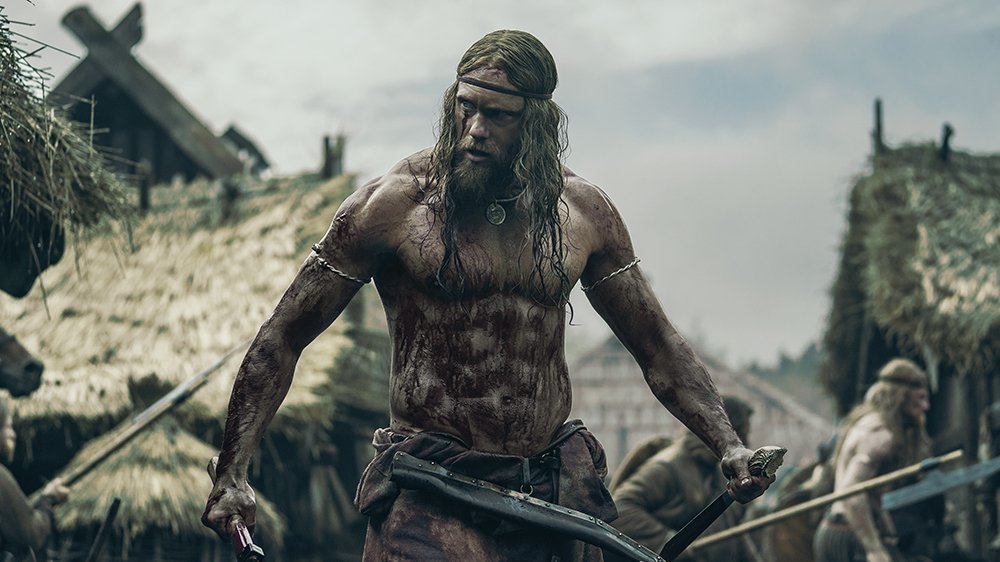
The film is based on the medieval Scandinavian legend of Amleth, which also inspired William Shakespeare's Hamlet.  However, if you are not into the Bard, you don't need to worry about this being Hamlet, it is basically more like a Viking version of Gladiator (2000), or a plot line from Game of Thrones (2011-2019).  Eggers, who has made his name with cerebral so-called "elevated horror" films such as The Witch (2016) and The Lighthouse (2020), may not seem like the obvious choice for making a blood-and-thunder action film, but the action is staged very well, even though it can be difficult to tell one hairy. bearded, mud-caked Viking from another.  The film is well-designed and it is a pretty bleak, unsympathetic worldview, even anti-hero Amleth seems more than happy to raid and pillage villages.  Alexander Skarsgård is good as the snarling, steely-eyed Amleth, Nicole Kidman is good as the sinister queen, and Anya Taylor-Joy, who made her name with Eggers' The Witch,  provides the film's conscience as the mystical, nurturing Olga.  The film has a semi-supernatural aspect with Olga's magic, and Amleth's frequent hallucinatory visions, as well as a magical sword.  Even though it is quite a long film, there is too much going on for it to ever get dull.  It's been a while since there was a proper musclebound sword and shield historical action film like this, so it is quite welcome.  It also comments on the price to be paid for vengeance on both sides.


Alexander Skarsgård is The Northman


The Remains of the Day

 Year:  1993

Director:  James Ivory

Screenplay:  Ruth Prawer Jhabvala and Harold Pinter (uncredited), based on the novel The Remains of the Day by Kazuo Ishiguro

Starring:  Anthony Hopkins, Emma Thompson, James Fox, Christopher Reeve, Peter Vaughan, Hugh Grant, Michael Lonsdale, Tim Pigott-Smith, Lena Headey

Running Time:  134 minutes

Genre:  Period drama

The late 1950s:  Stevens (Hopkins), the butler of the large English stately home Darlington Hall, looks back on twenty years of devoted service to the disgraced Lord Darlington (Fox) and, in particular, reflects on his relationship with housekeeper Miss Kenton (Thompson).


Throughout the 1980s and '90s, Merchant Ivory Productions (producer Ismail Merchant, director James Ivory and screenwriter Ruth Prawer Jhabvala) were the undisputed champions of handsomely mounted, serious period dramas.  This faithful adaptation of the celebrated 1989 novel by Kazuo Ishiguro is one of their best known productions.  Unfolding mostly in flashback while Stevens takes a journey by car over several days to visit Miss Kenton, the film mostly takes place in the late 1930s.  Stevens is a man whose entire life is devoted to serving his master, and he is responsible for ensuring that everything in this world runs like clockwork, that everything is immaculate and in it's proper place.  He is also a tragic figure, deeply repressed and unable to open up about his true feelings.  It is never blatantly expressed, but pretty clear that Stevens is in love with Miss Kenton, and she seems to have feelings for him, but their relationship goes no further than her bringing him flowers for his little parlour, at no point in the film fro they even refer to each other by their given names.  Anthony Hopkins gives an immaculate performance as Stevens, in a very difficult role having to express a lot with very little.  He is very straightlaced,  very buttoned down, and expresses a lot with a look, or the flicker of an expression.  Emma Thompson is wonderful as the kindly Miss Kenton, who sometimes finds herself conflicted between her secure employment and her principles, and appears to harbour unspoken feelings for Stevens.  James Fox plays Stevens' employer Lord Darlington, who falls into disgrace due to his Nazi sympathies in the 1930s, although he is portrayed as more misguided and ignorant than being a true fascist.  Christopher Reeve, best known for Superman (1978) and it's three sequels, plays the new American owner of Darlington Hall in the 1950s.  Veteran actor Peter Vaughan, best known for the TV comedy seres Porridge (1974-1977), plays Stevens' father, also a butler at Darlington Hall.  There are also early appearances for Hugh Grant and Game of Thrones (2011-2019) star Lena Headey.  The film is about regret, change, loss and ageing. Late in the film Miss Kenton remarks that "for some people the evening is the best part of the day."  The "remains of the day" can also refer to the years left.  Stevens is left in the evening of his life with little left to show.


Anthony Hopkins and Emma Thomson in The Remains of the Day


Wednesday, 13 April 2022

Total Recall

 Year:  1990

Director:  Paul Verhoeven

Screenplay:  Ronald Shusett, Dan O'Bannon and Gary Goldman, from a story by Ronald Shusett, Dan O'Bannon and John Povill, based on the short story "We Can Remember It for You Wholesale" by Philip K. Dick

Starring:  Arnold Schwarzenegger, Rachel Ticotin, Sharon Stone, Michael Ironside, Ronny Cox

Running Time:  114 minutes

Genre:  Science-fiction, action


In a future where humans have colonised other planets of the Solar System, construction worker Douglas Quaid (Schwarzenegger) who lives on earth with his wife, Lori (Stone), is plagued by recurring dreams of a mysterious woman (Ticotin) on Mars, which is under the dominion of industrialist dictator Cohaagen (Cox).  Quaid visits an agency called Rekall, Inc. which implants realistic fake memories.  Quaid chooses an "Ego Trip" package where he can have a memory of visiting Mars under the guise of being a secret agent. However, during the implant procedure Quaid suddenly starts lashing out, revealing that he has already had his memory suppressed by a shadowy organisation.  Soon Quaid finds himself on the run, pursued by gunmen, lead by Richter (Ironside), Cohaagen's chief henchman, as he learns that his entire life as Douglas Quaid was an illusion, and Lori and his friends are all spies sent to watch him.  Searching for his true identity, Quaid travels to Mars, and makes contact with the underground resistance against Cohaagen's tyranny.  However, as Quaid's investigation progresses, dreams and reality become harder to distinguish.

Total Recall began as a short story called "We Can remember It for You Wholesale" by prolific science-fiction author Philip K. Dick.  The project spent a long time in development, at one time acclaimed horror director David Cronenberg was attached to direct, his vision of the film stuck close to the short story, in which Quaid, called Quail in the original, was a timid, weedy, little clerk.  Cronenberg wrote twelve drafts of the script, but the producers were unhappy with his cerebral take on the material, because they wanted, in producer/writer Ronald Shusett's terms "Raiders of the Lost Ark go to Mars".  Eventually Dutch director Paul Verhoeven, who had had a hit with RoboCop (1987), was given the director's job, and Arnold Schwarzenegger was chosen to star.  Obviously, Schwarzenegger is no-one's idea of a timid, weedy little clerk, as the film moved further away from the Philip K. Dick short story.  At the time, Total Recall was one of the most expensive films ever made, and it remains one of the iconic science-fiction and action films of that era.  Verhoeven was good at lacing fast paced, lurid action and carnage with  often quite subversive satire (here Cohaagen is the ultimate evil capitalist who has even privatised the air supply).  The special effects are showing their age, but mostly still stand up, particularly the vast alien complex where the film's climax takes place, and the Martians, who are mutated due to the use of cheap, inadequate protective domes, are memorable.  The film moves along at a good pace, it's funny, there is plenty of action, and very graphic violence, although the pulpy plotting often becomes very silly.  Although, one of the most interesting aspects of the film is the possibility that the whole thing is  Quaid's fantasy, which makes the daftness and weirdness make more sense.  The film leaves the question open, and there are hints in the film either way.  The performances are pretty good, including Sharon Stone in her first major role, but everything takes second place to Arnie and the action.  Arnold Schwarzenegger is basically Arnold Schwarzenegger, doing what he does best, he handles the action well and delivers the odd quip. Quaid himself comes across more as a gleefully violent anti-hero in his quite callous attitude, probably a lot of civilians get caught up in the crossfire in this film  (in the film's most controversial scene he points a gun at Lori who says: "You won't shoot me, will you?  After all, we're married."  Quaid shoots her point blank in the head and quips: "Consider that a divorce.").  One of the movies incidental pleasures is the future world, including self-driving taxis, with irritating robot taxi drivers, called "Johnny Cabs", although some of the future world looks charmingly dated now.  This is the kind of film that as it goes on, you get caught up in it, and it is a fun action packed ride.  Later you start picking holes in it.  It is flawed, but I enjoyed it.


Arnold Schwarzenegger in Total Recall

Saturday, 9 April 2022

The Saragossa Manuscript

 Year:  1965

Director:  Wojciech Has

Screenplay:  Tadeusz Kwiatkowski based on the novel The Manuscript Found in Saragossa by Jan Potocki

Starring:  Zbigniew Cybulski, Iga Cembryzńska, Joanna Jędryka

Running Time:  182 minutes

Genre:  Fantasy 


In the Spanish town of Saragossa, during the Napoleonic Wars, two soldiers from opposing sides seek refuge from a battle in an abandoned inn.  They find a large, lavishly illustrated book which one of the soldiers recognise as being written by his grandfather, Alfonso von Wordon (Cybulski), a captain in the Walloon Guard.  The scene moves to Alfonso's story, as he makes his way through the dangerous Sierra Morena Mountains, encountering various bizarre characters including two seductive princesses, a mystical hermit, a possessed man, a cabalist, a rational philosopher, the forces of the Inquisition and groups of travellers and brigands.  All have their own stories to tell.


Based on the 1815 novel by Jan Potocki, this Polish film contains stories within stories within stories, which connect and branch out in unexpected  narrative pathways making it a labyrinth of tales.  The film is beautifully designed, with every frame full of details, and the use of fluid camera movements and skewed angles.  Despite it's forbidding length it never seems to drag. It depicts a beguiling, fairy-tale world where the rational sits cheek by jowl with the supernatural. A world of foolish nobles, charming rogues, bewitched lovers, spirits, demons and clever tricksters.  Some of the stores are creepy, some are exciting, some are dark, some are funny (and this is a very funny film, it has several jokes throughout and there are some very good bits of physical comedy).  When it was released in the USA and Britain it became something of a cult film, even though it was heavily cut.  Jerry Garcia, lead singer of the Grateful Dead, referred to it as his favourite film, and surrealist director Luis Buñuel, who rarely wanted to see any film more than once, liked The Saragossa Manuscript so much he watched it three times.  Martin Scorsese and Francis Ford Coppola both helped to restore and re-release the film.  Other fans include David Lynch and Neil Gaiman.  It is a demanding film, with it's length and complex, puzzle-box structure, but if you go along with it, it is a delightful, frustrating, entertaining film.     


Zbigniew Cybulski and Joanna Jędryka in The Saragossa Manuscript