Sunday, 6 March 2022

Accattone

Year:  1961

Director:  Pier Paolo Pasolini

Screenplay:  Pier Paolo Pasolini with additional dialogue by Sergio Citti

Starring:  Franco Citti, Franca Pasut, Silvana Corsini

Running Time:  117 minutes

Genre:  Drama


In a seedy section of Rome, Vittorio (Citti), nicknamed "Accattone" (Italian for "beggar" or "scrounger"), happily lives as a pimp, off the earnings of sex worker Maddalena (Corsini).  Until Maddalena is arrested and Accattone finds himself having to find an alternate source of income, and possibly finding himself having to do something like working, which he has no intention of doing.


This was the film debut of acclaimed filmmaker Pier Paolo Pasolini.  However Pasolini was already a major, if controversial, figure in Italian cultural and intellectual life as a poet, author, essayist, critic and public intellectual, and Accattone does tie in with Pasolini's previous writing, which often dealt with the urban poor.  Accattone is largely seen as the last of the great Italian neorealist films, although Paolini himself rejected the neorealist label.  Neorealism was a subgenre that sprung up in Italy in the years immediately following the Second World War.  During the war a lot of film studios were used as munitions factories and were bombed, and many filmmakers and actors were drafted into the military and many didn't return.  Lacking facilities and actors, filmmakers made a virtue out of a necessity and began filming almost documentary style on the streets, with non-professional actors as performers.  Accattone was filmed on the streets, with a largely non-professional cast, and it does have a feeling of scenes snatched from real life.  Despite the plot and characters, and unlike most other neorealist films, the film has stylised, almost religious, overtones, with it's Bach soundtrack and frequent religious imagery.  The performances range from being very good to unimpressive.  Franco Citti in his film debut manages to be both repulsive and charismatic as the deeply unpleasant but magnetic Accattone.  Citti would go on to appear in several Pasolini films and went on to greater fame with his appearances in the three Godfather films.  His brother, Sergio Citti, became a screenwriter and director, and contributed to the script of Accattone.  While Pasolini made better films, this is a hugely impressive debut.  


              Franco Citti is Accattone

Saturday, 5 March 2022

The Hound of the Baskervilles

Year:  1959
Director:  Terence Fisher
Screenplay:  Peter Bryan, based on the novel The Hound of the Baskervilles by Sir Arthur Conan Doyle
Starring:  Peter Cushing, André Morell, Christopher Lee, Marla Landi, David Oxley
Running Time:  87 minutes
Genre:  Mystery, thriller

According to legend, since the 1700s when notorious squire Hugo Baskerville (Oxley) met a gruesome end, the Baskerville family of Dartmoor have been cursed by a ghastly Hell Hound.  When Sir Charles Baskerville dies under mysterious circumstances, his best friend Dr. Richard Mortimer (Francis de Wolff) consults the famous detective Sherlock Holmes (Cushing) and Dr. Watson (Morell).  To make matters more urgent, the last surviving Baskerville, Sir Henry (Lee), intends to return to the ancestral seat of Baskerville Hall on Dartmoor.  Legend or no legend, Holmes is convinced that Sir Henry's life is in serious danger.


First serialised in the Strand magazine from 1901 to 1902, The Hound of the Baskervilles is probably the single best known of Sir Arthur Conan Doyle's evergreen Sherlock Holmes stories, and with it's plot revolving around old family curses and iconic imagery of the huge, ghostly Hound on the mist shrouded moors a perfect choice for Britain's Hammer Films, and their signature "Hammer Horror" style.  The film sticks more or less to the plot of the original story, and the narrative moves along at a brisk pace.  Peter Cushing, who was a fan of the original Sherlock Holmes stories, makes for an energetic Holmes with a nice line in acidic retorts.  André Morell anchors the film with his charismatic, heroic Watson.  Christopher Lee is good as ever as the stern, sceptical Sir Henry Baskerville, except the scenes where he is being threatened never really seem that convincing, one of Lee's glares would be enough to send even the most fearsome Hound of Hell scampering back to it's kennel.  Marla Landi plays the mysterious Spanish born daughter of a local farmer who falls for Sir Henry's grim charms.  The film has plenty of gothic atmosphere, with plenty of mist shrouded ruins and strange lights.  The hound never really looks as fearsome as it should, however.  It's an enjoyable slice of vintage mystery with some impressive performances, and also one of the more faithful Holmes adaptations.


 Peter Cushing and Christopher Lee in The Hound of the Baskervilles

Thursday, 3 March 2022

Dr. Terror's House of Horrors


Year:  1965

Director:  Freddie Francis

Screenplay:  Milton Subotsky

Starring:  Peter Cushing, Christopher Lee, Max Adrian, Alan Freeman, Ann Bell, Peter Madden, Donald Sutherland, Roy Castle, Michael Gough

Running Time:  98 minutes

Genre:  Horror


Six strangers meet in a train carriage.  One of them, Dr. Schreck (Cushing), whose name, we're told, means "terror" in German, offers to tell the others' fortunes with his tarot deck (which he calls his "house of horrors").  His five companions are each told their grim fates in a series of stories involving werewolves, killer vines, voodoo curses, vengeful disembodied hands and vampires.

Back in the 1960s and 1970s, Hammer Films held British horror cinema in it's cold, undead grasp.  However one of their main competitors was Amicus Films, which had a similar look to the Hammer Films and often used the same actors (Peter Cushing and Christopher Lee were both regulars in Amicus films as well as their better known Hammer films).  However Amicus usually had a contemporary setting, as opposed to Hammer's usual period settings, and they really found their niche with a series of anthology, or "portmanteau", films.  Instead of having a single narrative running throughout the film, these consisted of four or five separate short stories usually connected by a framing story.  Dr. Terror's House of Horrors was the first of these (and was followed by Torture Garden (1967), The House That Dripped Blood (1970), Tales from the Crypt (1972), Asylum (1972), The Vault of Horror (1973) and From Beyond the Grave (1974)).  These films, by their very nature, were usually something of a mixed bag, but if you weren't enjoying one story, you didn't have to wait too long for something else to come along.  As with all of these films, the title promises far more scares and gore than it delivers, it really is very mild particularly by modern standards.  The special effects are really basic, with the killer plant being someone shaking a vine off-screen, the disembodied hand is a rubber glove fitted with a pump and then there is the rubber bat bobbing along on a wire.  The cast is very eclectic with veterans such as Christopher Lee as an obnoxious art critic, Peter Cushing as the creepy fortune teller and Michael Gough, alongside Roy Castle who would later become beloved to decades of British children as the host of Record Breakers (1972-1994), jazz singer Kenny Lynch, future Hollywood star Donald Sutherland in an early role, and a rare acting role from DJ Alan "Fluff" Freeman ("Not 'arf, pop-pickers!") doing battle with killer weeds.  Everyone plays the material as best they can, providing impressive gravitas.  The stories are enjoyable, with some welcome humour.  The story with the vengeful hand is probably the best of the bunch, the worst being the voodoo story which has not aged well (even though it does feature a weird little in-joke where Roy Castle is terrified by a lurid poster for Dr. Terror's House of Horrors).  It all ends with a surprisingly eerie conclusion.  


Christopher Lee, Peter Cushing, Alan Freeman, Neil McCallum and Roy Castle in Dr. Terror's House of Horrors

Wednesday, 2 March 2022

Deep Red

Year:  1975

Director:  Dario Argento, 

Screenplay:  Dario Argento and Bernardino Zapponi

Starring:  David Hemmings, Daria Nicolodi, Gabriele Lavia, Macha Méril, Clara Calamai

Running Time: 126 minutes 

Genre:  Horror, thriller


One night Marcus Daly (Hemmings), a jazz pianist living in Turin, witnesses the gruesome murder of his upstairs neighbour, psychic medium Helga Ulmann (Méril).  Daly rushes to help, but is too late, however he sees the raincoat clad killer escape into the night.  Haunted by the idea that he saw something important which he cannot quite remember, Daly teams up with ambitious journalist Gianna Brezzi (Nicolodi) to hunt the killer, but the killer is hunting them.

This stylish murder-mystery is one of the classic giallo films.  Giallo was a sub-genre of horror and mystery films that came out of Italy in the 1960s and became hugely popular during the '70s.  Often seen as the fore-runner to later "slasher" films, these films were usually very stylish and showcased elaborate, stylised murders and violence, but were more focussed on the mystery and detection elements than piling up the bodycount.  The term giallo (Italian for "yellow") came from a hugely popular series of cheap paperback mystery novels which were published with distinctive yellow covers.  Deep Red features elaborate, over the top and extremely gory set pieces and a constantly moving camera, but it also has an intriguing and complex mystery plot.  As with most Argento films the dazzling, excessive visuals cover the fact that a lot of it doesn't really make any sense.  However it doesn't really matter, because as labyrinthine and bizarre as the film is, it is full of unforgettable elements, with bizarre sequences and characters, such as the mechanical killer doll (which surely must have been an influence on the Saw films) and the pulsing soundtrack from prog-rock band Goblin.  David Hemmings is charismatic in the lead role, but the film is stolen by Daria Nicolodi as the energetic and funny journalist.  Nicolodi would go on to appear in five more Argento films, and the two were married for a time.  This is definitely one of Argento's best films, and possibly the best example of the giallo genre.  Argento turned the film into a stage musical in 2007, and adopted the film's Italian title "Profondo Rosso" as the name for his horror memorabilia shop and museum in Rome.  


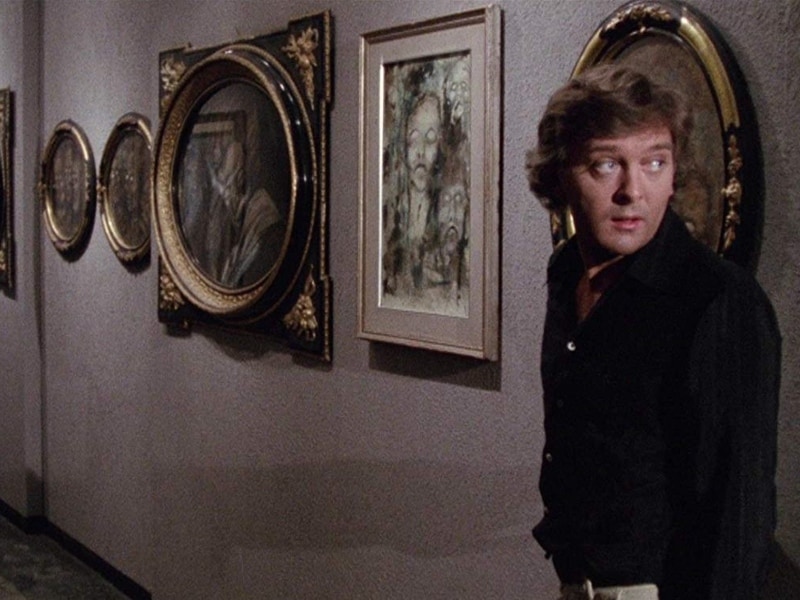
 David Hemmings in Deep Red

Saturday, 26 February 2022

The Driller Killer

Year:  1979

Director:  Abel Ferrara

Screenplay:  Nicholas St. John

Starring: Abel Ferrara, Carolyn Marz, Baybi Day, Harry Schultz, Allan Wynroth

Running Time:  101 minutes (96 minutes theatrical release)

Genre:  Drama, comedy, horror


New York City, the late 1970s:  Reno Miller (Ferrara) is a struggling artist who lives with his girlfriend Carol (Mark) and her lover Pamela (Day), in a cramped, cluttered apartment.  Reno is working on a painting that will make him a lot of money, providing that Dalton (Schultz), the gallery owner who commissioned the piece, likes it.  Unable to pay his rent or bills, Reno knows full well that this is really his one chance, but is overcome with anxiety that he is reluctant to actually finish the piece.  To make matters worse a punk band have moved into the flat next door and practice loudly day and night.  Desperate for some peace and time to think, Reno takes to wandering the New York streets, where he becomes disgusted by the large numbers of people living on the streets, and terrified that he may very soon be joining them.  Eventually Reno snaps, and takes to the streets armed with a power drill, embarking on a killing spree targeting the unhoused population of New York.


After spending the 1970s making short, experimental films and a pornographic film, this marked the (relatively) mainstream debut of controversial auteur Abel Ferrara who becomes something of a cult figure in the '80s and '90s with exploitation films such as Ms .45 (1981), more mainstream crime dramas such as King of New York (1990) and The Funeral (1996), the hugely controversial Bad Lieutenant (1992), as well as science-fiction horror film Body Snatchers (1993), and bizarre vampire film The Addiction (1995).  More recently he has turned to making more experimental films in Italy and documentary features.  Those coming to The Driller Killer expecting grisly thrills may be disappointed because, while it is violent and gruesome, it isn't really as gory as the title and advertising promise, with the exception of a couple of very gruesome scenes, including a notorious scene where one unfortunate gets drilled in the head.   It's also a long time before any murders are committed.  Before then there are long rambling arguments and discussions, and a lot of punk music, as well as a gratuitous lesbian shower scene.  There are a lot of scenes of the band playing, and you could take out all the murders and have, basically, a punk comedy-drama.  This is an obviously very low-budget film filmed in an almost documentary style on the streets of New York, with much of the dialogue being so badly delivered and recorded that it is difficult to make out what the characters are saying.  Ferrera is a very good visual director and there are some scenes of unexpected beauty, and his talent does shine through at several points.  However, acting is not one of his skills.  Ferrara plays the lead role (under the pseudonym of Jimmy Laine) and seems to be spending the film doing a Robert De Niro impression.  The rest of the performances can be politely described as enthusiastic, with Carolyn Marz delivering by far the best performance.  The film does work as something of a time capsule of the underground scene in late 1970s New York.  Unusually for a horror film, Reno Miller's main trigger for his rampage is his financial woes rather than sexual frustration, also unusually almost all of his victims are men.  When it comes to the female characters it is left unclear whether he attacks them or not.  The Driller Killer does have it's unexpected place in film history due to it being almost singlehandedly responsible for the notorious "video nasty" scare in Britain in the 1980s.  Not the film itself but the gruesome VHS cover which depicted a close-up of the head drilling scene and the charming tagline "The Blood Flows in Rivers... And Still the Drill Keeps Tearing Through Flesh and Bone."  When this appeared in video trade magazines in the early 1980s, Conservative politicians clutched their pearls in horror and, by the mid '80s even such relatively innocuous films as The Exorcist (1973), The Texas Chainsaw Massacre (1974) and The Evil Dead (1983) were legally unavailable in Britain.  The recent film Censor (2021) is a good look at the video nasty period.  


Abel Ferrara is The Driller Killer


Lamb

Year:  2021

Director:  Vladimar Jóhansson

Screenplay:  Sjón and Vladimar Jóhansson

Starring:  Noomi Rapace, Hilmer Snær Guðnason, Björn Hlyner Haaraldsson

Running Time:  107 minutes

Genre:  Fantasy, horror


María (Rapace) and Ingvald (Guðnason) live alone on an isolated sheep farm in Iceland.  One day they discover that one of their sheep has given birth to a strange, part-sheep part-human creature.  They name the creature Ada and raise her as if she was a human child.  However, it isn't long before their little family idyll is shattered.


This is a deeply strange slice of folk-horror, which plays like a strange fairytale.  The film has a contemporary setting, but it barely pays lip service to our modern age.  The characters wear modern clothes, they watch television, listen to the radio and have a tractor, but it really could be set at any time, with barely any change in plot.  It moves at a sedate pace, without much dialogue.  There is a lot that is suggested without being explained.  It appears that María had a child called Ada who died, whether with Ingvald or not is never revealed, and also that María had an affair with Ingvald's ne'er-do-well brother Pétur (Haraldson), although it is only hinted at when Pétur, who turns up to crash at the farm, tries to seduce her.  Ingvald never mentions it and it is never clear whether he ever knew about it.  Ada is a comic-horrible creation, a young girl with the head and right arm of a sheep, but there is also real sweetness there, and there is a genuine love and connection in the family, which makes the inevitable tragedy really heartbreaking.  The cast are impressive, particularly Noomi Rapace, and the rural settings are truly beautiful.  However, it is very slow, and it's suspense really comes from the knowledge that there is going to be something bad happening, but not knowing what.  It will probably be seen as a cult film in years to come. 


Hilmer Snær Guðnason and Noomi Rapace in Lamb
   

Wednesday, 23 February 2022

Vertigo

Year:  1958

Director:  Alfred Hitchcock

Screenplay:  Alec Coppel and Samuel Taylor, based on the novel D'entre les morts by Pierre Boileau and Thomas Narcejac

Starring:  James Stewart, Kim Novak, Barbara Bel Geddes, Tom Helmore, Henry Jones

Running Time:  128 minutes

Genre:  Thriller


San Francisco police detective John "Scotty" Ferguson (Stewart) resigns from the force after a rooftop chase results in the death of a fellow police officer and leaves him with crippling acrophobia (fear of heights) and vertigo.  Some time later Scotty is approached by an old schoolfriend, Gavin Elster (Helmore), who wants to hire him to follow his wife, Madeline (Novak), who Ester fears is suicidal.  Scotty accepts the assignment, however in the course of the investigation he falls in love with Madeline.  However his vertigo prevents him form saving her when she plummets from a church bell tower.  A year later, still dealing with his trauma, Scotty becomes obsessed by Judy (Novak), a woman who bears a remarkable resemblance to Madeline.


This is one of the Master of Suspense's strangest and darkest films.  While it still made money on it's original release, it was not as big a hit as Alfred Hitchcock's previous few films, and was widely criticised by fans (including fellow director Orson Welles) and critics.  However it's reputation has grown considerably in recent years, and it is frequently named as one of the greatest films ever made.  James Stewart, who is probably best known for playing All-American nice guys in such films as It's a Wonderful Life (1946), plays against type as an ambiguous antihero.  While the term "toxic masculinity" was probably not coined in 1958, John "Scotty" Ferguson is a perfect example of it.  The most disturbing passage in the film is where Scotty tries to make Judy into the image of the dead Madeline, changing her clothes, hair colour, hair style, makeup, everything - whether she likes it or not.  The act of looking is a major element in Vertigo:  Scotty's vertigo is triggered when he looks down (the sense of vertigo is depicted by the film's signature "reverse zoom" technique, where the camera is moved backwards which zooming in creating a kind of telescoping effect); spying on the blonde, statuesque Madeline, Scotty falls in love with her without ever speaking to her (of course Alfred Hitchcock had a penchant for blondes in his films); Scotty is doomed to watch helplessly as she plunges to her fate, mirroring the fate of his police colleague at the beginning of the film; and when he meets Judy he becomes obsessed with her purely because of her resemblance to Madeline, completely dismissing Judy as a person in her own right.  Madeline herself is obsessed with a portrait of a long dead relative which she spends hours staring at and prompts Elster to comment that she might be possessed by the ghost of the woman in the portrait.  In the opening half an hour or so of the film, it almost seems to be shaping up to be ghost story, and in a way it is, only not in a supernatural sense.  Scotty and Judy are both haunted by Madeline, and Scotty's attempts to turn Judy into Madeline could be seen almost like a possession.  The plot reveals it's mystery about a third of the way into the film, in an almost throwaway scene, indicating that the plot isn't really important, and in fact the reveal is kind of disappointing, but the mysterious atmosphere of the film lingers.  It's very well made, with a beautiful sense of colour.  James Stewart is fantastic, both pitiable and disturbing in the lead role, and Novak is great in the dual role of Madeline and Judy, although the 49 year old James Stewart and the 24 year old Kim Novak make for a very unlikely romantic pairing.  Barbara Bel Geddes provides some humour and some much needed warmth to the film as Scotty's friend Midge, who of course is madly in love with him.  Vertigo is one of Alfred Hitchcock's best films, and while it might not be the greatest film ever made, which of course is a debate which will never end as long as film exists, it is a truly great film.


James Stewart and Kim Novak in Vertigo