Monday, 21 February 2022

Kes

Year:  1969

Director:  Ken Loach

Screenplay:  Barry Hines, Ken Loach and Tony Garnett, based on the novel A Kestrel for a Knave by Barry Hines

Starring:  David Bradley, Freddie Fletcher, Lynne Perrie, Colin Welland, Brian Glover

Running Time:  112 minutes

Genre: Drama


Fifteen year old Billy Caspar (Bradley) lives with his mother (Perrie), and older half-brother Jud (Fletcher), in a rough, working-class coal mining town in South Yorkshire.  At home Billy is frequently bullied, both physically and verbally, by Jud who works as a miner, and is more or less ignored by his mother.  At school things are no better, as Billy has been more or less written off by his teachers, and is often bullied by classmates and teachers.  Billy is due to leave school soon, and faces the grim prospect of working down the mine with Jud, the one thing that he has sworn that he will never do.  However, a chink of light shines into Billy's bleak existence when he finds a baby kestrel, which he calls Kes.  As he raises and trains Kes, Billy forms an increasingly strong bond with the wild bird.

Based on the 1968 novel A Kestrel for a Knave by Barry Hines, which is well worth seeking out if you haven't read it, this is an early film from acclaimed British director Ken Loach (credited here as Kenneth Loach).  Loach had already made something of an impact with gritty, socially conscious work such as the controversial TV play Cathy Come Home (1966) about a homeless teenage girl, and his feature film debut Poor Cow (1967).  Filmed on location, in and around the Yorkshire town of Barnsley, with a cast of mostly non-professional actors, and dialogue delivered in strongly accented Yorkshire dialect.  Everything in the film looks and feels grim and bleak, but there are moments of real beauty when Kes soars over the hills and valleys.  It also happens to be a very funny film.  One stand out scene is Brain Glover's hilarious performance as the monstrous Manchester United supporting PE teacher who takes Billy's class for a football lesson.  David Bradley, who now goes by Dai Bradley to avoid confusion with the Harry Potter and After Life actor of the same name, gives a fantastic, naturalistic performance as the tough, yet vulnerable Billy.  The actors often weren't told what would happen in some scenes, in order to get a more natural reaction from them.  The film is a portrayal of British working class life in the late 1960s, and also a howl of protest on behalf of the children who were written off by the education system.  Billy is not a bad kid, although he is no angel, he occasionally steals eggs, bottles of milk from a milk float, a chocolate bar and a comic, as well as a book on falconry after he is unable to join the library, and it is mentioned that he has been in trouble with the law.  However he is intelligent  and compassionate, and has a deep yearning for freedom, which finds expression in his bond with Kes.  


David Bradley in Kes

Saturday, 19 February 2022

Texas Chainsaw Massacre

Year:  2022

Director:  David Blue Garcia

Screenplay:  Chris Thomas Devlin, story by Fede Álvarez and Rodo Sayagues, based on characters created by Kim Henkel and Tobe Hooper

Starring:  Sarah Yarkin, Elise Fisher, Mark Burnham, Moe Dunford, Nell Hudson, Jessica Allain, Olwen Fouéré, Jacob Latimore, Alice Krige

Running Time:  81 minutes

Genre:  Horror


Young entrepreneurs Melody (Yarkin) and Dante (Latimore), along with Melody's sister Lila (Fisher) and Dante's girlfriend Ruth (Hudson) travel to the remote Texas town of Harlow, which they plan to auction off piece by piece to create an exclusive, gentrified new development.  However, the town still has some remaining occupants - local mechanic Richter (Dunford), who is reluctantly working for the group, elderly orphanage proprietor Mrs. Mc (Krige) who refuses to leave her home, and, most of all, a masked, chainsaw-wielding murderer known as Leatherface (Burnham).  The group's only chance of survival rests with Sally Hardesty (Fouéré), the only survivor of Leatherface's killing spree some fifty years earlier, and is now obsessed with revenge.

As incredible as it may sound, this is the ninth film in The Texas Chainsaw Massacre franchise.  It follows on from the 1974 original, ignoring the sequels as is they had never happened.  The character of Sally Hardesty, the only survivor of the original Texas Chainsaw Massacre, reappears, this time played by Irish actor Olwen Fouéré, Marilyn Burns, who played the part in the original film, having died in 2014, and John Larroquette reprises his role as narrator.  Despite being short, the film drags towards the beginning, even though we never know much about the characters, except that Lila is traumatised after a school shooting, during which she was injured, and Dante has an internet cookery show.  Despite the provocative title and being banned in Britain for 25 years, the original The Texas Chainsaw Massacre was scary, but not gory, hence it's trouble with the British censors, they thought the film was too intense, but they didn't know what to cut.  This Texas Chainsaw Massacre, however, is almost drenched in blood, when it does kick into gear, the slaughter barely stops, including a scene where Leatherface carves his way through a tour bus full of people.  There aren't many surprises here.  You'll quickly guess what is going to happen, and you'll probably be able to quickly work out who will survive and who won't.  The cast are good, and do the best they can with limited material, and the action is pretty well staged, and well photographed, with Bulgaria standing in for Texas.  Probably the best scene in the film is when Leatherface starts to attack people on the bus, while everyone is live-streaming him at first and we see one of the phones with with viewers "hearting" the carnage and comments such as "OMG THATS SO FAKE".  The problem is that there is some lazy storytelling, characters suffer fatal injuries but survive long enough to provide help or information when our heroes happen to pass by, before immediately expiring; Leatherface, who must be at least approaching 70, given the timescale of the films, and has a bad leg, at times lumbers around like the elderly, injured man he would be, but at other times seems as sprightly as an Olympic gymnast; and there are plot holes, and, most crucially, there isn't enough backstory to the characters for us to really care about them.  It's not the worst film, or even the worst Texas Chainsaw Massacre film, but it really isn't good.  If you are in the right frame of mind for it, then it might be fun.  I'm sure it will find it's rightful place at parties come Halloween, and it would probably be good during the early hours at an all night horror movie marathon, because it's loud, lightweight and gory.  


Elise Fisher, Sarah Yarkin, Nell Hudson and Jacob Latimore in Texas Chainsaw Massacre  

Friday, 18 February 2022

Annie Hall

Year:  1977

Director:  Woody Allen

Screenplay:  Woody Allen and Marshall Brickman

Starring:  Woody Allen, Diane Keaton, Tony Roberts, Paul Simon, Carol Kane, Janet Margolin, Shelley Duvall, Christopher Walken, Colleen Dewhurst

Running Time:  93 minutes

Genre:  Comedy

In New York City, neurotic comedian Alvy Singer (Allen) and Annie Hall (Keaton), an aspiring singer form the Midwest embark on an on-again, off-again romance.


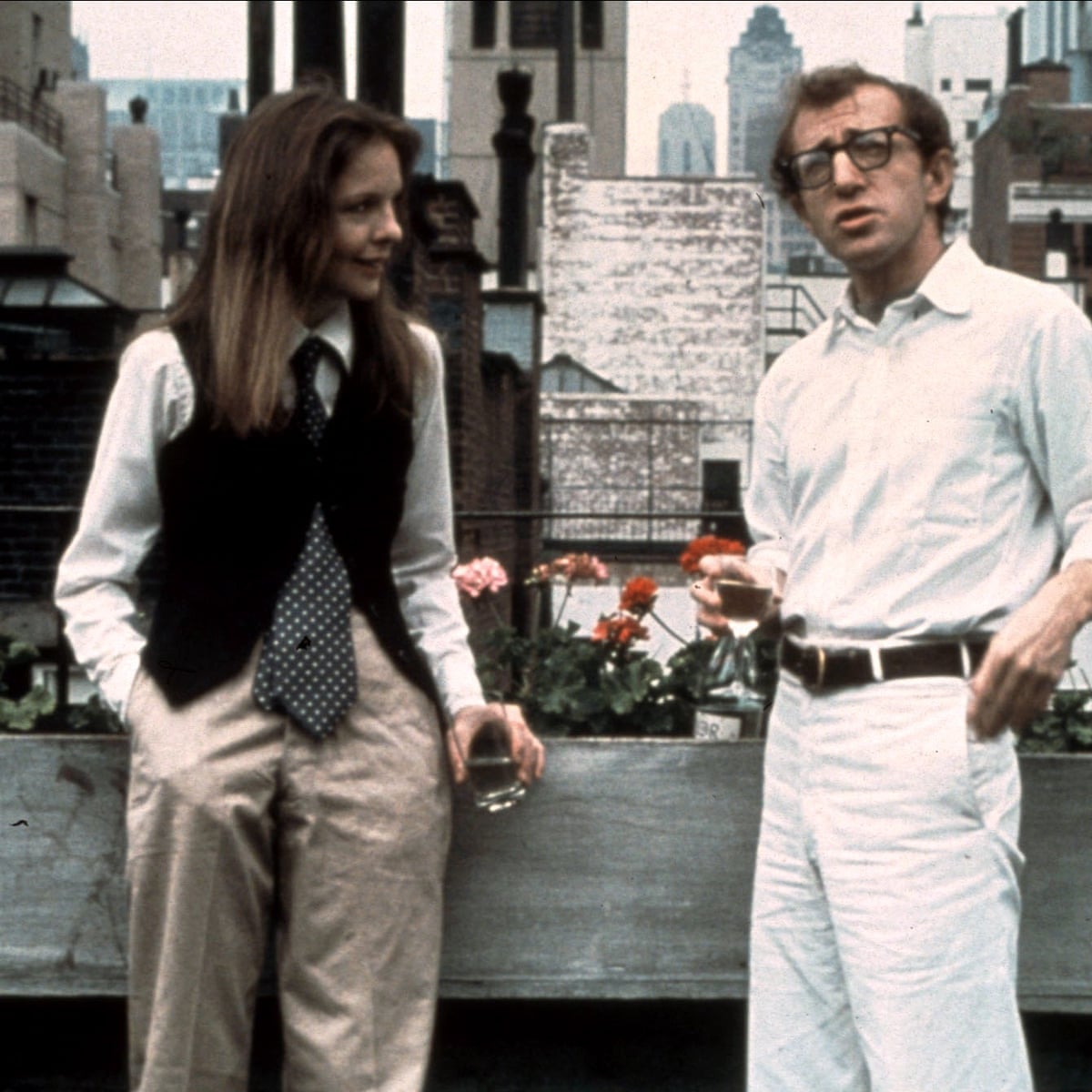
Woody Allen has made approximately 50 films in his career, many of which he not only writes and directs but also stars in.  His early films were pure comedies, where everything was about the jokes, and the plot was basically just a string to hang a series of gags on.  Most of them revolved around the neurotic, intellectual, weedy, uptown New Yorker Woody Allen character, that he had honed in his standup act, being thrust into unlikely situations.  By the end of the 1970s, however, Allen became interested in working with more substantial, dramatic plots, and indulging in some of his more philosophical interests.  Annie Hall is kind of a crossover film, while it is a comedy, it also has some more dramatic elements.  These days Woody Allen is something of a controversial figure, due to his private life, but his influence on American cinema is undeniable, and Annie Hall is probably the quintessential Woody Allen film.  If you have never seen any of his films, and are curious to give them a try, then this is probably the one to go for.  It is a very simple story, told in a very inventive way.  There are flashbacks, Woody Allen frequently breaks the forth wall and addresses the camera directly, in one scene Allen and Keaton are having a conversation and their thoughts appear as subtitles, there is even an animated sequence where Allen imagines himself dating the Evil Queen from Snow White and the Seven Dwarfs (1937).  Allen essentially plays the typical Woody Allen character.  Diane Keaton shines as Annie Hall, who is kind of an early example of the "manic pixie dream girl" stereotype, but the part is elevated by Keaton's performance.  Also in the cast is singer Paul Simon and early appearances from Christopher Walken as Annie's creepy brother, Dwayne,  Jeff Goldblum as an LA party guest on the phone to his guru, complaining that he has "lost his mantra", and a very early non-speaking appearance from Sigourney Weaver as one of Alvy's dates.  It is a very funny, well-constructed, clever film, and while it has inevitably dated, it is certainly one of Allen's finer, if not finest, works.


Diane Keaton and Woody Allen in Annie Hall

Thursday, 17 February 2022

Death on the Nile

Year:  2022

Director:  Kenneth Branagh

Screenplay:  Michael Green, based on the novel by Death on the Nile by Agatha Christie

Starring:  Kenneth Branagh, Tom Bateman, Annette Bening, Russell Brand, Ali Fazal, Dawn French, Gal Gadot, Armie Hammer, Rose Leslie, Emma Mackey, Sophie Okonedo, Jennifer Saunders, Letitia Wright, 

Running Time:  127 minutes

Genre:  Mystery

1937:  Wealthy heiress Linnet Ridgeway (Gadot) and her new husband Simon Doyle (Hammer) are celebrating their honeymoon in Egypt, during which they invite a large number of family and friends to join them on a luxury cruise down the Nile.  When one of the passengers turns up dead, famed detective Hercule Poirot (Branagh) finds that he has no shortage of suspects.


I have never read the Agatha Christie novel, Death on the Nile, nor have I read any of her many other books, however I have seen a lot of the film and television adaptations, and this enjoyable, old-fashioned murder mystery, a sequel to the 2017 film Murder on the Orient Express, fits in with them comfortably.  The film opens with a prologue set in 1914, which explains Hercule Poirot's impressive moustache, by suggesting that he grew the moustache to cover facial scars he suffered during his time in the First World War.  As with most Agatha Christie adaptations, there is a large number of familiar faces to provide victims and/or suspects.  The films starts leisurely, building up it's cast of characters and providing motivation as to why any of them could be the murderer.  The cast is eclectic and everyone seems to relish their roles, and it is fun to see popular British comedy duo Jennifer Saunders and Dawn French as a wealthy American Communist and her devoted nurse.  It is quite odd however to see famously outrageous and flamboyant comedian Russell Brand as a quiet, strait-laced doctor.  The film was made in 2019 and was due to be released in 2020, but it was delayed several times, and in that time some of the cast have fallen out of favour, notably Armie Hammer.  Kenneth Branagh is good as the Belgian detective, and directs with impressive visual style.  While the film does drag at times, it is an enjoyably star-studded, old fashioned and largely bloodless mystery.  It may not be unmissable, and is unlikely to feature on many "Best of the Year" lists come December, but it is a fun, glitzy entertainment.


 Gal Gadot, Emma Mackey and Armie Hammer in Death on the Nile


Monday, 14 February 2022

Peeping Tom

Year:  1960

Director:  Michael Powell

Screenplay:  Leo Marks

Starring:  Carl Boehm, Moira Shearer, Anna Massey, Maxine Audley

Running Time:  101 minutes

Genre:  Horror, thriller


London:  Mark Lewis (Boehm) is a quiet, polite, soft-spoken young man who works in a film studio, and supplements his income by taking nude photographs of models which are sold in a seedy newsagents.  However Mark also has an obsession with filming fear, to which end he films himself murdering women with a spike concealed in the leg of his camera's tripod, he also uses a mirror so that his victims can see themselves as they die, which Mark believes heightens their terror.  


"The only really satisfactory way to dispose of Peeping Tom would be to shovel it up and flush it down the nearest sewer, and even then the stench would remain" howled the thoroughly outraged review in London's Tribune magazine at the time of the film's release.  This was pretty much the standard reaction in the British press to the film at the time, with the Monthly Film Bulletin comparing Michael Powell to the Marquis de Sade.  The hysterical response to the film now seems almost comically quaint, but it did pretty much destroy Michael Powell's career.  Alongside producer Emeric Pressburger, Michael Powell was one of the most successful and acclaimed British filmmakers of the 1940s and 50s with such classics as The Life and Death of Colonel Blimp (1943), A Matter of Life and Death (1946), Black Narcissus (1947) and The Red Shoes (1948), and possibly part off the reason for the film's overwhelmingly negative response is that it seemed so off-brand for Powell.  More recently, the film has been recognised as the classic that it is, praised by critics and directors such as Martin Scorsese.  The fact is that the film is one of the greatest horror films ever made.  The film is visually striking, creating an authentically cluttered and seedy looking London, it also uses a fluid, mobile camera reflecting the killer's point of view, and what he sees through the end of his own small camera, which he constantly has with him.  The film allows us to spend time with the victims.  They are not just disposable but people with hopes and dreams, and their deaths have some real weight.  Austrian-German actor Karlheinz Böhm (billed as Carl Boehm) plays the killer, Mark Lewis, who has been warped by his scientist father's attempts to film his son's terror.  Incidentally Michael Powell played Mark's father in the grainy home movies that Mark watches, and Powell's own son Columba played the young Mark.  Böhm gives a powerful, and genuinely moving performance as the killer, who tries but is unable to control his murderous impulses.  Anna Massey gives a very good performance as Helen, an aspiring author who lives with her blind mother in the flat below Mark and strikes up a friendship with him.  Modern horror fans may be disappointed by the lack of blood 'n' guts, but it was certainly strong stuff for the time, particularly in regards to the sexual content, which is also mild by modern standards.  This is a beautiful, powerful film, which is still disturbing today.  One of the best horror films ever made, it is also one of the darkest films made about the nature of film and filmmaking.  Who exactly is the Peeping Tom?  Is it Mark himself? Mark's camera? Or us, the audience?  As Helen's mother (played by Maxine Audley) tells Mark: "All this filming isn't... healthy."


Karlheinz Böhm (Carl Boehm) and Anna Massey in Peeping Tom
  

Sunday, 13 February 2022

"Luckenbooth" by Jenni Fagan

 Year of Publication:  2021

Length:  338 pages

Genre:  Horror


In 1910, Jessie MacRae, the devil's daughter, arrives at 10 Luckenbooth Court, an imposing tenement building in the heart of Edinburgh.  She is there to bear a child for the wealthy couple who own the building.  When things go horribly wrong, Jessie places a curse on the building.  As her supernatural revenge echoes through the decades it draws in the various lonely, lost souls that inhabit the building.  

This novel moves from 1910 to 1999, and is made up of a number of different narrators and stories, impacted to a greater or lesser extent by Jessie's curse.  We hear from, among others, Flora, a lovelorn trans woman, Levi, an African-American from Louisiana adrift in 1940s Scotland, Ivy, an ambitious would-be spy fuelled by revenge, famous Beat author William Burroughs, and Bee, a woman on a murderous quest for revenge.   It's a complex book, at times almost impressionistic and told in an almost stream of consciousness style.  There is a vivid, almost incantatory rhythm to the prose.  Crucially there is a lot of anger here, about long forgotten victims, dreadful crimes that go unpunished, and the depth of human cruelty, particularly male violence towards women.  It's bleak and troubling at times, but there is some light in the dark, love between people which at least provides some solace and hope.  Fagan has a real sense of time and place and it really captures Edinburgh very well.  At times it can be overwhelming and dense, and some of the stories certainly are more interesting than others.  Also it is more disturbing than actually scary, but it is worth your time.  It's a powerful and deeply resonant work.


Fright

Year:  1971

Director:  Peter Collinson

Screenplay:  Tudor Gates

Starring:  Susan George, Ian Bannen, Honor Blackman, John Gregson, George Cole, Tara Collinson, Dennis Waterman

Running Time:  87 minutes

Genre:  Horror


College student Amanda (George) is hired by wealthy couple Jim (Cole) and Helen Lloyd (Blackman) to look after their young son (Collinson) while they go for a night out.  However Amanda soon finds herself terrorised by Helen's psychotic ex-husband, Brian (Bannen).


Directed by Peter Collinson, best known for The Italian Job (1969), this is a pretty unassuming little British horror film that is pretty typical of the early 1970s.  It's deeply problematic in it's depiction of mental illness and women.  Susan George does the best she can with what she is given, although she isn't really called upon to do much except look pretty and scream, and be leered over by men.  She would, of course, suffer an even worse ordeal in what would be her best known film, Straw Dogs, the following year.  Ian Bannen is effective as the disturbed ex-husband Brian, who is threatening, but also strangely sympathetic and pitiable at other times.  Honor Blackman is good as the haunted woman, whose fears turn out to be all too justified.  John Gregson is convincing as the condescending doctor who is convinced that Helen's fears are all in her head.  George Cole is engaging as possibly the only likeable man in the film, and Dennis Waterman is convincingly loathsome as Amanda's obnoxious boyfriend, who almost sexually assaults her.  Although they don't share any scenes in the film, George Cole and Dennis Waterman would both co-star again in the popular British comedy-drama TV series Minder (1979-1994).  Incidentally, the child that Amanda is babysitting is played by director Peter Collinson's own son Tara.  The film starts off satisfactorily creepy, with Amanda alone in the vast, gloomy mansion, full of strange tappings and drippings, however the atmosphere isn't really sustained, and the build up is spoiled somewhat by frequent cutaways to the Lloyd's night out at the most 1970s restaurant imaginable, and some comic relief business with the police slow the pace down even more, which feel like they were added in order to pad out the film's run-time.  In some ways it could be seen as a forerunner to the "slasher" film and bears some similarities with the far more celebrated Halloween (1978).  It is worth watching for horror fans, and it really does work for the most part, even if the sleazier aspects leave something of a bad taste in the mouth.


I could be so good for you:  Susan George and Dennis Waterman in Fright