Saturday, 12 February 2022
I Bury the Living
Dogs Don't Wear Pants
Year: 2019
Director: J-P Valkeapää
Screenplay: J-P Valkeapää and Juhana Lumme
Starring: Pekka Strang, Krista Kosonen, Ilona Huhta, Jani Volanen, Oona Airola, Iiris Anttila, Ester Geislerová
Running Time: 105 minutes
Genre: Drama, comedy
Surgeon Juha (Strang) lives alone with his teenage daughter Elli (Huhta), following the accidental drowning death of his wife and Elli's mother some years before. While Elli has managed to more or less recover, Juha is still mired in grief and unable to connect with the world. One night Juha stumbles into an S&M club and encounters dominatrix Mona (Kosonen), who strangles him, causing him to hallucinate his wife. Juha becomes a regular client of Mona's, finding a new lease of life. However, his constant desire to push things further disturb Mona, and begin to threaten his daily life.
This pitch-black comedy-drama from Finland is on one level an icy portrayal of grief, and an intriguing portrayal of the world of BDSM. Pekka Strang is good as the cold surgeon Juha, whose grief is convincing, even if he is not a particularly likeable character, as he constantly pushes away his lonely teenage daughter. Krista Kosonen is memorable as the dominatrix Mona, who works as a physical therapist in her day job, and develops something of a complex relationship with Juha. Ilona Huhta is the standout as Juha's increasingly estranged daughter, Elli, who despite her best attempts to connect and reach out to him, loses her father to his new obsession. The film is stylishly made, with each frame carefully composed, contrasting the sterile hospital where Juha works, the equally sterile interiors of Juha and Elli's home, and the interiors of the S&M club, dimly lit in red, with bright strobe lighting. This is a film about BDSM and, while it is not as graphic as it could have been, may still be too explicit for some audiences, and there are some brief scenes, such as Juha pulling off his own fingernail and an amateur tooth extraction, which made me look away from the screen. It certainly won't be to everyone's tastes, nut it is worth checking out.
Krista Kosonen in Dogs Don't Wear Pants
Friday, 11 February 2022
Fort Apache
Year: 1948
Director: John Ford
Screenplay: Frank S. Nugent, based on the short story "Massacre" by James Warner Bellah
Starring: John Wayne, Henry Fonda, Shirley Temple
Running Time: 125 minutes
Genre: Western
Arrogant, embittered Lieutenant Colonel Owen Thursday (Fonda) and his teenage daughter, Philadelphia (Temple), arrive at Fort Apache, an isolated U. S. Cavalry outpost, where Thursday is to assume command. While Philadelphia adapts well to life at the Fort, Thursday's high-handed manner and strict adherence to military rule and discipline, alienate him from his troops, particularly his second in command Captain Kirby Yorke (Wayne). To make matters worse, Thursday's ignorance and bigotry towards the indigenous Apache tribes threatens to lead to war.
This was the first of director John Ford's "Cavalry Trilogy", which also included She Wore a Yellow Ribbon (1949) and Rio Grande (1950), both of which also starred John Wayne. For the first hour or so, the film feels almost like a comedy, as the strict, strait-laced Lieutenant Colonel finds himself at odds with the ragtag bunch of soldiers he finds himself commanding, while his daughter falls for a dashing young officer (played by John Agar), much to her father's displeasure. However, it becomes more somber and surprisingly dark as it goes along. Despite having star billing, John Wayne really has more of a supporting role here, with Henry Fonda's Owen Thursday being the main character. Thursday was a General in the Civil War and is bitter at being busted down to the ranks and posted to some isolated fort in the middle of nowhere. From his appearance here, it seems that Thursday was at best an armchair general, who might be able to recite chapter and verse of Genghis Khan's campaigns, but is terrible at the business of real leadership. His attitude towards the local Native American tribes, in whom he is completely uninterested, veers from hostility to contempt. In fact it's his daughter Philadelphia who is far better able to adapt to life at the Fort and, while he immediately dismisses the Fort and it's surroundings, Philadelphia is interested and curious about the country and the people who live there. Fort Apache is notable for Westerns of it's time in taking a sympathetic view of the Native Americans. While it is still very much from the view of the white settlers, the Native Americans are willing to come to a peaceful solution and their demands are perfectly reasonable, it's Thursday's racism that escalates the conflict. The film was shot in Ford's favourite location, Monument Valley. The film takes it's time to get into it's stride and the story doesn't really get into it's stride until it's second hour. The climax is well staged and exciting and there is a moving epilogue which shows how the myth of the West was being written even while it was happening. Henry Fonda is good as Thursday, managing to humanise a pretty unlikeable character. John Wayne does well as Yorke, trying his best to counter Thursday's bigotry and avoid disaster for all concerned. Shirley Temple is good as Philadelphia, and it is a pity that she isn't even more to do.
Thursday, 10 February 2022
The Matrix Resurrections
Year: 2021
Director: Lana Wachowski
Screenplay: Lana Wachowski, David Mitchell, Aleksander Hemon, based on characters created by The Wachowskis
Starring: Keanu Reeves, Carrie-Anne Moss, Yahya Abdul-Mateen II, Jessica Henwick, Jonathan Groff, Neil Patrick Harris, Priyanka Chopra Jones, Jada Pinkett Smith
Running Time: 148 minutes
Genre: Science-fiction
San Francisco: Thomas Anderson (Reeves) is a successful video game developer who became famous for the hugely successful Matrix trilogy of games. However he is experiencing strange hallucinations, memories from his previous life as Neo, which he puts down to stress from developing the games and the resulting fame. In a coffee shop, Anderson happens upon Trinity (Moss), who is living a quiet life as mother of three Tiffany. When he is approached by a new group of rebels, lead by hacker Bugs (Henwick) and Morpheus (Abdul-Mateen II), Anderson discovers that the hallucinations are real memories of his past, and he needs to embrace his identity as Neo to save himself and Trinity from the Matrix and help the human rebels fight the machines that have enslaved humanity. The problem is that he is not the man he was.
The concept behind The Matrix series of films is that what we see and experience as reality is in fact a vast, complex computer simulation known as The Matrix, and that the real world is a ravaged, bleak place controlled by malevolent machines, and humans are trapped in pods, brains plugged into The Matrix, bodies being harvested for energy to power the machines. However, a small group of humans have escaped The Matrix and are fighting to defeat the machines. The Matrix was released in the summer of 1999 and, despite being released mere weeks before Star Wars Episode I: The Phantom Menace, it was a huge hit, with an imaginative plot, lots of style, and groundbreaking visual effects. Two sequels followed, The Matrix Reloaded and The Matrix Revolutions, which were both released in 2003. The Matrix Resurrections is the fourth film in the series and its easy to be cynical about sequels that come out such a long time after their predecessor, but this is a very solid entry in the franchise, and possibly the best of the series since the first one. Like the other films in the series, it suffers from a confused plot, with a lot of philosophical discussions and technobabble, and the characters often seem more like video game characters, ironically enough, so it's hard to really feel any sense of danger in the action scenes. Also, it doesn't give any concessions to newcomers to The Matrix franchise, or those who may have forgotten the previous films, in the nearly twenty years since the previous one was released. However, this is an enjoyable, intelligent science-fiction action film, and there is a lot more humour in this one. The performances are good, and the new characters are engaging. In this films, The Matrix film exist as games, and the story is kicked off when Anderson is asked to make a fourth game in the series, which gives the filmmakers an opportunity to poke fun at sequels and franchises. In the scene where Anderson is in his bosses office being given the pitch for Matrix 4 it's easy to imagine director Lana Wachowski, who co-wrote and co-directed the first three films with her sister Lily Wachowski, sitting in an office being given the same pitch. Interestingly enough, the boss turns out to be a hostile computer program. Of course the special effects and action are as spectacular as ever and, while it is far from perfect, at least it feels like a big, special effects driven action film with brains and some heart as well.
By the way, there is a brief additional scene after the end credits, which is funny, but it's certainly not unmissable and not worth missing the bus for.
Keanu Reeves and Carrie-Anne Moss in The Matrix Resurrections
Sunday, 6 February 2022
My Life as a Courgette
Year: 2016
Director: Claude Barras
Screenplay: Céline Sciamma
Starring: Gaspar Schlatter, Sixtine Murat, Pauline Jaccound, Nick Offerman, Amy Sedaris, Elliot Page, Will Forte
Running Time: 65 minutes
Genre: Animated, drama
When nine year old Icare's alcoholic single mother dies, he is sent to a children's home. At first Icare, who prefers to be called "Courgette", finds it difficult to fit in but, thanks to some new friends, including a kindly police officer, Icare finally begins to find some acceptance.
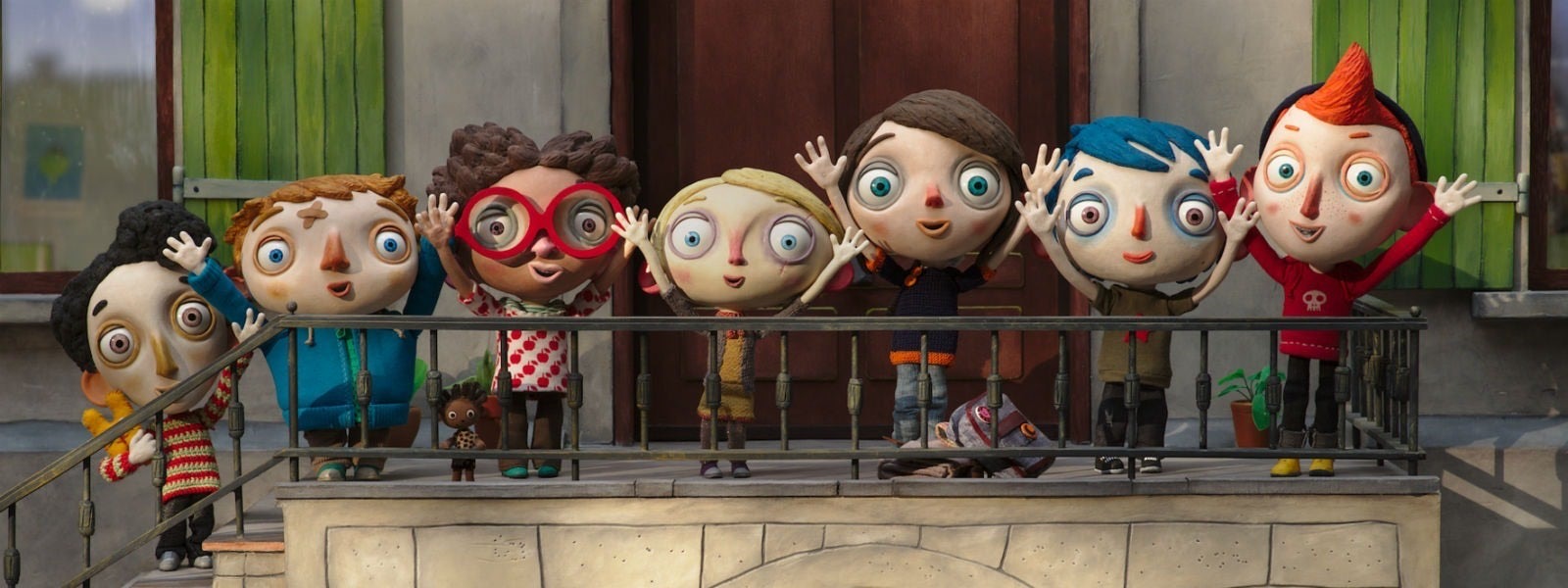
This animated Swiss/French film is beautifully realised in colourful stop-motion. However it's bright colours, odd title and flashes of humour hide a surprisingly dark tale. Essentially it is a gentle, warm-hearted tale about a boy finding love and acceptance, it's also a story about grief, loneliness and loss, which doesn't shy away from the tragic histories of many of the children in the home. Despite a brief running time the film moves at a sedate pace. The script by Céline Sciamma (writer and director of acclaimed dramas such as Water Lilies (2007), Tomboy (2011) and A Portrait of a Lady on Fire (2019)) is funny and moving, and the animation and character design is striking. A re-dubbed English language version was released as My Life as a Zucchini with a voice cast including Nick Offerman, Amy Seders, Will Forte and Elliot Page. While it may be too dark for younger children, this is certainly worth checking out for adults as well as children.
My Life as a Courgette
Thursday, 3 February 2022
Parallel Mothers
Year: 2021
Director: Pedro Almodóvar
Screenplay: Pedro Almodóvar
Starring: Penélope Cruz, Milena Smit, Israel Elejalde, Aitana Sánchez-Gijón, Rossy de Palma, Julieta Serrano
Running Time: 123 minutes
Genre: Drama
Madrid-based photographer Janis (Cruz) meets renowned forensic archeologist Arturo (Elejade), and asks him to help her excavate a mass grave in her home village, where her great-grandfather and others from the village were killed and buried during the Spanish Civil War. However, her plans are put on hold when she becomes pregnant after spending the night with Arturo. In the maternity ward Janis meets teenager Ana (Smit) and the two form a friendship based on their mutual status as single mothers. Janis and Ana prove to be devoted mothers to their respective daughters, until Janis discovers that due to a mix-up at the hospital, she is not her daughter's biological mother.
This is the 22nd feature film from Spanish writer/director Pedro Almodóvar, and reunites him with frequent collaborator Penélope Cruz. Here Almodóvar still shows some of his flair for melodrama, it's of a more muted tone. There are two key plot lines here: the main story is that of 40 year old Janis and teenager Ana, their experiences of motherhood and their growing connection with each other. The other story is Janis' attempts to excavate the mass grave outside her village. Of course, the film is about family, both biological and the family we make for ourselves. Janis' mother died at the age of 27 and named her after Janis Joplin (who Ana has never heard of). Ana's parents are separated, her mother cares about her but is more preoccupied with her own acting career, but she still care more than Ana's father who isn't interested in his daughter or his granddaughter, and sent Ana away to avoid scandal. Janis and Ana form something of a surrogate family, despite their differences. Ana can't understand Janis' preoccupation with her great-grandfather and the mass grave, and Janis is angered when Ana tells her to move on and leave the past behind. Janis knows that there are less and less people alive who remember these atrocities, and that people, particularly young people, don't know or care enough about their past. There are many unidentified mass graves in Spain following the Spanish Civil War and part of the reason for making this film, for Almodóvar, was to bring this to people's attention. This issue bookends the film, and the final fifteen minutes are almost a very moving drama-documentary. However, this isn't a somber, bleak issue film, while it is more serious than much of Almodóvar's previous work, it is still a hugely enjoyable movie. As always with Almodóvar, everything looks great, the colours are vivid and every frame is perfectly composed, there are also some of his traditional campy flourishes, and the performances are fantastic, particularly Penélope Cruz and Milena Smit. It's worth mentioning that there are barely any men in the film, the only principal male character is Arturo, and even he is not in the film that much, Ana's father never appears on screen we just here him on the film, and, of course Ana and Janis' both have daughters. This is a powerful and emotional film, but it is also entertaining and there are a few good laughs.
Milena Smit and Penélope Cruz are Parallel Mothers
Tuesday, 1 February 2022
The Man Who Fell to Earth
Year: 1976
Director: Nicolas Roeg
Screenplay: Paul Mayersberg, based on the novel The Man Who Fell to Earth by Walter Tevis
Starring: David Bowie, Rip Torn, Candy Clark, Buck Henry, Bernie Casey
Running Time: 139 minutes
Genre: Science-fiction
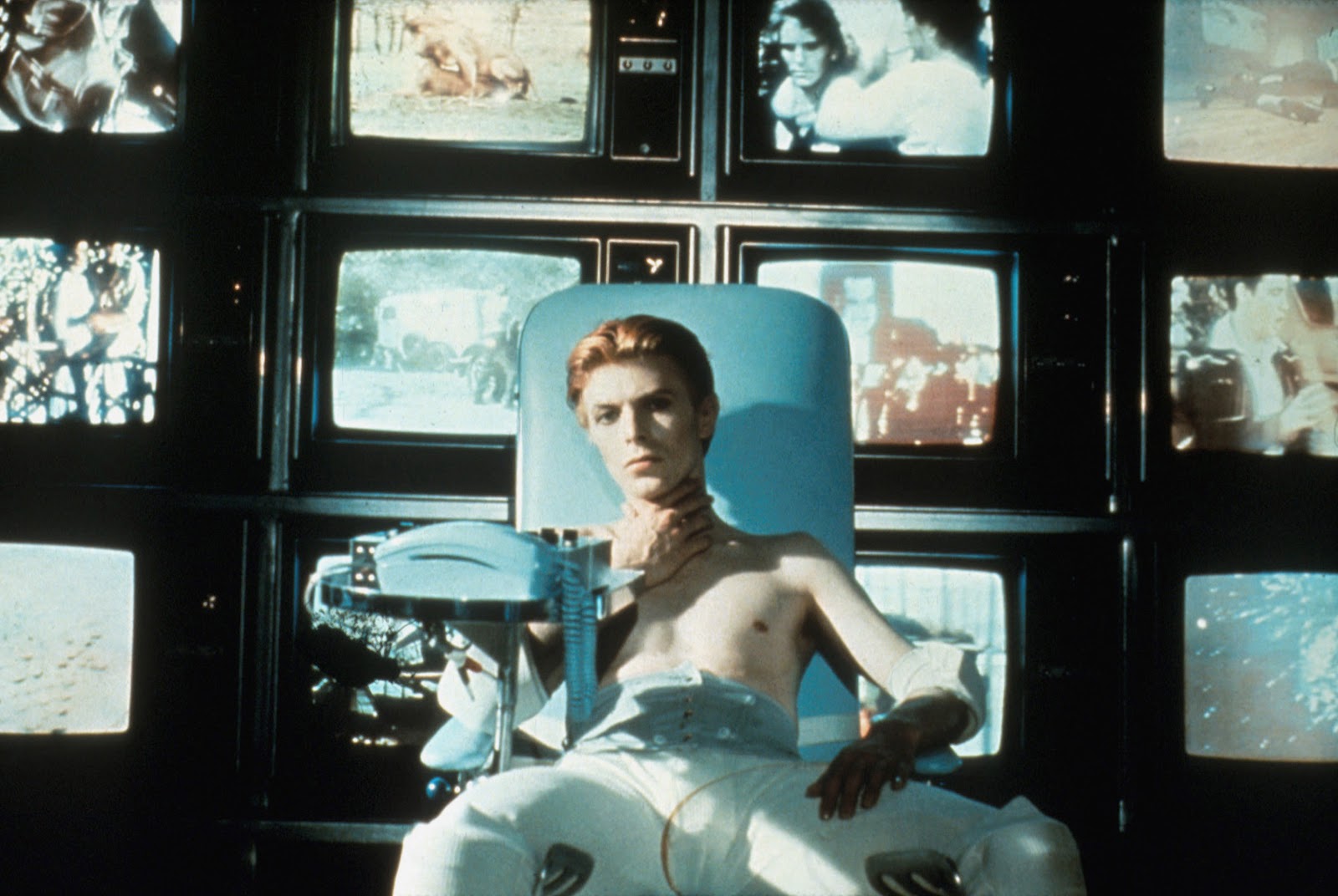
A strange man, Thomas Jerome Newton (Bowie), stumbles into a small New Mexico town. Within a few years he is the multi-millionaire head of World Enterprises Corporation, a company which sells innovative technological products. However, Thomas Newton is not what he appears. In reality he is a humanoid alien sent to Earth from a dying planet to bring back much-needed water supplies for his homeworld. He has been using his advanced alien technology in his company's products, and plans to use the money that he is making to finance the construction of a spaceship to ship the water to his planet. However, during his time on earth he begins to fall victim to human vices such as alcohol, sex, television and corporate greed.
This film was David Bowie's first leading role, and at the time he was at the height of his "Thin White Duke" phase. He gives an astonishing performance, and is utterly convincing as an alien, according to Bowie he was in such a fragile state at the time that didn't need to act in the role at all, he just learned his lines for the day and acted naturally. Rip Torn plays a creepy professor who finds the mystery of Newton and his corporation even more interesting than chasing after his female students; Buck Henry plays a patent lawyer who becomes Newton's confidante and right hand man; and Bernie Casey plays the ruthless owner of a rival company. They all give good performances, but Candy Clark is very good as the naive hotel chambermaid who falls in love with Newton and both becoming the other's nemesis. Based on the novel by American author Walter Tevis (who also wrote The Hustler and it's sequel The Color of Money which were both made into successful films, and The Queen's Gambit which became a miniseries on Netflix), the film was directed by British director Nicolas Roeg, who was coming off the success of the horror film Don't Look Now (1973). Roeg was known for his innovative style, combining surreal, poetic imagery with a jagged stream-of-consciousness style of editing. Despite a fairly conventional alien innocent on Earth storyline, The Man Who Fell to Earth is a very unconventional science-fiction film. For one thing, there is very little traditional science-fiction imagery in the film, aside from several brief sequences where Newton remembers his homeworld. Despite being set entirely in America, it is a British film made with an almost entirely British crew, which may help explain how the film makes America look like the alien planet, it's one of the great outsider's views of America. The film is long, slow, and the style makes it at times difficult to follow, but it is mesmerising. At times it is funny and it is powerful, while the technology and values on display (such as Rip Torn's professor sleeping around with students) date the film as a product of the seventies, it is still a pertinent comment on the modern world, which may be more pertinent now than in 1976. The film is visually striking, powerful and memorable, and remains one of the highpoint of David Bowie's career and of 1970s science-fiction cinema.