Year of Release: 1975
Director: Robert Altman
Screenplay: Joan Tewkesbury
Starring: Ned Beatty, Ronee Blakely, Keith Carradine, Geraldine Chaplin, Henry Gibson, Michael Murphy, Lily Tomlin
Running Time: 160 minutes
Genre: Comedy-drama
This film follows the numerous intersecting stories of a large group of people in Nashville, Tennessee, over a five day period in the run-up to a rally for a populist outsider candidate running for President. Most of the characters are involved to a greater or lesser extent in the worlds of music or politics.
This is a long, sprawling, epic comedy-drama with about twenty-four main characters, an hour of musical numbers and a multitude of interlocking storylines. The film was written by Joan Tewkesbury based on her own experiences of visiting Nashville, although as was often the case with Altman, much of the dialogue and many subplots were improvised on set. The large ensemble cast is impressive, particularly Ronee Blakely as an emotionally fragile singer, Geraldine Chaplin as a chatty BBC Radio reporter, Henry Gibson as a politically ambitious Grand Ole Opry star and Gwen Wells as an ambitious but talentless aspiring singer. It also features an early appearance by Jeff Goldblum as the silent "Tricycle Man", and Shelley Duvall as an eccentric groupie. It is a film that is very much a product of it's time. On the surface it is about Nashville, but really it is about where America was at politically and culturally in 1975, and scarily enough is still quite relevant today. It does require a lot of attention, and the length, loose structure and lack of a single overarching story may be off-putting to some viewers, but it is very rewarding, which is funny, dramatic and sometimes moving. It also has a great soundtrack.
Ronee Blakely, Allen Garfield, Henry Gibson and Barbara Baxley welcome you to Nashville
Saturday, 28 March 2020
Nashville
Labels:
comedy drama,
Geraldine Chaplin,
Henry Gibson,
Joan Tewkesbury,
Keith Carradine,
Lily Tomlin,
Michael Murphy,
movies,
Nashville,
Ned Beatty,
reviews,
Robert Altman,
Ronee Blakley
Saturday, 7 March 2020
"Kim Jiyoung, Born 1982" by Cho Nam-Joo
Year of Publication: 2016
Translator: Jamie Chung
Number of Pages: 163
Genre: fiction
Meet Kim Jiyoung, an ordinary woman living in South Korea with a husband and young daughter. However Kim Jiyoung is exhibiting strange behaviour, adopting the personalities of women she has met in her life. We flash back to her earliest years and see her life marked with constant everyday sexism and institutional misogyny.
A short but powerful book exploring everyday sexism and misogyny in modern-day Korea, but there is enough in here to resonate with women throughout the world. Kim Jiyoung is born into a family that wanted a son instead of a daughter; she is tormented by a male classmate but is told that she should be flattered; she is threatened at a bus stop and made to feel that she is the problem; she is constantly overlooked for promotion at work; she gives up her life and career for motherhood and domesticity. All of this is presented in stark, pitiless prose, bolstered by statistics from a variety of sources.
This book was a sensation on it's first publication in Korea, and was gifted to South Korea's president, Moon Jae-in.
An important and powerful book, this will resonate with female readers, and should make male readers think about how we should be better.
Labels:
books,
Cho Nam-Joo,
feminism,
fiction,
Jamie Chung,
Kim Jiyoung Born 1982,
reviews
Monday, 2 March 2020
The Invisible Man
Year of Release: 2020
Director: Leigh Whannell
Screenplay: Leigh Whannell, based on the novel The Invisible Man by H. G. Wells
Starring: Elisabeth Moss, Aldis Hodge, Storm Reid, Harriet Dyer, Michael Dorman, Oliver Jackson-Cohen
Running Time: 124 minutes
Genre: Science-fiction, horror, thriller
Cecilia Kass (Moss) escapes from her abusive, manipulative partner, scientist Adrian Griffin (Jackson-Cohen), and tries to start a new life. When she learns that Griffin has killed himself, she finally feels able to move on. Shortly afterwards, strange things start happening. Cecilia soon becomes convinced that Griffin is not only still alive, but that he has somehow become invisible and is still tormenting her.
This was originally set up as part of Universal Studios' "Dark Universe" strand of inter-connected films based around their beloved classic monsters series. However, after The Mummy (2017) flopped with audiences and critics, the "Dark Universe" was abandoned, and The Invisible Man has been retooled as a separate stand-alone film. If you are a fan of the famous H.G. Wells novel or the 1933 James Whale film, then be warned that this film has little to nothing to do with either, aside form the central premise of a scientist named Griffin who becomes invisible. The focus of the film is on Cecilia and how the invisible Griffin basically gaslights her. It starts slowly, but it is atmospheric, and there are some really good scares, with the camera taking Griffin's point of view and showing Cecilia often in the distance, framed in doorways, windows or hallways. there are some effective, and well-staged action sequences that are pretty exciting. Elisabeth Moss gives a strong performance as the terrorised Cecilia, and she has strong support from Aldis Hodge, as her policeman friend who aids her, and Storm Reid as his teenage daughter. More of a thriller than a straightforward horror film, this is a classy slice of suspense, with some contemporary relevance.
Elisabeth Moss and, possibly, The Invisible Man
Labels:
Aldis Hodge,
Elisabeth Moss,
H. G. Wells,
Harriet Dyer,
horror,
Leigh Whannell,
Michael Dorman,
movies,
Oliver Jackson-Cohen,
reviews,
science-fiction,
Storm Reid,
The Invisible Man,
thriller
This Sporting Life
Year of Release: 1963
Director: Lindsay Anderson
Screenplay: David Storey, based on the novel This Sporting Life by David Storey
Starring: Richard Harris, Rachel Roberts, Alan Badel, William Hartnell
Running Time: 134 minutes
Genre: Drama
Set in the English town of Wakefield, the film concerns Frank Machin (Harris), an angry coal miner, whose natural aggression leads to him being recruited by the local rugby league club, and he soon becomes something of a local hero. However Machin's violent streak causes havoc with his life off the playing field, particularly in his turbulent relationship with brittle widow Margaret (Roberts), who also happens to be his landlady.
This is a raw and powerful film, which marked the feature film debut of director Lindsay Anderson and the first starring role for Richard Harris. Based on the prize-winning novel by former rugby league player David Storey, who also wrote the screenplay, this is part of the so-called "kitchen sink" films of the 1950s and 60s, which attempted social realism, tackling the lives of ordinary, working-class Britons, with cynical, disillusioned "angry young men" protagonists and tackling topics that for the time were quite controversial. The film is notable for the visceral rugby scenes, in which Anderson gets his camera right among the player, and uses a fast paced editing style and some slow-motion sequences. Richard Harris turns in a fantastic performance as the brutal Frank Machin, a burly, angry man ready to lash out at a moment's notice, physically or verbally, even in his quieter moments the threat of violence is never far away. It's an innate part of him, that serves him well as a rugby player, and makes him a star, but which poisons everyone and everything around him. Rachel Roberts gives a heartbreaking performance as the damaged Margaret, grieving for her husband and bringing up two children on her own, she views Machin with a mix of fear and contempt, even if she cares about him, she can't allow herself to open up to him. The cast also includes the first Doctor Who William Hartnell, as a seedy talent scout.
Rachel Roberts and Richard Harris in This Sporting Life
Labels:
Alan Bladel,
David Storey,
Lindsay Anderson,
movies,
Rachel Roberts,
reviews,
Richard Harris,
This Sporting Life,
William Hartnell
Wednesday, 26 February 2020
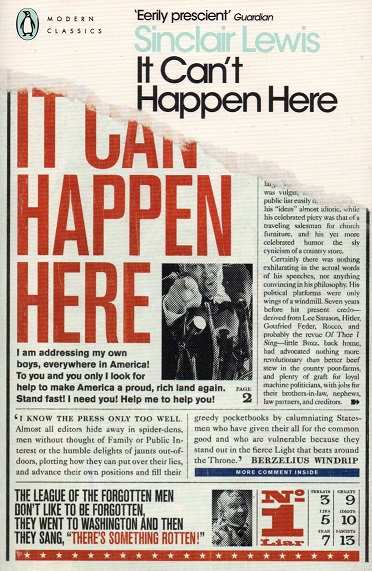
"It Can't Happen Here" by Sinclair Lewis
Year of Publication: 1935
Number of Pages: 376
Genre: Political fiction, dystopia
Senator Berzelius "Buzz" Windrip, a vain, outlandish, racist, sexist demagogue is voted President of the Unites Sates of America, with promises that he will make angry, white voters proud, prosperous and powerful, and, more or less, that he will Make America Great Again. Before long he becomes the dictator of a totalitarian United States. The rise of Windrip, and America's descent into tyranny, is shown through the increasingly appalled eyes of small town newspaper editor Doremus Jessup who soon learns, to his horror, that it can happen here.
This is a powerful anti-fascist novel that, distressingly, feels possibly more timely now than it did when it was first published in 1935, at the height of fascism in Europe. While the book is very much of it's time, it's set during the late 1930s and references several real-life people and events of the time, it is still readable today. And this is a very readable book. Lewis was a good writer, with a memorable turn of phrase and a dab hand in writer striking one-liners. In the early stages of the book it is often laugh out loud funny, but as the novel progresses, and the situation becomes more serious, the laughs quickly vanish. This book is a must read for anyone, just to see where we are and where we may be headed. Remember, not only can it happen here, but it is happening here.
Labels:
books,
dystopia,
fiction,
It Can't Happen Here,
politics,
reviews,
satire,
Sinclair Lewis
Monday, 24 February 2020
High Life
Year of Release: 2018
Director: Claire Denis
Screenplay: Claire Denis and Jean-Pol Fargeau, story by Claire Denis
Starring: Robert Pattinson, Juliette Binoche, André Benjamin, Mia Goth
Running Time: 110 minutes
Genre: Science-fiction, horror, drama
A group of death-row inmates are sent on an expedition into deep space to attempt to extract energy from a Black Hole. The expedition has been sold to them as an alternative to the death penalty, but in reality they have no way of ever returning to Earth. On the long voyage the prisoners are subjected to a series of medical experiments by the sinister Doctor Dibs (Binoche). As time goes on the tensions between the prisoners, in the close quarters of the increasingly run-down spaceship lead to madness and violence.
This is the first English-language film, and the first science-fiction film from critically acclaimed French director Claire Denis. It has to be said that for anyone looking for sci-fi action-adventure, you will not find it in High Life. Told in a fragmented, non-linear style, this is a slow, meditative film, punctuated by brief bursts of graphic violence, and explicit sex and nudity. The prisoners are kept drugged throughout most of their voyage and speak to each other in slow, hushed tones. The film opens with Robert Pattinson's Monte, who has been condemned for killing his friend over a dog as a child, alone on the spaceship with his baby daughter. The rest of the crew and prisoners are all dead, and the bulk of the film is taken up with flashbacks to how the prisoners met their fates and how Monte came to have a child in outer space, and flashforwards. Pattinson gives an icy performance as Monte, usually calm and introverted, but given to bouts of violence. Juliette Binoche is also memorable as the disturbed and frustrated Doctor Dibs, who uses the other prisoners for sex and experimentation. The film is frequently aching slow and deathly dull, punctuated by genuinely shocking scenes (including scenes of sexual assault), and hauntingly beautiful images. The film is at it's best in the later scenes with Monte and his teenage daughter (played by Jessie Ross), which provide the only touches of warmth and humanity in the film. I did not enjoy this film, I probably won't see it again, and yet there are moments that I think will stay with me for a long time.
Jessie Ross and Robert Pattinson blast off in High Life
Labels:
Andre Benjamin,
Claire Denis,
drama,
High Life,
horror,
Jean-Pol Fargeau,
Juliette Binoche,
Mia Goth,
movies,
reviews,
Robert Pattinson,
science-fiction
Friday, 21 February 2020
While We're Young
Year of Release: 2014
Director: Noah Baumbach
Screenplay: Noah Baumbach
Starring: Ben Stiller, Naomi Watts, Adam Driver, Amanda Seyfried, Charles Grodin, Adam Horovitz
Running Time: 97 minutes
Genre: Comedy, drama
New York City: Josh Schrebnik (Stiller) is 44 year old documentary filmmaker and teacher. After making a splash with his debut film, he has spent ten years working on his follow-up, and is married to Cornelia (Watts). One night Josh meets 25 year old aspiring filmmaker Jamie Massey (Driver) and his wife Darby (Seyfried). Josh is enamored with the free-spirited hipster couple, Cornelia is more reluctant, but still finds herself drawn to Jamie and Darby. Before long the older couple are adopting the tastes and lifestyles of their younger friends, at the expense of their older friends. But things go wrong, when Josh realises that Jamie's values and worldview don't match up with his own.
This is an enjoyable and consistently funny film which does make some pertinent points about ageing. Josh and Cornelia are approaching their mid-forties and so are a long way from being elderly (full disclosure I am currently 41) but they are facing the specter of old age there are things that they want to do in their lives that they realise they have to do sooner rather than later, or risk never being able to do them at all. Also they are stuck in a rut, Josh has been working in the same film for ten years, and still doesn't know what it's about. Both he and Cornelia feel alienated from their best friends, who are new parents. They are drawn to Jamie and Darby because of their creativity, energy, and their enthusiasm particularly for retro pop culture. However, Josh soon comes to realise that Jamie is full of pretence and artifice, and is also very manipulative. However the film makes it clear that Jamie and Darby are part of a changing world, and Josh and Cornelia are not condemned or really mocked for embracing a youthful lifestyle, in fact it proves a mostly positive experience. Ben Stiller is funny and engaging in the lead, and Adam Driver gets a lot of mileage form his cool hipster persona. Naomi Watts and Amanda Seyfried are largely sidelined though. Noah Baumbach has usurped Woody Allen as the king of New York comedy-dramas, mixing heart and humour in nearly equal doses. This isn't his best work but it is still worth checking out.
Amanda Seyfried, Adam Driver, Ben Stiller and Naomi Watts in While We're Young
Labels:
Adam Driver,
Adam Horovitz,
Amanda Seyfried,
Ben Stiller,
Charles Grodin,
comedy,
drama,
movies,
Naomi Watts,
Noah Baumbach,
reviews,
While We're Young
Subscribe to:
Posts (Atom)